
China
Internet, Medium Will Soon See a Chinese Influx
For better or for worse, platforms like Quora has seen an influx of mainland Chinese users, with some “internet trolls” injecting pro-China slant that the world has yet to familiarise with.
Key Points:
- China’s Influence
- New World Order; New Internet Order
- Cyber Sovereignty
“Today (12th Jun), Twitter and Zoom both revealed news on China’s influence on the internet space, separated by only a few hours between.”
THIS is a difficult topic to write about. It has been gnawing at the back of my mind.
Medium has so far been a predominantly U.S. centric platform (with 34% of user demographics from the U.S., followed by 17% from India). Having seen how an open discussion site like Quora gradually manifests a pro-China bent, I can’t help but think Medium will only naturally follow in its footstep.
The fact is the entire English-speaking part of the internet is seeing an influx of pro-China opinions that were previously shut off. And the Anglosphere is not used to it.
Internet mischief-makers, or “trolls”, frequently instigate clashes with nativist and nationalist ideals. Sometimes, rightly so. The western world has for too long demonised the Chinese.
Now, the Chinese are speaking up. Patriotic as they are, the world can’t help but asks itself, has the internet become pro-China?
Granted, not every discussion is political, and it doesn’t need to be.
I expect this topic to be a hot potato, and have personally seen Chinese netizens shutdown China-related opinions in droves. So I need to be clear here.
Caveat: Dear internet users, this discussion is meant to be objective. I will not take a stance against China nor for China. My goal is to bring to light both the factual phenomenon and the mainstream narrative, and thereby better predict the future of internet.
China’s Influence
WUMAO, or 50 Cent, is the well-known army of Internet commentors who are hired by the Community Party of China to keep vigil on and disputably manipulate public opinion to its benefit.
But the term has since evolved to become an internet slang, label, or insult, equivalent of “troll” or “hater” with added political connotation.
Their proliferation proves a trend – hereon, I discuss the various media platforms that has seen a rise in Chinese influence.
Quora: 50 Cent or Scholars
First up, Quora.
It is worth investigating Quora because of the similarities it shares with Medium.
Quora is a question-and-answer based social media that users can freely post questions or request for answers. Much like Medium, Quora boasts high quality content, inviting unfettered input from international experts around the world. Also, like Medium’s unbridled writers, Quora users are free to ask, answer, and edit both factual and opinionated questions/answers.
“investigating Quora because of the similarities it shares with Medium. […] users are free to ask, answer, and edit …”
The platform also reflects the general psyche of the mainstream internet.
I have been on Quora since 2016 and I personally sense a significant increase in posts written by Chinese internet users. I like to believe that this group represents the tech-savvy youngsters who are adept at crossing the “Great Firewall of China”, instead of hired cyber-warriors – to give the benefit of the doubt.
It is not just me who have noticed this trend. On Quora itself, people took to the platform and asked away:
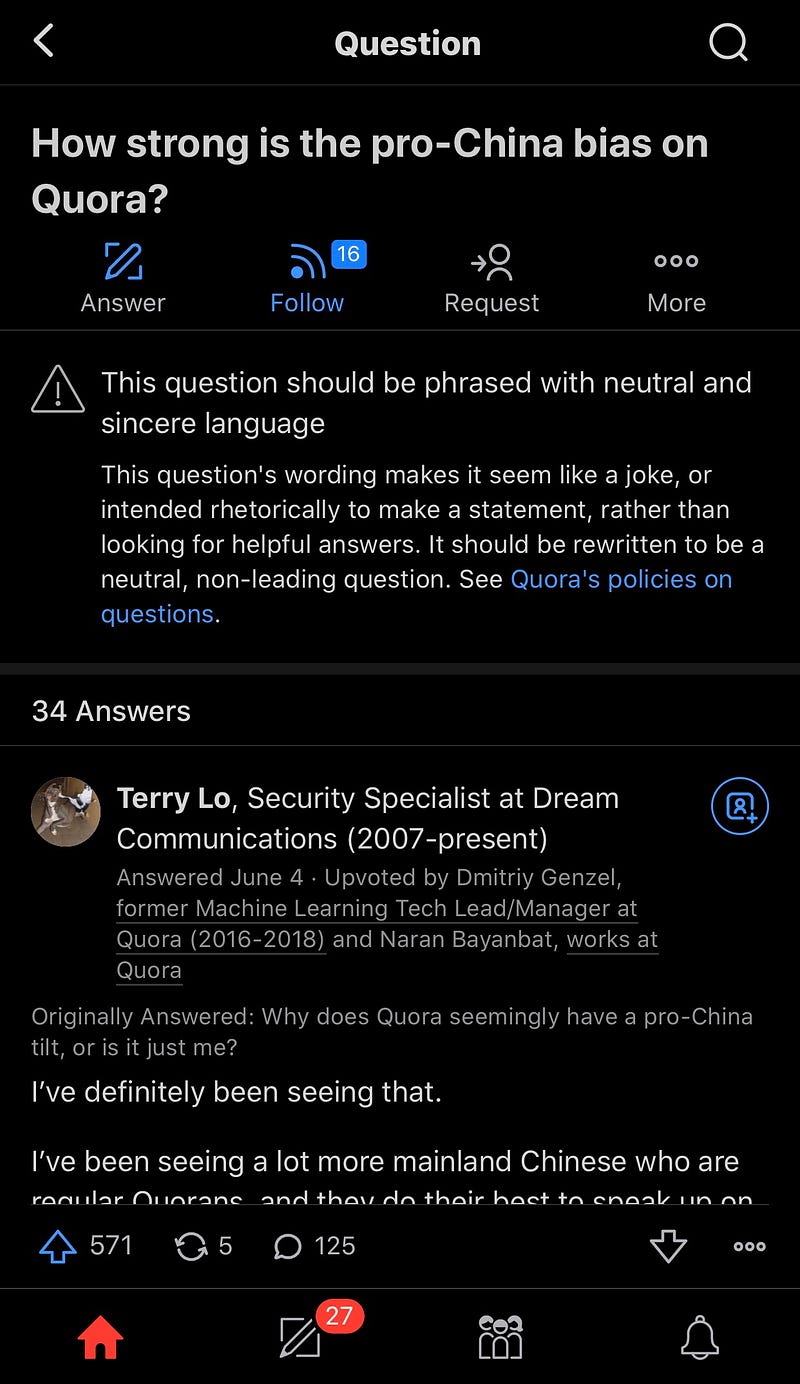
Here are my observations:
What I have noticed is that Chinese netizens on Quora are patriotic, but hyper sensitive to topics disparaging of China.
They also like to speak in a peculiar way when referring to countries, as if they are persons.
When questioned in a debate on bad decisions by the country government, they are likely to fall back on the ‘everyone else does it’ rationalisation card.
All these are inline with the concept of “saving face”.
Fortunately, the patrons of Quora have largely been scholarly. Perhaps with help of hardworking regulators in Quora.
Many Chinese users have explained that the platform has been used and recommended by school teachers to practice written English, and therefore the heightened popularity in China.
Others denied it, and argued it was the skew in feed recommendation algorithm.
Headlines Today: Twitter and Zoom
There are few Chinese users among Twitter users so far, partly because of Weibo the chinese equivalent. Yet this does not stop the influence.
Today (12th Jun), Twitter and Zoom both revealed news that highlighted China’s influence on the internet space, separated by only a few hours between.
I’m sure you have heard:
Twitter announced that it discovered over 170,000 inauthentic accounts linked to the government that tried to put the good word for China in the handling of COVID-19 virus.
Zoom acknowledged that the Chinese government had contacted it about 4 planned video calls to commemorate the 1989 Tiananmen crackdown, and to disabled accounts of former Tiananmen Square leader amongst other targeted Chinese dissidents in US.
Zoom did in 3 cases.
The influence of China on the internet is once again brought to the spotlight.
Gaffe in Translation
Not long ago, a translation gaffe by Google caused a stir in the Hong Kong community, and alarmed the rest of the world watching. Especially during Hong Kong protest against China’s extradition bill.
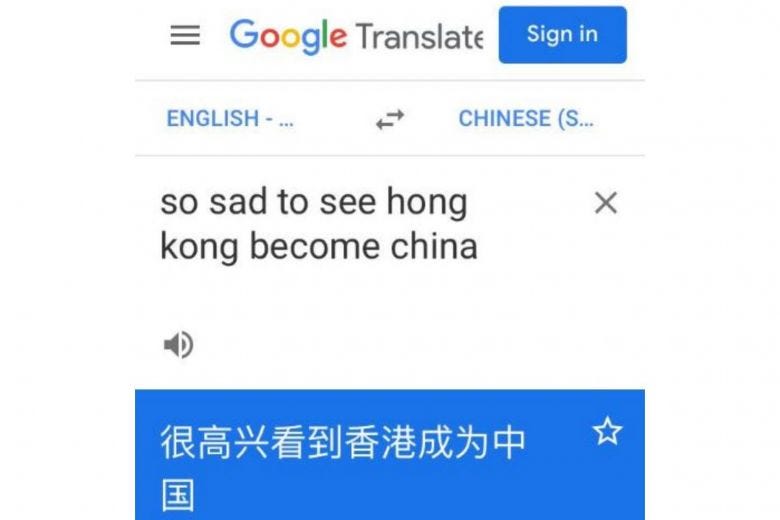
Google users discovered that when people entered the phrase “I am sad to see Hong Kong become part of China”, the suggested translation in both Simplified and Traditional Chinese converted the word “sad” to “happy”
Some had suspected that the translation error is orchestrated by China poisoning the model through Google Translate’s manual suggestion feedback. A statistical confidence level of 95% is required to trick the system, which is implausible without a systematic and concerted attack.
However, the official word suggested technical error, no foul play.
New World Order; New Internet Order
LET’S face it. The mainstream narrative of the world is defined by the western world. They wrote the world order, collective human history, and even the way people think.
Philosophy from the Greeks, ethics from the Romans, and culture from the colonials are not spared. The entire idea of the economy is based upon western concepts. Heck, even communism originated from the best thinkers of the west.
The world order is more biased than people notice.
Now before anyone slams the imminent new order, let us step back and impartially reconsider the implications of a less westernized internet.
Balanced, as all things should be
Perhaps Quora did not turn pro-China. Instead, it turned less anti-China ever so slightly, making for a more balanced internet on the whole.
Chinese netizens lament the attacks they face on the opposite side of the Great Firewall as they claim to correct the mainstream media’s misinformation on China. In a hypocritical fashion, shutting out pro-China opinion for its own sake is a form of ad hominum, a personal attack to the person who does not subscribe to the same ideals and beliefs.
Who is the one brainwashed? Or in internet slang, who is the one hating?
The truth is so often mistaken as what is mainstream; and the hated synonymous with the hater.
Self censorship fears
Few anecdotes exemplify neoliberalism better than NBA’s censorship.
It began with a faux pas with China in the spat between Hong Kong protesters and China (or more specifically China internet users). The consequence exposed the naïveté of chasing profits.
In similar vein, companies and countries who seek a share of the profit pie will find themselves riding the coattails of whoever brings the biggest pie. Soon, addicted to the overwhelming profits, countries/companies would please whoever promises the lion’s share to continue reaping the benefits.
All is fine and dandy until people realise “people-pleasing” has another name: self-censorship.

NBA players were forced to apologise and retract statements they made on Twitter in support of the Hong Kong protesters, which got on the wrong side of Beijing. With $1.5 billion worth of streaming agreements at stake, players’ free-speech rights were pushed to the backseat.
In this respect, the Basketball company probably won’t be the last to self censor.
Internet Inclusivity
TikTok is by now no stranger to the social media scene. Owned by a Chinese company called Bytedance, the world’s most valuable startup, dubbed so by Bloomberg, has seen overwhelming success rivaling Youtube and Instagram putting Facebook and Google on edge.
The world has already began the transition and soon it will face a new flood of pro-China media.
Medium is by no means an exception.
In response to the unfamiliar, people naturally reject. But people also learn, and eventually accept. And soon during the transition phase we will see more posts like this:
The confusion and, arguably, xenophobia is understandable, as explained eloquently in this article by Ming Qian, a fellow writer. (He and I discussed this article) He showcased a personal account of his experience on Medium where a comment led to conflicting emotions bubbling up.
We have a long road ahead to internet inclusivity.
Cyber Sovereignty
WHAT if we never reach there, the wholesome internet inclusivity?
We only have to turn to China and see how the government regulates its cyberspace to find the answer.
Cyber sovereignty is not unlike the concept of territorial sovereignty. Countries will each have their own versions of the internet, blocking out or allowing selected overseas media platforms to filter in by means of firewall. These nucleated versions of the web will restrict traffic flow among them, much like border control.
Some tout it as the natural progression in the development of cyber space. After all, a local intranet is indeed more secure than the World Wide Web, in the cybersecurity standpoint.
Others cannot phantom it’s existence and scream end of “free speech” and “anonymity”. (quoted because they are technically not true)
One things for sure, it will look nothing like the internet we know.
Stay Kind Folks
NEVERMIND that, the world may be unprepared yet it can do nothing but let the Chinese have a fair share of the pie, like it or not.
They say the internet is inherently emancipatory. The liquid flow of information favours the oppressed more than the oppressor, which is a chance at freedom.
We just have to get used to it.
What is the ideal internet then? All inclusive? Unbridled free speech? Anonymity?
Then perhaps we should not be so scathing to our Chinese counterparts, and recognise that this change is part of progress.
“We have a long road ahead to internet inclusivity.”
Knowing that, and all perils along with it, then we may be prepared.
Clarification of Terms:
“Chinese” refers to mainland Chinese.
References:
https://www.quora.com/How-strong-is-the-pro-China-bias-on-Quora
Feel free to drop by, connect, or say Hello on my Medium and Twitter for more China perspectives.
Or, read more: