
PSYCHOLOGY
Ink Blobs. What Do You Want to Know About the Smart Unconscious?
New psychological insights and my view
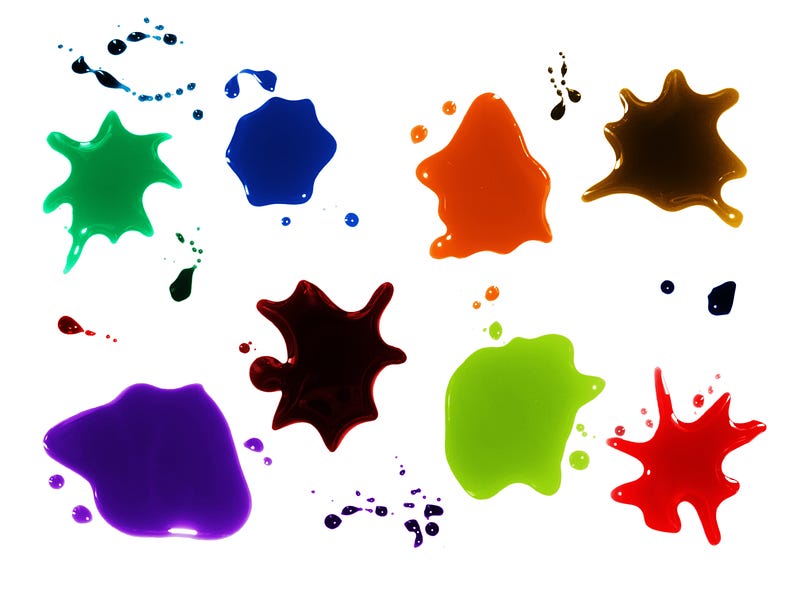
Ink blobs have often been used by psychiatrists and psychologists to draw conclusions that might have been true or not. I don’t know. I never went through the horror of having my mind analyzed by some shrink.
Having him draw conclusions from things I just feel and then have to talk about it. For me, talking is overrated. I don’t need to talk to everybody about everything just to get it off my chest. I know much quicker ways to become lighter and have a good life.
The only work I did on myself was body-based.
Senses. Feeling emotions literally in my body. And letting them flow into the soil. Stuff like that. And it worked well for me. From a pleaser, I turned into a grounded, self-confident person who has the courage to speak her truth and has no problem belonging and making a variety of friends.
Since then, I love variety. I love nature. I love different cultures. I love my body when she swims like a mermaid on warm seas. And I love my nomadic life as a purposeful traveler without stuff.
And in my scientific work, I discovered my unconscious.
It’s mesmerizing to know more about the smart unconscious. So, that’s why I tell you this story. So you can tell me what you do with your unconscious. Meditate? Go deep into the night? Breathe and distract yourself a bit before you make a decision?
You just tell me.
The Smart Unconscious
The Smart Unconscious is a book by psychology professor Ap Dijksterhuis. He’s a very broad thinker and doer and that characteristic is the making of the best scientists for me. They can zoom out and see a bigger picture.
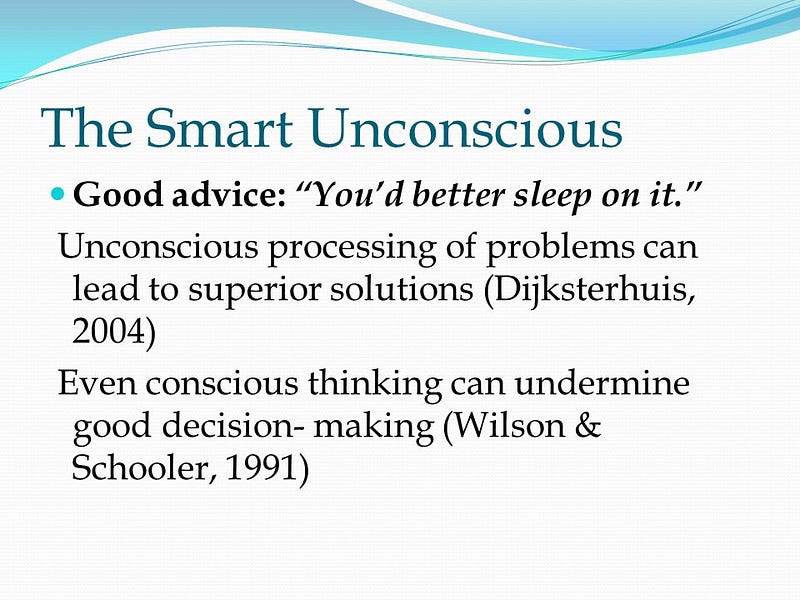
Professor Ap Dijksterhuis comes from my region and lectures here at the University of Nijmegen.
His hobbies are cooking (that’s nature’s chemistry!), photography (great for observing deeply), and enjoying the company of his family and friends (social man).
If you want to know if his research makes sense, I can only say: read the book. There are so many examples in there, that it blows my mind. If you want to know details of how it works, I also say: read the book.
But what stands out for me?
The fact that consciousness is an iceberg. The part above water (10%) is the conscious mind. The biggest part (90%) is the unconscious part.
The fact that the unconscious makes better decisions if we do two things.
- Take some moments of distraction (make an unrelated puzzle, do something else completely)
- Sleep on it
And this last part fascinates me nowadays. I find my strength to deal with cancer and chemo when I manage to enter my deep sleep. It’s the deep void inside of me that I can reach.
The unconscious part that neuroscientists talk about.
I treasure my sleep. My nights. And when I can’t sleep I know my body just needs to NOT sleep. My body knows best. So, I surrender to that and meditate instead. Do a body scan. Relax my body completely. Sometimes get some help from a relaxing meditation online.
Sleep is underrated.
Consciousness
There’s so much talk online about consciousness, that it gets irritating for me. As if we are holy and conscious all day and all the time.
I’m not. Are you?
I’ll talk about the unconscious instead. And the night. We are way too afraid of the dark. Way too afraid of death. It stops us from being courageous. Death on my doorstep, on the other hand, gives me a very good living compass.
Teaches me to treasure the little things in life. Be grateful.
And shadow work will give us the courage to include all light and dark in our way of living. My favorite shadow work is with Joanna Macy. She understands that we are all connected on this planet. Being disconnected from our planet is the biggest problem of our time.
If you go deep enough into the dark, you’ll bounce to infinite heights in your conscious day-life. Courage to be different and the comfort of belonging, as social scientist Brene Brown says.
And if you want to read about the mind and differences as a navigating factor, you might want to read this article by Gregory Bateson.
Kaia Maeve Tingley sent it to me. And I like it. I have talked to Gregory’s daughter, Nora Bateson, because of my work. And she’s soooooo inspiring! Check her out.
What’s my compass when I redesign humans systems like economies, societies, business models, and healthy personal lives?
- The iceberg underwater, the 90% unconscious do most of our work anyway. So, we can design cheap, affordable human systems with as little interference from people as possible. Why do a lot of work if we can keep things simple?
- Inclusivity of all people and all other living beings. After all, we are nature…
Conclusion
So, my advice is, don’t ever think about ink blobs anymore. Don’t analyze. Don’t attach so much weight to your thoughts. The waves of meditation or sleep are way more important.
And the more you can enter these waves, the better decisions you will make in your daily life.
It goes automatically. So, please don’t worry. Avoid stress (the biggest factor in illnesses) and live with spontaneity. It’s enough. You are enough. And the world will be okay. We are just in a phase of evolution.
And everything will be alright for the next generations when we learn how to be adaptable. Resilient. Flexible. Live with the flow. Face what has to be faced and be courageous and inventive.
Adaptable species are thriving species.
Nowadays, I only make ink blobs creatively with children and older students. Ink blobs are an artist thing. Not a psychological analysis method anymore.
I do as physics artist Zoro Feigl does. After all, art and science are two sides of the same medal.
Play is all.
Happy unconscious living!
Some old-school credibility for my writing can be found here. I’m a certified biomimicry professional and external expert to the European Commission.
Thank you, Mike, for adding your wise energy to my words on Abundanism. Systemic Design for a good future, and Wild Writing. © Désirée Driesenaar, 2022


