avatarAvi Kotzer

Free AI web copilot to create summaries, insights and extended knowledge, download it at here

2201

Abstract

ning TV show about angst-y doctors, the original medical show:</p><figure id="6cf1"><img src="https://cdn-images-1.readmedium.com/v2/resize:fit:800/1*bHSd_AxCkXPQgjNhrW0K8g.png"><figcaption>Credit: Dr. Henry Gray?</figcaption></figure><p id="fa78">Admittedly, this is not as compelling as a soap-opera-ish, Emmy-studded television series. But trust me, back when it was published in the mid-19th century, this book was considered primetime reading stuff. At least if you wanted to become a doctor and not be embarrassed when someone asked you “What is an inion, sir?”</p><p id="4273"><i>Inion</i> appears five lines from the bottom in the text on the far right side of the page spread above, in <b>bold</b>, so we know it was word back in 1827 when the first edition of Dr. Henry “Hank” Gray’s book came out in 1858. The next year it ws published in the United States, and in 1873 it definitely <b>did not</b> make the <i>New York Times’s</i> bestseller list. I promise you.</p><p id="e9d9">To answer the naggin question about the inion, it’s the highest point of a <b>bulge </b>on the <b>outside</b> of the <b>back of your skull</b>. The three terms in <b>bold</b> are the layperson’s way of saying “External occipital protuberance”. And if we all could study anatomy that way, most of us would <i>still not</i> read Hank’s book for leisure.</p><h2 id="0861">Nuchal ligament</h2><p id="f5bf">Nope, nothing’s changed from the previous section. Still trying to sound like a smarty-pants with my fancy-schmancy words.</p><p id="2888">Don’t worry, we’re really just gonna talk about the paddywhack. Seriously.</p><p id="d3f2">The nuchal ligament goes from the <i>inion</i> to the seventh cervical vertebra, in the lower part of the neck. And this ligament is key for humans and other animals that like to run. Well, some of you may not enjoy running that much, but the ligament is still there in case you need it.</p><p id="e1c0">Now, in non-human animals like cattle and sheep, that ligament is known as a <i>paddywhack</i>, and serves two main purposes. (1) It helps relieve the animal of the weight of its head. (2) Once the animal no longer has a head, it’s sold as a doggy treat.</p><p id="8db3">Alth

Options

ough it’s tempting (and creative) to think that <i>paddywhack</i> originated from the ancient custom of smacking cows on the nape of the neck, the word came from the corruption of <i>paxwax</i>, which in turn was originally pronounced <i>faxwax. </i>The latter term came from Old English words meaning <i>hair</i> + <i>to grow. </i>I guess that’s where ancient people thought hair started growing on animals.</p><p id="7710">What does all this have to do with the lyrics of the song <i>This Old Man</i>? Remember that creepy nursery rhyme?</p><blockquote id="e5f3"><p>This old man, he played one, He played knick-knack on my drum; With a knick-knack <b>paddywhack</b>, Give a dog a bone, This old man came rolling home.</p></blockquote><p id="e943">One explanation I found was that the old man is “playing the bones”, a folk instrument that originally consisted of a pair of animal bones. In the U.S. today, people usually use spoons in something known as (duh) “playing the spoons”. But way back when it was bones. Likely sheep bones. And since sheep have that nuchal ligament, the word <i>paddywhack</i> ended up in the children’s song. That sounds contentedly unsatisfying to me as an explanation.</p><p id="d30c">If you know a better one, pray do tell.</p><p id="4e16">If you want to play paddywhack, please be humane and use sticks or spoons. And if you want to sound fancy by using big words, you can go ahead and say “external occipital protuberance”. But don’t say <i>inion… </i>because the editors of the Spelling Bee have proclaimed: “<b>G</b>ee, <b>N</b>ot <b>A</b> <b>W</b>ord”.</p><p id="a913">Check out my previous entry on words that g.n.a.w. at you:</p><div id="0f42" class="link-block"> <a href="https://readmedium.com/ancilla-3ec1f80fee08"> <div> <div> <h2>Ancilla</h2> <div><h3>A handmaid without a tail</h3></div> <div><p>medium.com</p></div> </div> <div> <div style="background-image: url(https://miro.readmedium.com/v2/resize:fit:320/0*zqidG7vU5OcmIu0K)"></div> </div> </div> </a> </div></article></body>

Inion

With a knick knack, paddy whack, let’s learn about a bone.
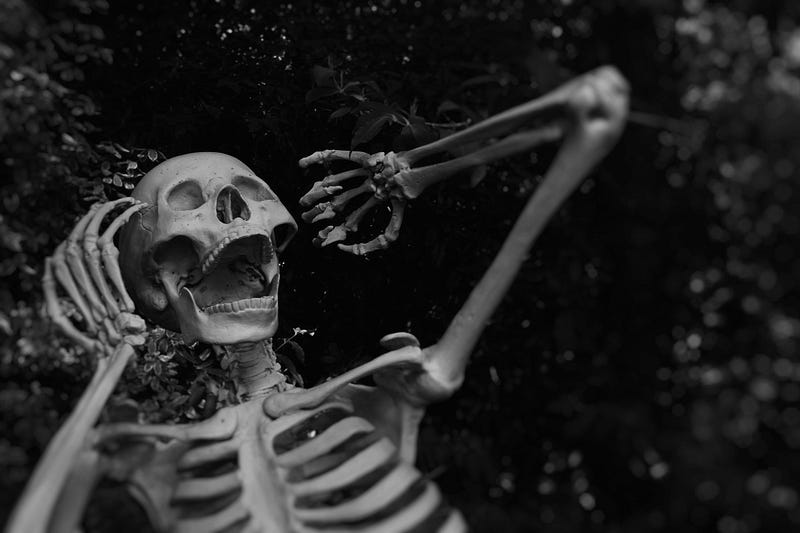
Photo by Sabina Music Rich on Unsplash

Today’s New York Times Spelling Bee letters: C, D, E, F, N, O, and center I (all words must include I).

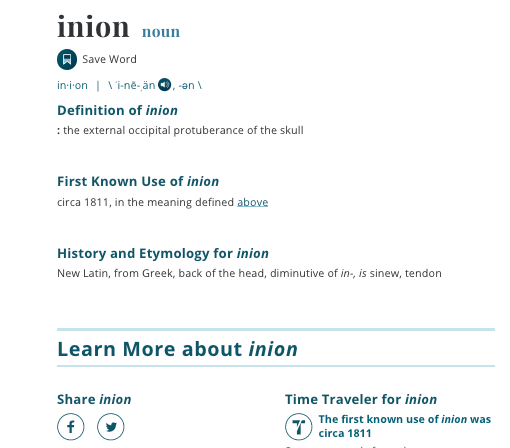
Merriam-Webster says…
Credit: merriam-webster.com

Silly little dictionary! Don’t you know inion can’t possibly be a word if the New York Times says it ain’t?

For further fascinating facts, check out the Spelling Bee Master.

What’s your favorite g.n.a.w. from today’s puzzle?

My Two Cents

Just to be clear here, I am talking about an inion, not an onion. That you, my esteemed reader, might think it was a typo is most natural, since I and O are right next to each other on the keyboard. Sort of like when one types ESPM instead of ESPN, or promhub instead of… well, you get the idea.

Etymologists explain that the word inion originated between1805 and 1815. It came from a New Latin version of the Greek īníon, meaning nape of the neck. The Greeks made up the word by adding īn- (stem of ī́s) meaning fiber or sinew to the diminutive suffix -ion. So, “small sinew”.

External occipital protuberance

Yep, just trying to impress you with more obscure multisyllabic words.

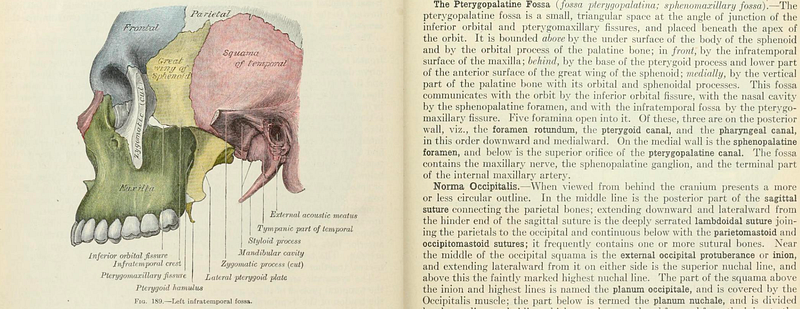
Would you be more interested if I told you we’re going to gossip about Gray’s Anatomy? No, not the long-running TV show about angst-y doctors, the original medical show:
Credit: Dr. Henry Gray?

Admittedly, this is not as compelling as a soap-opera-ish, Emmy-studded television series. But trust me, back when it was published in the mid-19th century, this book was considered primetime reading stuff. At least if you wanted to become a doctor and not be embarrassed when someone asked you “What is an inion, sir?”

Inion appears five lines from the bottom in the text on the far right side of the page spread above, in bold, so we know it was word back in 1827 when the first edition of Dr. Henry “Hank” Gray’s book came out in 1858. The next year it ws published in the United States, and in 1873 it definitely did not make the New York Times’s bestseller list. I promise you.

To answer the naggin question about the inion, it’s the highest point of a bulge on the outside of the back of your skull. The three terms in bold are the layperson’s way of saying “External occipital protuberance”. And if we all could study anatomy that way, most of us would still not read Hank’s book for leisure.

Nuchal ligament

Nope, nothing’s changed from the previous section. Still trying to sound like a smarty-pants with my fancy-schmancy words.

Don’t worry, we’re really just gonna talk about the paddywhack. Seriously.

The nuchal ligament goes from the inion to the seventh cervical vertebra, in the lower part of the neck. And this ligament is key for humans and other animals that like to run. Well, some of you may not enjoy running that much, but the ligament is still there in case you need it.

Now, in non-human animals like cattle and sheep, that ligament is known as a paddywhack, and serves two main purposes. (1) It helps relieve the animal of the weight of its head. (2) Once the animal no longer has a head, it’s sold as a doggy treat.

Although it’s tempting (and creative) to think that paddywhack originated from the ancient custom of smacking cows on the nape of the neck, the word came from the corruption of paxwax, which in turn was originally pronounced faxwax. The latter term came from Old English words meaning hair + to grow. I guess that’s where ancient people thought hair started growing on animals.

What does all this have to do with the lyrics of the song This Old Man? Remember that creepy nursery rhyme?

This old man, he played one, He played knick-knack on my drum; With a knick-knack paddywhack, Give a dog a bone, This old man came rolling home.

One explanation I found was that the old man is “playing the bones”, a folk instrument that originally consisted of a pair of animal bones. In the U.S. today, people usually use spoons in something known as (duh) “playing the spoons”. But way back when it was bones. Likely sheep bones. And since sheep have that nuchal ligament, the word paddywhack ended up in the children’s song. That sounds contentedly unsatisfying to me as an explanation.

If you know a better one, pray do tell.

If you want to play paddywhack, please be humane and use sticks or spoons. And if you want to sound fancy by using big words, you can go ahead and say “external occipital protuberance”. But don’t say inion… because the editors of the Spelling Bee have proclaimed: “Gee, Not A Word”.

Check out my previous entry on words that g.n.a.w. at you:

Spelling Bee
Greys Anatomy
Bones
Language
Skeleton
Recommended from ReadMedium