
Ancilla
A handmaid without a tail
Today’s New York Times Spelling Bee letters: A, G, I, L, N, W, and center C (all words must include C).
Merriam-Webster says…
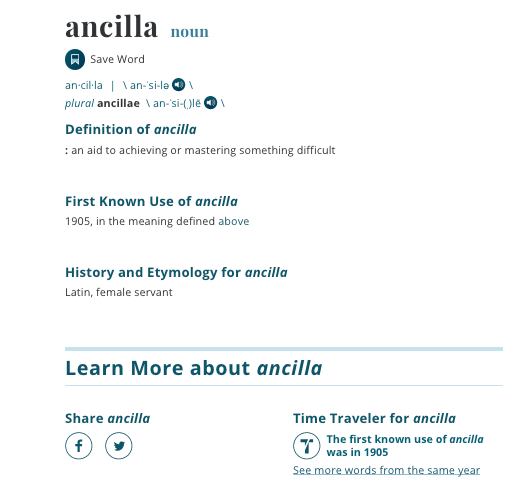
Silly little dictionary! Don’t you know ancilla can’t possibly be a word if the New York Times says it ain’t?
For further fascinating facts, check out the Spelling Bee Master.
What’s your favorite g.n.a.w. from today’s puzzle?
My Two Cents
In case you’re wondering if I meant to write “tale” instead of “tail” in the header… I didn’t.
I was trying to be clever by alluding to the suffix -ry as a sort of “tail” to ancilla (the handmaid) and referencing a popular TV series related to a handmaid and her story about living in a dystopian future not to far-removed from our dystopian present. (But please read the book first!)
Clearly my subtle attempt at humor failed miserably. Onward to the word, then…
I was referencing handmaids because although ancilla’s meaning, “an aid to achieving or mastering something difficult”, seems quite nice and appropriate and certainly not sexist or chauvinistic, its origin is, well, quite the opposite.
The word comes from the Latin meaning “maidservant”. How ancilla became maid in Middle English is a mystery I’m still uncovering. In Middle English, maid meant not only “an unmarried woman, or a virgin” — both of which are still used today — but also specifically a female servant.
In any case, clearly ancilla begot “maid”, but it also begot the adjective “ancillary”, a commonly-used word. It conveys the sense of support in a way that supplements something else. So, ancillary describes something that is secondary in importance to whatever it’s supporting.
Student Torture
People who work in Educational Publishing, like I do, are familiar with the term ancillary (and its synonym supplementals) as an umbrella for whatever product is created to support the Student and Teacher Editions. Way back when, ancillaries included Practice Books, Review Books, Quizzes, and Transparencies.
It was torture for students. We thought were done after reading a story and discussing it with the teacher, when suddenly she’d pull out a bunch of pages she had xeroxed (because back then Xerox was a verb) and hand them out for us to complete. Or she’d display transparencies to review everything we had just gone through minutes before. Or we’d get a pop quiz passed around as the entire classroom joined in one extended groan.
But it was also torture for teachers, who had to make a bunch of photocopies and grade every single one. The lucky ones had class pets who would do this for them and enjoy the eternal gratitude of their teachers and the contempt of the entire classroom.
Before copy machines, however… there were these horrible, stinky humongous appliances called mimeographs. They were the early versions of photocopiers, except they were much worse and entailed much more work. Essentially they duplicated pages by forcing ink through stencils onto paper. This provided even more torture for teachers, and those that retired before modern copiers became widespread in the late 70s forever hated Xerox for taking too long to create its best-known product.
For those of you born this millennium, transparencies were the analog equivalents of today’s digital powerpoint presentations. They were sheets made of plastic that were… um, transparent. You would write or print content on them and place them on an electric overheard projector that would display them on the classroom wall as a huge poster made of light so all the bored students could see it. Except students were busying doing anything else by taking advantage of the fact that the classroom lights were out.
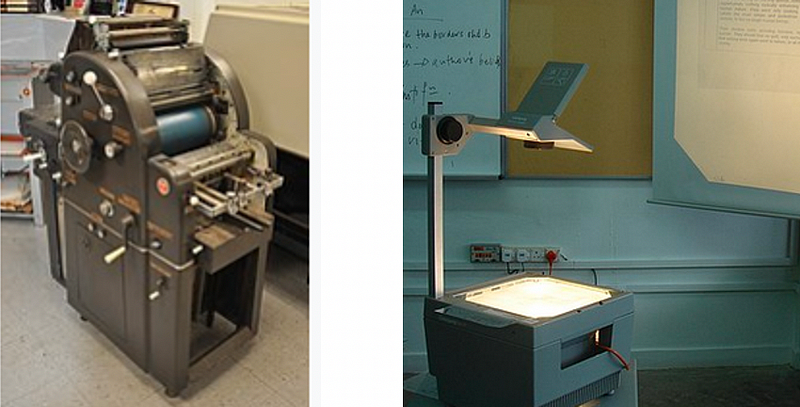
To the left, a mimeograph machine. To the right, an overhead projector. Wasn’t 20th century technology beautiful, compact, and efficient?
Today, ancillaries have moved into the same world everyone and everything else has: the digital universe. Companies compete to create attractive, animated content to entertain students… and maybe educate them.
So although now students may no longer feel tortured, we can’t say the same about teachers. They still have to figure out how to send links and connect and download and play and find a way to make these video games relevant to figuring out if their students are learning anything at all.
An ancilla-ry by any other name…
Did you know the word ancilla has other interesting uses? Of course you did! But please continue reading anyway.
▹ There’s a school in Indiana named Ancilla College. The name made sense when I discovered it was founded in 1937 by the Poor Handmaids of Jesus Christ to train their novices.
▹ In computation, Ancilla bits are used for specific purposes, such as reversible computation and quantum computing. I’m way out of my depth here, so all I can do is provide the link to the Wikipedia article and ask that if any reader can explain this in simple terms, they can do so by leaving a comment. What I can say is these bits are named Ancilla because they are auxiliary.
▹ There is an entire genus of sea snails called Ancilla, with over 40 known species. The incredibly specific gastropod.com website has dedicated a page to each of them.
Conclusion: If you want to discuss colleges, quantum computing or sea snails, you can’t… because the editors of the Spelling Bee saw ancilla and said: “Gee, Not A Word”.
Check out my previous entry on words that g.n.a.w. at you: