
Inflation Won’t Get Better Anytime Soon
Annualized figures will stay above desired amounts

The headline news from Thursday’s inflation report was that consumer prices rose 5% from last year.
That’s not an ideal number. It’s far higher than most people’s annual salary increase.
But to play devil’s advocate, the 5% increase shows the difference between May 2021 and May 2020. A year ago, May 2020 was the height of the pandemic’s economic madness and had just seen two straight months of deflation.
A bigger concern should be the recent monthly increases.
Monthly Increases
After seeing deflation during some pandemic months, the last twelve months have all seen positive inflation numbers.
Below is a table showing the percent increase in consumer prices, on a month-over-month basis.

So, for example, inflation increased 2% in September 2020 when compared to August 2020.
June and July’s large numbers were a result of deflation the previous few months. The alarming sight is how we have started 2021.
All of the numbers in 2021 are above the Federal Reserve’s goal of 2% annual growth.
Annualized Increases
On an annualized scale, things look worse.
The 6% increase of March and May on an annualized basis is 7.2%. And the 8% in April is annualized at 9.6%.
That's treading on dangerously high levels of inflation. Those won’t be seen, hopefully, but even dealing with those numbers monthly is not ideal.
Since inflation is an increase from a previous number, it takes more in the future to move it the same percentage value.
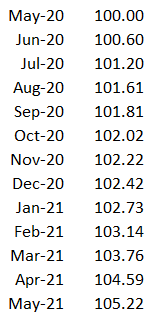
If May 2020 is the base period of 100, using the monthly increases leads us to a 5% increase by May 2021.
Something that cost $100 a year ago would theoretically cost $105 today.
2021 is not off to a good start. Five months in and we already see inflation has increased more than 2%, with seven months still to go.
The Impact
The direct impact is obvious — consumers will have to pay more for the same items than previously.
But inflation impacts a variety of other situations from wages to investments. Public policies and benefits are also tied to inflation numbers.
Almost no one wins from high levels of inflation. One way to take advantage is to hold assets that benefit from inflation. Stocks and real estate are generally considered assets that can be propped up in value due to inflation.
There are also assets such as gold, or bitcoin, that are considered inflation hedges.
Inflation likely isn’t going anywhere soon. The Federal Reserve has other concerns about the economy before addressing inflation. You can’t change inflation, but you can do certain things to protect yourself against it.


