avatarMichele Diodati

Free AI web copilot to create summaries, insights and extended knowledge, download it at here

6232

Abstract

re variations, precisely this has resulted; that the space is flat, surprisingly flat.</p><p id="5556">Cosmologists use the Greek capital letter Ω (<i>omega</i>) to indicate the relationship between the current density of the Universe and its critical density, that is, that in which the push of gravity and the expansion of space are perfectly balanced. From the data, it appears that today the value of Ω is equal to 1, with an error margin of <a href="https://map.gsfc.nasa.gov/universe/uni_shape.html">around 0.4%</a>. It means not only that the space is flat but that at the time of the Big Bang, it had to be <i>incredibly</i> <i>flat</i>. In fact, the effects of curvature amplify over time. To be clear, if the density of matter and energy in the early Universe had been even only 1 part out of 10⁶² (1 followed by 62 zeros) higher than the critical density, the expansion would have stopped very soon, and the Universe would have collapsed on itself billions of years ago. So how is the space so flat? The cosmological model of the Big Bang is unable to answer this question.</p><p id="dc4f">The third problem has to do with the expected, but not yet observed existence of some very massive subatomic particles, which should explain, among other things, the asymmetry between matter and antimatter. We live in a Universe made up almost exclusively of matter, but we do not know why. All laboratory experiments <a href="https://home.cern/science/physics/matter-antimatter-asymmetry-problem">carried out with particle accelerators</a> have so far obtained only weak clues in this regard. To explain the origin of the evident asymmetry between matter and antimatter, physicists have thus elaborated elegant theoretical models. They predict that, at the very high energies present in the initial moments after the Big Bang, super-heavy particles would have had to form, some of which <i>stable</i>, that is, such as to survive, at least in modest quantities, up to the present day.</p><figure id="7028"><img src="https://cdn-images-1.readmedium.com/v2/resize:fit:800/1*TyiggwZMBaEFXninjyBA4Q.png"><figcaption>If a magnet is broken, its magnetic poles are not isolated, but two new magnets are created, each with its own North pole and South pole [<a href="https://commons.wikimedia.org/wiki/User:Sbyrnes321">Sbyrnes321</a> / Wikimedia]</figcaption></figure><p id="f664">One of these particles predicted by theoretical models is the so-called <i>magnetic monopole</i>, a “monster” with an immense mass, equal to 10¹⁶ times that of the proton. However, unlike electric charges, which are observable in isolation (electrons have negative charge and protons positive charge), magnetic charges, as far as we know, <i>never</i> appear separate, but always in pairs. Any magnet <i>always</i> has a positive pole and a negative pole. If we break it in half, the poles do not separate, but both reform in each of the two halves, no matter how small they are. It seems, in short, that there is currently no magnetic monopole observable in isolation. It could be that these elementary magnetic charges are each other’s antiparticle, so that, if they come into direct contact, they annihilate. But, if at the time of the Big Bang, the very high energies predicted by the theory were really reached, at least a small amount of the magnetic monopoles then created should have survived until today. If so, how is it possible that — except for a single, unrepeatable case reported in <a href="https://journals.aps.org/prl/abstract/10.1103/PhysRevLett.48.1378">an experiment from 1982</a> — magnetic monopoles stubbornly refuse to let us observe them?</p><p id="4b70">These three problems to which the theoretical model of the Big Bang is unable to provide solution, namely the extremely uniform temperature of the CMB, the flatness of space and the absence of magnetic monopolies, could also be put aside and not considered problems at all, but natural conditions, “innate” aspects of the structure of the Universe. But it would not be a very scientific way of proceeding. Science prefers to avoid, as far as possible, those theoretical models that, in order to work, require to calibrate <i>a priori </i>certain parameters on very specific values (for example Ω=1) for no good reason.</p><figure id="7a95"><img src="https://cdn-images-1.readmedium.com/v2/resize:fit:800/1*h8KXB5vE8eJRIjd4-F6IfA.jpeg"><figcaption>Alan Guth, the winner of the <a href="https://breakthroughprize.org/Laureates/1/L2">Breakthrough Prize in Fundamental Physics</a> for the year 2012, awarded him in recognition of his exceptional contribution to the development of inflationary cosmology</figcaption></figure><p id="2579">So, as early as the 70s of the last century, various physicists and cosmologists began to produce hypothetical scenarios that could integrate the theoretical model of the Big Bang, freeing it from the need to set initial <i>ad hoc </i>parameters, inserted in order not to contradict the observational data available. Since then, a theoretical model has imposed itself on all the others, gathering an almost universal consensus, that of the <i>inflationary Universe</i>, developed in the early 1980s thanks mainly to the contribution of three theoretical physicists: <a href="https://en.wikipedia.org/wiki/Alan_Guth">Alan Guth</a>, <a href="https://en.wikipedia.org/wiki/Andrei_Linde">Andrei Linde</a>, and <a href="https://en.wikipedia.org/wiki/Paul_Steinhardt">Paul Steinhardt</a>.</p><p id="8536"><i>Inflation</i>, in a cosmological sense, is a process of exponential expansion of space, which occurred during the first second since the Big Bang. We cannot be sure of its exact duration, but it is possible that it was an immeasurably short phenomenon for our conception of time. For example, according to <a href="https://www.scientificamerican.com/article/the-self-reproducing-inflationary-u/">an article</a> from 1994 by the Russian physicist Andrei Linde, the period of exponential expansion from which our Universe originated probably ran out in a time not exceeding 10⁻³⁵ seconds (i.e., 0.00000000000000000000000000000000001 seconds). But in that microscopic time interval the size of the cosmos grew dramatically, going from a diamet

Options

er of 10⁻³³ centimeters — the <a href="https://en.wikipedia.org/wiki/Planck_length">Planck length</a>, that is the smallest size endowed with physical meaning — to one of tens of orders of magnitude greater than the diameter of the observable Universe (which is between 10²⁸ and 10²⁹ cm).</p><figure id="b398"><img src="https://cdn-images-1.readmedium.com/v2/resize:fit:800/1*H_lbvofPYKfkNHigY0l5Zg.jpeg"><figcaption>Andrei Linde, one of the fathers of the inflationary Universe theory</figcaption></figure><p id="7866">The seemingly bizarre hypothesis of the inflationary cosmos suddenly solved the three problems to which the theoretical model of the Big Bang could not answer. The enormous and very rapid growth of the newborn Universe brought with it significant consequences:</p><ul><li>All parts of an initially microscopic universe can interact directly with each other, homogenizing the distribution of energy without violating the limit of the light speed. CMB temperature uniformity, which we find today in every direction, is a direct consequence of the fact that inflation suddenly transferred to cosmic scale the homogeneity that had occurred following local interactions in the newborn Universe <i>before</i> it began the exponential expansion phase. Here, then, solved the horizon problem — there was a time when regions of space that billions of light-years separate today, were instead in a direct, causal connection.</li><li>Inflation expanded the space like a balloon, stretching it so that any curvature, positive or negative, became invisible even on a cosmological scale. As mentioned above, the inflationary model predicts that the exponential expansion of space has made the Universe<i> dozens of orders of magnitude</i> larger than its observable volume. We are, therefore, in the same condition as a person looking towards the horizon from the center of the flattest desert on Earth. Even if there is a curvature, we cannot see it. This solves the problem of flatness. Space appears to us flat not because of the very improbable perfect random balance between the rate of expansion of space and the density of matter/energy in the cosmos, but simply because space has been so flattened by inflation that we do not (yet) possess enough distance to appreciate the possible curvature.</li><li>Finally, inflation dilutes the density of magnetic monopoles by spreading them over a huge space, which explains why we are unable to observe them today. However, it is worth noting that, according to another version of the inflationary model, the current lack of magnetic monopoles would be the consequence of the fact that during the exponential expansion of space, monopoles did not yet exist. And they were not created even afterward when the Universe was filled with matter and radiation, because the density of energy at the end of the inflationary phase was not sufficient for their production. In both cases, the fact that no magnetic monopoles are observable today is to be regarded as a consequence of inflation.</li></ul><figure id="f09e"><img src="https://cdn-images-1.readmedium.com/v2/resize:fit:800/1*KyDGQCwvbX0FFBk9GGf3Gw.jpeg"><figcaption>Inflation is represented in the drawing by four adjacent squares, in which the sphere visible on the left, symbolizing the Universe, triple in size with each passage to the right. The exponential expansion of space solves the problem of flatness in a simple and elegant way, making the curvature of space quickly invisible to anyone who observes the lattice too closely [Le Scienze n. 191 (1984)]</figcaption></figure><h1 id="6a0a">Notes</h1><p id="4fea">[1] To realize this, imagine an equilateral triangle drawn on the earth’s surface, with a vertex at the North Pole and the other two vertices lying along the equator. For observers located in the two vertices along the equator, each of the respective angles measures 90°. By adding the angle at the North Pole, the sum is always greater than 180°.</p><p id="3ce5"><i>What you read is the <b>second part</b> of a four-part story. Read the <b>other three parts</b> here:</i></p><div id="5353" class="link-block"> <a href="https://readmedium.com/an-eternal-and-uncreated-universe-or-the-big-bang-12f5ccf7c4fd"> <div> <div> <h2>An Eternal and Uncreated Universe or the Big Bang?</h2> <div><h3>The conflict between the Big Bang theory and the steady-state theory was overcome thanks to the discovery of cosmic…</h3></div> <div><p>medium.com</p></div> </div> <div> <div style="background-image: url(https://miro.readmedium.com/v2/resize:fit:320/1*x03elU6PFaWnYXuSrbiqlg.jpeg)"></div> </div> </div> </a> </div><div id="1eb8" class="link-block"> <a href="https://readmedium.com/inflation-is-a-bridge-between-microcosm-and-macrocosm-d8dd56abbd3e"> <div> <div> <h2>Inflation Is a Bridge between Microcosm and Macrocosm</h2> <div><h3>The small inhomogeneities in the distribution of matter in the Universe are the effect of quantum fluctuations occurred…</h3></div> <div><p>medium.com</p></div> </div> <div> <div style="background-image: url(https://miro.readmedium.com/v2/resize:fit:320/1*4NdKaE_xz97bTXvX2s9K5g.jpeg)"></div> </div> </div> </a> </div><div id="5e38" class="link-block"> <a href="https://readmedium.com/if-inflation-is-true-then-we-live-in-a-multiverse-d2555178d062"> <div> <div> <h2>If Inflation Is True, Then We Live in a Multiverse</h2> <div><h3>In an eternally inflating universe, anything that can happen will happen; in fact, it will happen an infinite number of…</h3></div> <div><p>medium.com</p></div> </div> <div> <div style="background-image: url(https://miro.readmedium.com/v2/resize:fit:320/1*LlHQlBsxg27cBCQTczZ4Dw.jpeg)"></div> </div> </div> </a> </div></article></body>

Inflation Goes to the Rescue of the Big Bang

The theory of inflation, established in the early ’80s of the last century, brilliantly solves three problems that the Big Bang theory could not answer: the horizon problem, the flatness problem, and the magnetic monopoles problem

Despite its undoubted successes, the Big Bang theory is unable to answer all the questions of cosmologists. There are at least three open questions for which it cannot provide solutions: the horizon problem, the flatness problem, and the monopoles problem. Let’s go through them one by one.

The most striking feature of the cosmic microwave background (CMB) radiation is the almost perfect uniformity of its temperature in every region of the sky. How is it possible, for example, that the photons of the CMB coming from the western horizon have the same temperature as those coming from the east horizon? Indeed, the particles with which they last interacted, about 13.8 billion years ago, were not in a direct causal connection between them. Therefore, the energy of the CMB photons coming from the East could have been very different from that of the CMB photons coming from the West. How is it, instead, that those photons have precisely the same temperature, with variations of a few parts out of 100,000, wherever part of the sky they come from? This mysterious property of the CMB is known in cosmology as the problem of the horizon.

The second problem, that of the flatness, has to do with the shape of the space. As we know from general relativity, space can be curved. Still, it can be curved in two ways, curved like a horse saddle or curved like a sphere. In the first case, the sum of the inner angles of a triangle is less than 180°; in the second case, it is greater [1]. Then there is a third case, a perfectly flat space, without any type of curvature. It is only in this type of space, following Euclidean geometry, that the sum of the inner angles of a triangle gives exactly 180°. It should be pointed out, however, that a space that appears flat locally may not be flat on a cosmological scale. It is the same principle by which the earth’s surface appears flat to an observer located at sea level, but it is obviously curved in the photographs taken by astronauts in orbit on the International Space Station. It takes some distance to see if there’s curvature.
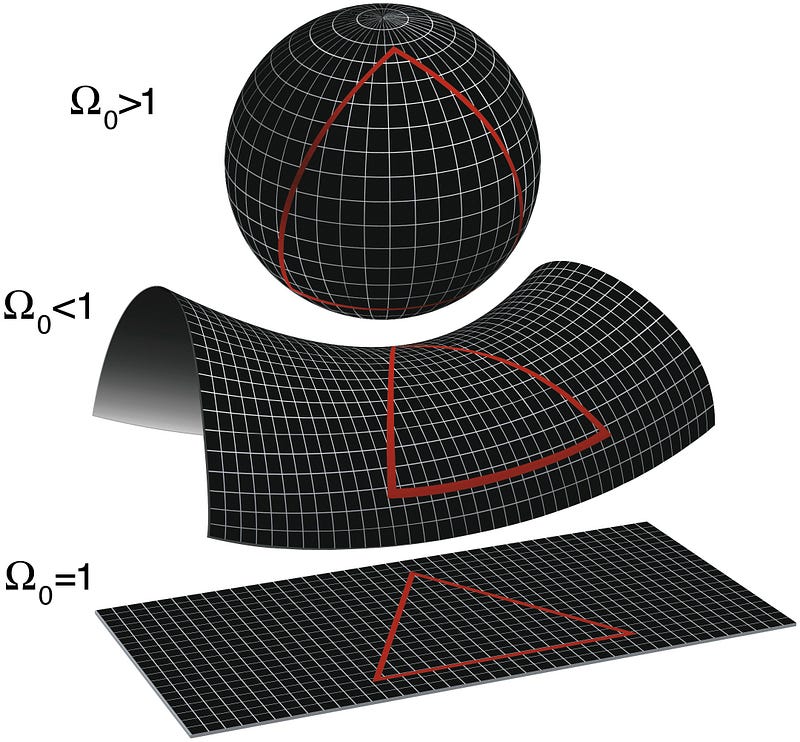
Space can have positive, negative, and zero curvature. The sphere indicates a space with positive curvature, in which the sum of the angles inside a triangle is greater than 180°. The saddle shape instead indicates a space with negative curvature, in which the sum of those angles is less than 180°. Only in a flat space, the last case, the sum of the angles of a triangle gives exactly 180° [NASA / WMAP]

The final destiny of the Universe is closely linked to its type of curvature. In a Universe with positive curvature, the cosmic struggle between gravity, which tends to collapse matter in one point, and the expansion of space, which tends to separate everything, is ultimately won by gravity. When the maximum possible expansion is reached, the Universe gradually begins to contract, becoming smaller, denser, and hotter. Everything eventually collapses into an apocalyptic Big Crunch, the mirror opposite of the Big Bang.

Instead, in a Universe with negative curvature, that is, saddle-shaped, it is the drive for expansion that prevails over gravity. The latter at most can slow down the speed at which space expands, but it cannot stop the process, much less reverse it. The final destiny of such a Universe is thermal death; after all the stars have gone out, after even black holes have evaporated, the thermodynamic equilibrium takes over, and no free energy remains, usable to accomplish work.

Then there is a third case, the one in which there is no positive or negative curvature. In a universe in which space is perfectly flat, the initial thrust to expansion is counteracted by gravity in such a balanced way as to impose a gradual slowdown, in which space expansion tends asymptotically to zero, without ever becoming zero. A similar universe is a watershed between the two previous cases; the flatness of the space corresponds to a critical density, in which even a single proton more or less determines two completely different final destinies (Big Crunch or thermal death).
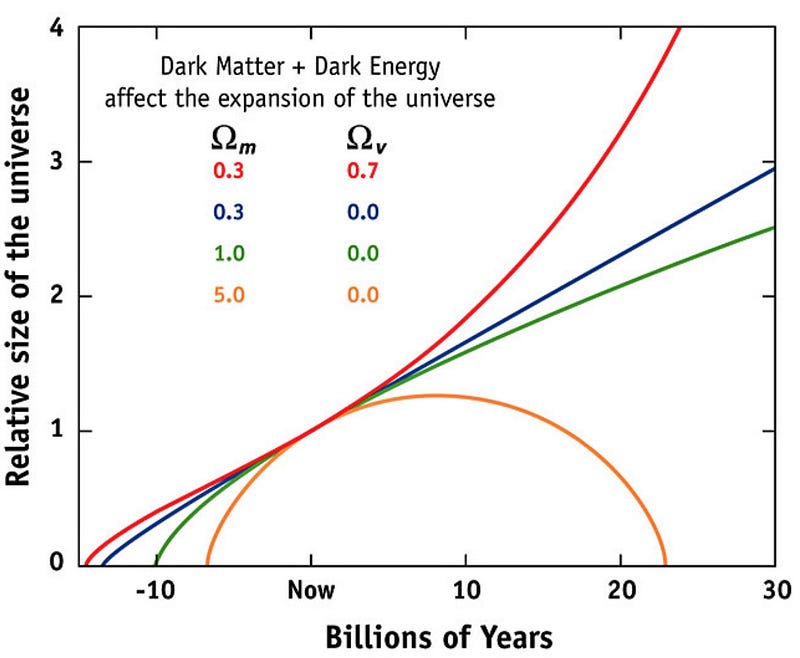
If the density of the Universe is less than the critical density, then it will expand forever, according to the green, blue, or red curves in the graph. Gravity might slow the expansion rate down over time, but for densities below the critical density, there isn’t enough gravitational pull to ever stop or reverse the outward expansion. If the density of the Universe is greater than the critical density, then gravity will eventually win, and the Universe will collapse back on itself, the so-called “Big Crunch,” like as in the graph’s orange curve [NASA / WMAP]

Come to think of it, the case of perfectly flat space is the most unlikely of all. There is, in fact, only one way in which space can be flat, but many ways in which it can be curved (the curvature of space can have many different values, either positive or negative). Yet, from studies carried out on type Ia supernovae and the CMB’s small temperature variations, precisely this has resulted; that the space is flat, surprisingly flat.

Cosmologists use the Greek capital letter Ω (omega) to indicate the relationship between the current density of the Universe and its critical density, that is, that in which the push of gravity and the expansion of space are perfectly balanced. From the data, it appears that today the value of Ω is equal to 1, with an error margin of around 0.4%. It means not only that the space is flat but that at the time of the Big Bang, it had to be incredibly flat. In fact, the effects of curvature amplify over time. To be clear, if the density of matter and energy in the early Universe had been even only 1 part out of 10⁶² (1 followed by 62 zeros) higher than the critical density, the expansion would have stopped very soon, and the Universe would have collapsed on itself billions of years ago. So how is the space so flat? The cosmological model of the Big Bang is unable to answer this question.

The third problem has to do with the expected, but not yet observed existence of some very massive subatomic particles, which should explain, among other things, the asymmetry between matter and antimatter. We live in a Universe made up almost exclusively of matter, but we do not know why. All laboratory experiments carried out with particle accelerators have so far obtained only weak clues in this regard. To explain the origin of the evident asymmetry between matter and antimatter, physicists have thus elaborated elegant theoretical models. They predict that, at the very high energies present in the initial moments after the Big Bang, super-heavy particles would have had to form, some of which stable, that is, such as to survive, at least in modest quantities, up to the present day.
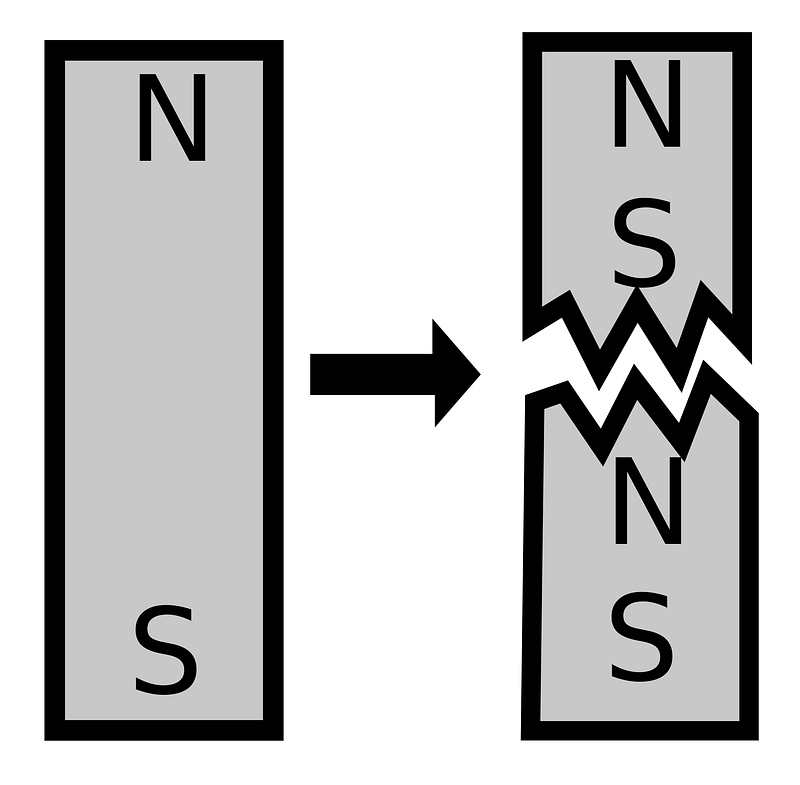
If a magnet is broken, its magnetic poles are not isolated, but two new magnets are created, each with its own North pole and South pole [Sbyrnes321 / Wikimedia]

One of these particles predicted by theoretical models is the so-called magnetic monopole, a “monster” with an immense mass, equal to 10¹⁶ times that of the proton. However, unlike electric charges, which are observable in isolation (electrons have negative charge and protons positive charge), magnetic charges, as far as we know, never appear separate, but always in pairs. Any magnet always has a positive pole and a negative pole. If we break it in half, the poles do not separate, but both reform in each of the two halves, no matter how small they are. It seems, in short, that there is currently no magnetic monopole observable in isolation. It could be that these elementary magnetic charges are each other’s antiparticle, so that, if they come into direct contact, they annihilate. But, if at the time of the Big Bang, the very high energies predicted by the theory were really reached, at least a small amount of the magnetic monopoles then created should have survived until today. If so, how is it possible that — except for a single, unrepeatable case reported in an experiment from 1982 — magnetic monopoles stubbornly refuse to let us observe them?

These three problems to which the theoretical model of the Big Bang is unable to provide solution, namely the extremely uniform temperature of the CMB, the flatness of space and the absence of magnetic monopolies, could also be put aside and not considered problems at all, but natural conditions, “innate” aspects of the structure of the Universe. But it would not be a very scientific way of proceeding. Science prefers to avoid, as far as possible, those theoretical models that, in order to work, require to calibrate a priori certain parameters on very specific values (for example Ω=1) for no good reason.

Alan Guth, the winner of the Breakthrough Prize in Fundamental Physics for the year 2012, awarded him in recognition of his exceptional contribution to the development of inflationary cosmology

So, as early as the 70s of the last century, various physicists and cosmologists began to produce hypothetical scenarios that could integrate the theoretical model of the Big Bang, freeing it from the need to set initial ad hoc parameters, inserted in order not to contradict the observational data available. Since then, a theoretical model has imposed itself on all the others, gathering an almost universal consensus, that of the inflationary Universe, developed in the early 1980s thanks mainly to the contribution of three theoretical physicists: Alan Guth, Andrei Linde, and Paul Steinhardt.

Inflation, in a cosmological sense, is a process of exponential expansion of space, which occurred during the first second since the Big Bang. We cannot be sure of its exact duration, but it is possible that it was an immeasurably short phenomenon for our conception of time. For example, according to an article from 1994 by the Russian physicist Andrei Linde, the period of exponential expansion from which our Universe originated probably ran out in a time not exceeding 10⁻³⁵ seconds (i.e., 0.00000000000000000000000000000000001 seconds). But in that microscopic time interval the size of the cosmos grew dramatically, going from a diameter of 10⁻³³ centimeters — the Planck length, that is the smallest size endowed with physical meaning — to one of tens of orders of magnitude greater than the diameter of the observable Universe (which is between 10²⁸ and 10²⁹ cm).
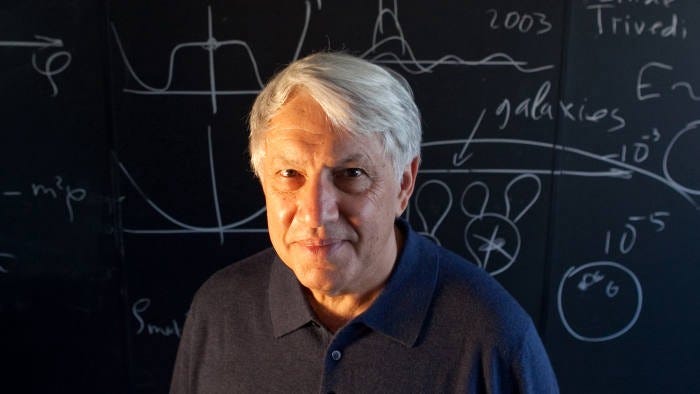
Andrei Linde, one of the fathers of the inflationary Universe theory

The seemingly bizarre hypothesis of the inflationary cosmos suddenly solved the three problems to which the theoretical model of the Big Bang could not answer. The enormous and very rapid growth of the newborn Universe brought with it significant consequences:

  • All parts of an initially microscopic universe can interact directly with each other, homogenizing the distribution of energy without violating the limit of the light speed. CMB temperature uniformity, which we find today in every direction, is a direct consequence of the fact that inflation suddenly transferred to cosmic scale the homogeneity that had occurred following local interactions in the newborn Universe before it began the exponential expansion phase. Here, then, solved the horizon problem — there was a time when regions of space that billions of light-years separate today, were instead in a direct, causal connection.
  • Inflation expanded the space like a balloon, stretching it so that any curvature, positive or negative, became invisible even on a cosmological scale. As mentioned above, the inflationary model predicts that the exponential expansion of space has made the Universe dozens of orders of magnitude larger than its observable volume. We are, therefore, in the same condition as a person looking towards the horizon from the center of the flattest desert on Earth. Even if there is a curvature, we cannot see it. This solves the problem of flatness. Space appears to us flat not because of the very improbable perfect random balance between the rate of expansion of space and the density of matter/energy in the cosmos, but simply because space has been so flattened by inflation that we do not (yet) possess enough distance to appreciate the possible curvature.
  • Finally, inflation dilutes the density of magnetic monopoles by spreading them over a huge space, which explains why we are unable to observe them today. However, it is worth noting that, according to another version of the inflationary model, the current lack of magnetic monopoles would be the consequence of the fact that during the exponential expansion of space, monopoles did not yet exist. And they were not created even afterward when the Universe was filled with matter and radiation, because the density of energy at the end of the inflationary phase was not sufficient for their production. In both cases, the fact that no magnetic monopoles are observable today is to be regarded as a consequence of inflation.
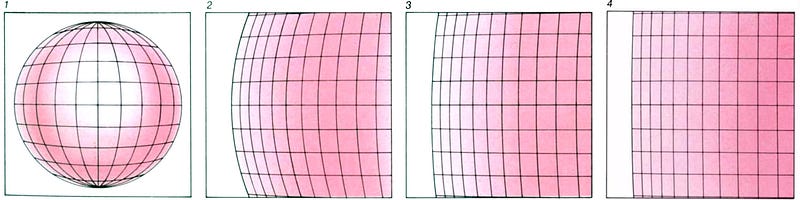
Inflation is represented in the drawing by four adjacent squares, in which the sphere visible on the left, symbolizing the Universe, triple in size with each passage to the right. The exponential expansion of space solves the problem of flatness in a simple and elegant way, making the curvature of space quickly invisible to anyone who observes the lattice too closely [Le Scienze n. 191 (1984)]

Notes

[1] To realize this, imagine an equilateral triangle drawn on the earth’s surface, with a vertex at the North Pole and the other two vertices lying along the equator. For observers located in the two vertices along the equator, each of the respective angles measures 90°. By adding the angle at the North Pole, the sum is always greater than 180°.

What you read is the second part of a four-part story. Read the other three parts here:

Physics
Science
Cosmology
Space
Big Bang
Recommended from ReadMedium