
If Inflation Is True, Then We Live in a Multiverse
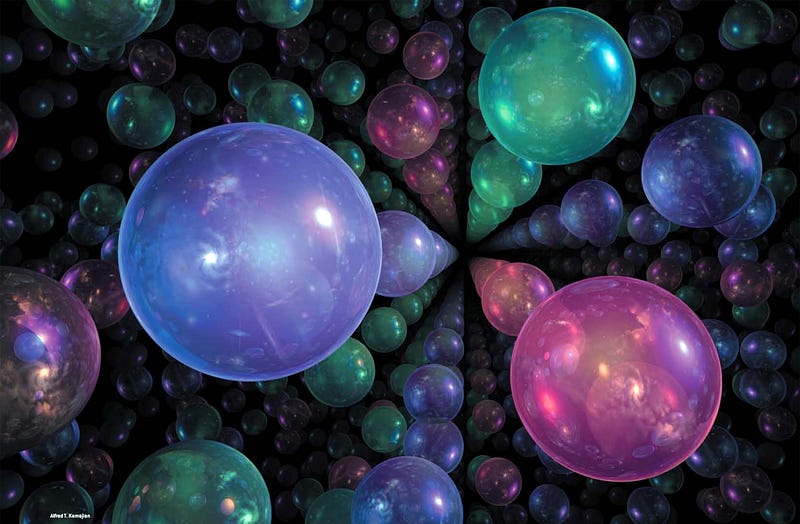
Inflation is an inherently quantum phenomenon. It follows that it cannot end at any point in space at the same time. As a consequence, inflation is eternal; once it begins, there will always be at least one region of exponentially expanding space, from which new Universes similar to ours, or different, will originate. Therefore, we inhabit a Multiverse in continuous, unstoppable expansion, formed by a fractallike structure of non-communicating Universes
Soon physicists realized that the early versions of the inflationary model led to conclusions that contrasted with observational data. They predicted, for example, the existence of a massive number of magnetic monopoles or large inhomogeneities in the structure of the Universe, of which, instead, there was no trace.
So, thanks to the efforts of theoretical physicists such as Alan Guth, Paul Steinhardt, Andreas Albrecht, Andrei Linde, and Alexander Vilenkin, by the mid-1980s, the first inflation models were replaced by new models, which did not contradict the observations. Two of them were particularly successful, the so-called new inflation (to distinguish it from the old one, i.e., the model proposed in 1980 by Alan Guth) and the chaotic inflation.
Without going into the details of the specific differences between the two theories, what interests us here is what they have in common, that is, the most extraordinary of predictions — once started, inflation is eternal and necessarily leads to the existence of a “collection” of not communicating Universes, that is, a Multiverse!
To understand how this is possible, one must keep in mind an essential fact. All the forces, particles, and properties of the Universe, including the scalar field or fields on which inflation depends, are, in their essence, quantum phenomena. It means that their potential energy is subject to quantum fluctuations. It leads to extraordinary consequences. In this regard, let us follow the explanation of Andrei Linde, the father of chaotic inflation [1]:
As I already mentioned, one can visualize quantum fluctuations of the scalar field in an inflationary universe as waves. They first moved in all possible directions and then froze on top of one another. Each frozen wave slightly increased the scalar field in some parts of the universe and decreased it in others.
Now consider those places of the universe where these newly frozen waves persistently increased the scalar field. Such regions are extremely rare, but still they do exist. And they can be extremely important. Those rare domains of the universe where the field jumps high enough begin exponentially expanding with ever increasing speed. The higher the scalar field jumps, the faster the universe expands. Very soon those rare domains will acquire a much greater volume than other domains.
From this theory it follows that if the universe contains at least one inflationary domain of a sufficiently large size, it begins unceasingly producing new inflationary domains. Inflation in each particular point may end quickly, but many other places will continue to expand. The total volume of all these domains will grow without end. In essence, one inflationary universe sprouts other inflationary bubbles, which in turn produce other inflationary bubbles.
This process, which I have called eternal inflation, keeps going as a chain reaction, producing a fractallike pattern of universes. In this scenario the universe as a whole is immortal. Each particular part of the universe may stem from a singularity somewhere in the past, and it may end up in a singularity somewhere in the future. There is, however, no end for the evolution of the entire universe.
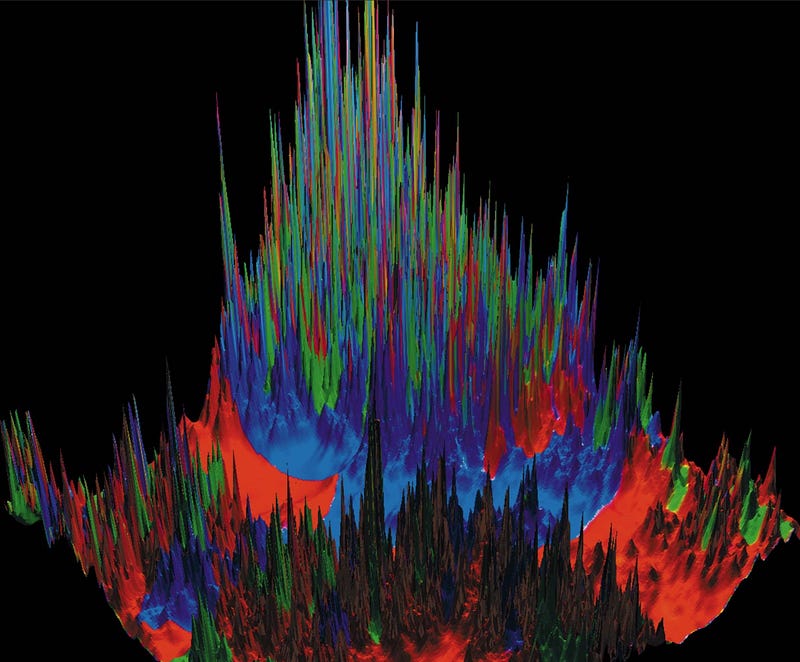
The quantum fluctuations Linde talks about imply the idea that the potential energy of the scalar field that governs inflation is subject to an inescapable uncertainty. From this uncertainty, it follows that inflation cannot end at the same time in all points of space, because, precisely because of those fluctuations, two adjacent points can have very different scalar field values. In one of those points, inflation will end, giving rise to a Big Bang and a Universe like ours. At the same time, at another location, space will continue to expand exponentially, creating a new branching of possibilities. There will be one (or more) places where inflation ends, giving rise to a new universe and one (or more) places where inflation continues instead. The inevitable result, once inflation has started, is, in any case, a Multiverse that perpetually reproduces itself and grows endlessly, punctuated by “bags” or “bubbles” containing Universes like ours, filled with matter, antimatter and radiation.
Each Universe is separated from all the others by an immeasurably greater amount of space than its extension. It is the space in which inflation goes on. Different Universes cannot, therefore, communicate with each other. The distances are so immense that there is no way to send or receive signals passing from a multiverse “bubble” to another.
Eternal inflation thus represents the end of the paradigm in which the Universe — the one we live in — is conceived as the totality of everything that exists. If we admit inflation, and there are excellent reasons for doing so, then we must also admit eternal inflation and the Multiverse, as Ethan Siegel explains in a chapter of his book Beyond the Galaxy [2]:
[…] it is tempting to have a classical picture of inflation in your head: that at some point in the past, you have a region of space that is exponentially expanding, and it inflates, inflates and inflates some more, uniformly, and then stops in all those regions all at once, giving rise to the Big Bang in all locations. But that picture is inconsistent with what the known laws of physics, when combined with what we know of inflation, tell us! Instead, we have a region of space that is expanding exponentially, inflating, and spawning many more new regions. In some of them, inflation ends (giving rise to a Big Bang) while others continue to inflate some more, spawning many more new regions. In some of those new regions, inflation ends (giving rise to a Big Bang), but others have inflation continue further, spawning many more new regions. So long as inflation is rapid enough, this process can occur for an eternity.
[…] if inflation begins in even one tiny region of the Universe, it continues, somewhere, eternally into the future. Sure, there are infinitely many regions like ours, where inflation comes to an end at some point, giving rise to a matter, antimatter and radiation-filled Big Bang, but separating each of those individual regions are places where the Universe continues to inflate. As time goes on, it is true that more and more regions will see inflation end. But the exponential expansion creates enough new space, continuously, to ensure that we will never lack for hot Big Bangs in independent, disconnected locations in our Universe. When people speak of a multiverse, or the idea that our Universe and what we can observe is not all there is out there, it is the very good science of inflation that leads to this inevitable conclusion!

In short, the inflation mechanism, initially conceived as a subset of the events that happened within the framework of the Big Bang, eventually becomes the dominant element in a cosmic process of inconceivable extent. Within this process our Universe, and the Big Bang that determines its characteristics, play a marginal role after all. Andrei Linde wrote about it in 1994:
The situation with the very beginning is less certain. There is a chance that all parts of the universe were created simultaneously in an initial, big bang singularity. The necessity of this assumption, however, is no longer obvious. Furthermore, the total number of inflationary bubbles on our “cosmic tree” grows exponentially in time. Therefore, most bubbles (including our own part of the universe) grow indefinitely far away from the trunk of this tree. Although this scenario makes the existence of the initial big bang almost irrelevant, for all practical purposes, one can consider the moment of formation of each inflationary bubble as a new “big bang.” From this perspective, inflation is not a part of the big bang theory, as we thought 15 years ago. On the contrary, the big bang is a part of the inflationary model.
Inflation, therefore, is no longer a content of the Big Bang but it is the container. And not of one, but of multiple, probably of infinite Big Bang. There is an underlying irony in all this. The theoretical model of the Big Bang has established itself almost universally on the competing model of the steady-state Universe and continuous creation because it can explain observational data such as cosmic background radiation and the expansion of the Universe better than the other model. But eternal inflation, which all in all is an extension of the Big Bang model, finally regains possession of the two main properties of the model competing with the Big Bang theory. They are the eternity of the Universe (although this time in the enhanced form of Multiverse) and continuous creation, which occurs whenever inflation ends somewhere in space, and the energy of its scalar field is converted into all the particles/antiparticles and radiation that fill a new Universe.
And there is more. Since nothing of the inflation era is directly observable, we do not know which and how many scalar fields have actually influenced the origin of our Universe, nor which and how many scalar fields are affecting, perhaps right now, the birth of other Universes. However, there is the possibility that those fields are more than one and that their interactions lead to the creation of Universes with physical laws utterly different from those existing in ours. It is interesting to read what the “usual” Andrei Linde wrote about it:
Could matters become even more curious? The answer is yes. Until now, we have considered the simplest inflationary model with only one scalar field, which has only one minimum of its potential energy. Meanwhile realistic models of elementary particles propound many kinds of scalar fields. For example, in the unified theories of weak, strong and electromagnetic interactions, at least two other scalar fields exist. The potential energy of these scalar fields may have several different minima. This condition means that the same theory may have different “vacuum states,” corresponding to different types of symmetry breaking between fundamental interactions and, as a result, to different laws of low-energy physics. (Interactions of particles at extremely large energies do not depend on symmetry breaking.)
Such complexities in the scalar field mean that after inflation the universe may become divided into exponentially large domains that have different laws of low-energy physics. Note that this division occurs even if the entire universe originally began in the same state, corresponding to one particular minimum of potential energy. Indeed, large quantum fluctuations can cause scalar fields to jump out of their minima. That is, they jiggle some of the balls out of their bowls and into other ones. Each bow corresponds to alternative laws of particle interactions. In some inflationary models, quantum fluctuations are so strong that even the number of dimensions of space and time can change.
[…] According to this scenario, we find ourselves inside a four-dimensional domain with our kind of physical laws, not because domains with different dimensionality and with alternative properties are impossible or improbable but simply because our kind of life cannot exist in other domains.
Inflation theory, taken to the extreme, requires accepting the possibility that the Universe, or rather the Multiverse, possesses properties that not even the most imaginative science fiction writer would be able to imagine. If Linde’s conjecture is correct, there will be at least one Universe in which even the most unthinkable possibility has already come true or will come true in the future, as Alan Guth correctly noted in an article from 2007 [3]:
In an eternally inflating universe, anything that can happen will happen; in fact, it will happen an infinite number of times. Thus, the question of what is possible becomes trivial — anything is possible, unless it violates some absolute conservation law. To extract predictions from the theory, we must therefore learn to distinguish the probable from the improbable.
In conclusion, the scenario depicted by the inflation theory confronts us with the idea that the totality of what exists is not only eternal but so vast, branched and complex, that it exceeds our own imagination, moreover remaining outside of any possibility of direct knowledge.
Perhaps only the idea that something exists instead of nothing is stranger and more incredible than the idea of a continuously expanding Multiverse, unknowable in its entirety, as emerges from the theory of eternal inflation.
Notes
[1] Andrei Linde, The Self-Reproducing Inflationary Universe, Scientific American, November 1994.
[2] Ethan Siegel, Beyond the Galaxy: How Humanity Looked Beyond Our Milky Way And Discovered The Entire Universe, World Scientific 2015.
[3] Alan H Guth, Eternal inflation and its implications, Journal of Physics A: Mathematical and Theoretical 2007.
What you read is the fourth part of a four-part story. Read the other three parts here: