
Infinite Jest and Lolita are the Same Story
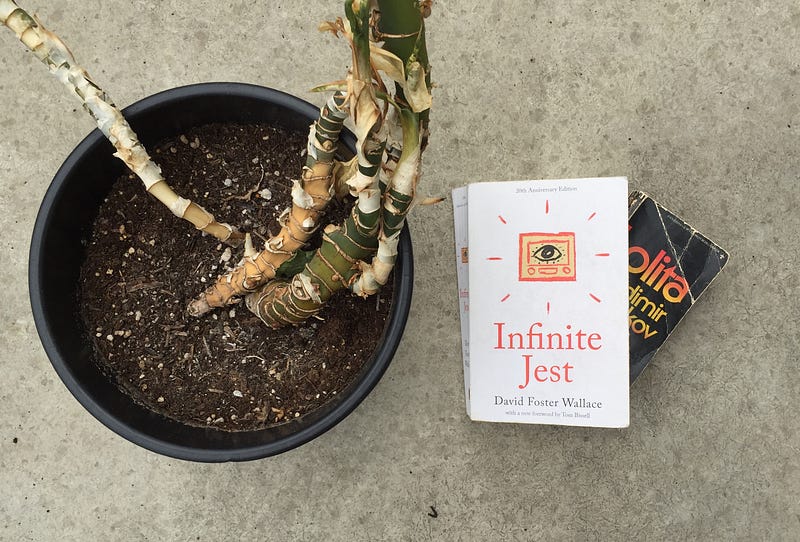
Reading Infinite Jest and Lolita feels similar in two ways. First, both novels are really embarrassing to read in public. Second, the two stories employ well-educated, charming, and very male narrators. And while these men do a frighteningly good job at hooking me in with their wit and linguistic play, I can’t help a slight throw-up-in-your-mouth-leaving-that-acidic-aftertaste feeling, as Wallace would put it, in my tummy.
That is, there’s something weirdly (and perhaps, intentionally) hollow about all the postmodern pyrotechnics, Humbert Humbert’s promise to provide a true account of his story, or Infinite Jest’s narrator’s obsession with sincere human emotions. And what’s going on is a certain self-consciousness under the pressure to perform; the narrators know they’re incapable of giving the reader what they need and they therefore resort to language games.
Of course, these narrators are self-reflective. What I think makes Infinite Jest and Lolita similar is that they’re both stories in some way about the narrators discovering what’s missing inside of them through other characters. Also, just look at this quote from Lolita:
“…and I doubt if much individual genius should be assigned to our interest in the plurality of inhabited worlds, competitive tennis, infinity, solipsism and so on.”
Ladies and gentlemen of the court, isn’t this also Infinite Jest?
1. Tennis and Solipsism
I’ve encountered a number of Medium articles about literature and competitive tennis, either in relation to Wimbledon (Literary Secrets of Wimbledon) or Wallace (What DFW Can and Cannot Teach Us About the State of American Men’s Tennis). And for all the philosophical talk about Wallace’s rendering of the sport into some metaphysical Eschaton-like crisis, I think his conception boils down to one simple idea.
In the game of tennis, there is a giver and a receiver. For a rally, the receiver needs to become the giver, and so on. The game is played in a well-defined box where the players are far apart from each other.
For me this serves (do you see what I did there) two purposes. The first, in relation to Wallace’s theme of entertainment, is to represent how passive consumers are in the television age. Of course, interactivity in television/the Internet has changed this, but in a way it hasn’t. We become the giver (of information), only to teach the receiver (companies) how to better defeat us. Tennis as consumerism then becomes a losing battle designed to advantage the giver when played ad infinitum.
The second has to do with human communication. Infinite Jest’s narrator clearly struggles with accessing his character’s feelings, and tries to compensate for this by being an overwhelming giver of text. And while many readers feel all sorts of confusion/anger/umbrage about how the novel ends, I think that the sudden ending is the necessary solution to the narrator’s problem. That is, by allowing the reader’s imagination to complete the rest of Infinite Jest, the reader also becomes a giver in the writing of the text. Rather than simply writing for a reader, the writer also demands that the reader participate in his literary project. This, the narrator gleams from Alcoholics Anonymous, is what allows for the possibility of sincere human feelings breaking the cynical veneer of, for example, the intellectual genius writer or the passive reader.
Lolita essentially comes to the same conclusion. The novel is spilling with Romantic sentiment and flowery metaphors in a way that only accentuates the hollow and grotesque nature of Humbert’s relationship with Dolores. Again, because the narrator struggles with real human feelings, and with the terrible nature of his crimes, he compensates and justifies by trying to overwhelm the reader. How can the reader accuse/judge Humbert when he was seduced, when his never-ending love was taken advantage of? Naturally, Humbert is a sad sack of bullshit who’s out of touch with human connection, and worse fails to teach his step-daughter about it too. He tries to teach her tennis instead:
“…and awkward Lo would slash at the ball and miss it, and curse, and send a simulacrum of a serve into the net…”
Yet, as her teacher says later to Humbert, Dolores does become “excellent to superb” at tennis, yet “cannot verbalize her emotions.” Like Hal, Dolores wasn’t raised to look inwards, and it’s only in through the game of tennis that she can find some uncynical mode of expression:
“There was nothing wrong or deceitful in the spirit of her game — unless one considered her cheerful indifference toward its outcome as the feint of a nymphet. She who was so cruel and crafty in everyday life, revealed an innocence, a frankness, a kindness of ball-placing.”
I think it’s a profound source of sympathy for Hal and Dolores that in both novels the game of tennis has been corrupted. For Hal, tennis is nothing more than a cutthroat competition, a gateway to college admissions, a continuation of his family’s tennis legacy. For Dolores, tennis is just Humbert’s tool to distract her, to cover his perversions with a semblance of normalcy.
This idea that growing up inherently involves the corruption of play and imagination is everywhere in fiction. From postmodern language games to Shakespeare (see Rereading Hamlet After College), writers have always been fascinated with how individuals must struggle with the complex systems of meaning thrust on them from birth onwards. Our two young characters can’t even choose their own names: Dolores is Lolita or Lo in Humbert’s mind, and Hal’s name is just a piece of Infinite Jest’s intertextual game.
Yet, these characters do grow up. They achieve this by escaping their respective narrator’s subjectivity, and only returning when they’ve had their own “adventures”, their own narrative life. The younger, outward Hal at the end of Infinite Jest is different from the older, inward Hal who, with Don Gately and Joelle, has dug up his father’s skull. When Humbert finally finds Dolores after Quilty abducted her, he finds his precious Lolita married, pregnant, and jaded. Interestingly, both return to their narrators at the age of 17, at the cusp of adulthood.
Of course, the reach of hideous adult’s goes beyond our tennis players. Infinite Jest is filled with children with developmental disorders, many of whom are sexually abused by their parents. Mario’s neurodevelopmental issues are presumably caused by his mother’s incestual relation with his uncle Charles. These parents are really messed up, and just like the incestuous “father” Humbert, who dreams of abusing Dolores’ children and then their children, they completely prevent these kids from growing up “normally,” or at least from having a fair crack at the game of life.
There are two conclusions in my mind, one solipsistic and the other not. The solipsistic answer is to say that people just cannot understand others, and to try is an exercise in oppression and puppetry. People need time to learn the same systems of meaning and get on a level linguistic playing field that allows for communication, genuine or not.
The other recognizes that fiction itself must be a kind of tennis game between the writer and the reader, that the symbiotic interaction between the writer’s ideas and the reader’s imagination create the space for empathy. I would argue that Hal and Dolores don’t just escape from the narrator, but that they escape into the reader, much like how readers escape into the novels.
“What I heard was but the melody of children at play, nothing but that, and so limpid was the air that within this vapor of blended voices, majestic and minute, remote and magically near, frank and divinely enigmatic — one could hear now and then, as if released, an almost articulate spurt of vivid laughter…and then I knew that the hopelessly poignant thing was not Lolita’s absence from my side, but the absence of her voice from that concord.”
2. Addiction as Infinity
Humbert Humbert is addicted to the idea of Lolita, and a central part of that addiction is his desire for Dolores to stay a nymphet forever. A central part of his despair then is the reality that she must grow up, and that she’ll eventually escape from him.
He employs quite a few tricks to sustain Lolita, the person and the idea, as well as the book. The most pressing of which connects the novel’s style with that of Infinite Jest: the overabundant use of clichés.
After murdering her mother, Humbert takes Dolores on the classic American road-trip. They take in rustic vistas, stay at stereotypical American motels, and meet all sorts of quirky American people. Humbert distracts Dolores by taking her to watch movies and buying her magazines, which fill her mind with wrought and sentimental ideas about romance.
The clichés are of course an integral part of Humbert’s dialect. His narrative is a never-ending stream of capital-R romanticisms and queasy, sentimental recollections. In his own hideous way, Humbert debases the beauty of language by using language to suspend his dreamed up reality and to distract Dolores and the reader from the true horror of the novel’s events. All this, I would say, to create a sort of imaginary infinity to nourish his addiction.
This relationship between clichés, infinity, and addiction is well-visited in Infinite Jest, with its narrator often talking about it explicitly. Many if not all of the novel’s characters are addicted to something, and often that something is a form of anesthetic, a substance, a person, or an idea that submerses them into a world independent of their painful pasts. In “The Entertainment”, we find an almost Platonic kind of infinity and addiction, one that renders consumers into complete slaves, one that concludes with the ultimate zero-point: death.
And while I think both novels align with this idea that the search for meaning in infinity is a terrible thing, the novels do seem to differ on their treatment of clichés. While Lolita, a postmodern work, seems to be completely cynical about the function of clichés, Infinite Jest appears to view them as both empty and meaningful. In its well-analyzed turn towards metamodern themes, Infinite Jest treats clichés and sincere feelings as sickly, manipulative tools that also can reveal very basic and truly universal facts about human life. What allows the characters, specifically the residents of Ennet House, to get at these facts is the presence of others who, sincerely or not, fully surrender their naked and infantile selves to each other.
This is a totally different kind of infinity that Infinite Jest seems to be proposing: not the spiralling vertical infinity of addiction, but the horizontal safety-net-like infinity of community and human connection. This is the kind of infinity that neither Humbert or Dolores find, and they both fall into hell for it.
“The bitch of the thing is you have to want to. If you don’t want to do as you’re told — I mean as it’s suggested you do — it means that your own personal will is still in control…your personal will is the web your Disease sits and spins in.”
I’m not the first to compare Wallace with Nabokov. In his Chicago Tribune review of The Pale King, Andrei Codrescu wrote that “Wallace, like Nabokov, the writer whom he most resembles, has a seemingly inexhaustible bag of literary tricks.” And while I do agree, and have argued here, that the two novelists share many themes and writing techniques, and I think there’s a striking difference that reflects the culture shifts that came with the turn of the century. That difference is the intention of literary tricks themselves.
Lolita is concerned with exposing the empty underbelly of contrived writing and letting readers see the novel as a puzzle to be solved, a game designed by the author. Infinite Jest, on the other hand, goes to the next level of employing a narrator who is already aware and self-conscious about the emptiness of his writing. The result is a text that clawingly searches for connection in others, at the same time betraying its own efforts to portray real emotions. The novel then, much like Lolita’s Humbert, becomes a living contradiction.
If you enjoyed my writing, please consider supporting me on Patreon: https://www.patreon.com/xichen