avatarBrett Berry

Free AI web copilot to create summaries, insights and extended knowledge, download it at here

2586

Abstract

readmedium.com/v2/resize:fit:800/1*kRZDOWkzjryP5_ieErEfSw.png"><figcaption>prime numbers</figcaption></figure><p id="08d4">Although this may seem like an obscure fact, it’s a result that’s been known for centuries. Our man Euclid showed us this was true back in 300BC. In fact, we proved this result a while back in <a href="https://readmedium.com/how-do-we-know-prime-numbers-are-infinite-9470f9d1aa39">this post</a>.</p><p id="4ff0">Since the set of primes is countably infinite, we can take the guests and systematically assign them to powers of prime numbers (which we know will be unique by the prime factorization theorem).</p><h2 id="5d8e">How to Move the Current Guests</h2><p id="4991">For starters, we’ll move the infinite set of guests currently in the hotel from their current room numbers (i.e. the natural numbers) to powers of the first prime number, 2.</p><p id="c769">So the guest in room 1 goes to room 2¹= 2, the guest in room 2 goes to room 2² = 4, and so on.</p><figure id="8412"><img src="https://cdn-images-1.readmedium.com/v2/resize:fit:800/1*ZlGX_oPtujfQx501iPRUSg.png"><figcaption>mapping for current hotel guests</figcaption></figure><h2 id="ac19">Bus #1’s Room Assignments</h2><p id="e59b">Then we’ll take the guests from the first bus and assign them to powers of the next prime number, which is 3, using their seat numbers as the powers.</p><p id="2e6c">For example in this first bus we’ll move the guest from seat 1 to 3¹ = 3, the guest from seat 2 to 3² = 9, and so on.</p><figure id="6421"><img src="https://cdn-images-1.readmedium.com/v2/resize:fit:800/1*O9J1rQiWP9FPgXtVym1YAg.png"><figcaption>mapping for guests on bus #1</figcaption></figure><h2 id="a188">Bus #2’s Room Assignments</h2><p id="6429">We’ll continue this pattern using the next prime number as the base for the next bus.</p><figure id="eb65"><img src="https://cdn-images-1.readmedium.com/v2/resize:fit:800/1*UIvvzIV_bLeB2-UuMSwkQQ.png"><figcaption>mapping for guests on bus #2</figcaption></figure><h2 id="8811">And So On…</h2><p id="564e">Because we have an infinite set of prime numbers, theoretically we can continue using the next prime as the base for each of the countably infinite busses. And since raising the prime number to a new power produces a brand new room number, we can locate rooms for the infinite guests on each bus.</p><p id="f854"><i>We did it! We’ve found a way to ensure a unique room for an infinite number of infinite guests!! And crazy as it may seem, we’ll leave a lot of rooms unoccupied in the process.</i></p><div id="2055" class="link-block">

Options

<a href="https://www.youtube.com/channel/UC1IUdHJjVZfXIkpSXB6iRXw"> <div> <div> <h2>Subscribe Now!! Math Hacks is on YouTube!</h2> <div><h3>Join me as we tackle math together one problem at a time. Spreading math love + self-empowerment. Subscribe for new…</h3></div> <div><p>www.youtube.com</p></div> </div> <div> <div style="background-image: url(https://miro.readmedium.com/v2/resize:fit:320/0*Wl2Bn7Nr8HSZNFT0)"></div> </div> </div> </a> </div><h2 id="255d">Other Puzzling Problems</h2><div id="77e3" class="link-block"> <a href="https://readmedium.com/solving-an-advanced-probability-problem-with-virtually-no-math-5750707885f1"> <div> <div> <h2>The Airplane Probability Problem</h2> <div><h3>The following seems like a difficult problem, one you might find in an extra credit section of college statistics exam…</h3></div> <div><p>medium.com</p></div> </div> <div> <div style="background-image: url(https://miro.readmedium.com/v2/resize:fit:320/1*Ci1ubdCTE0RGGOgmW9T_Kg.png)"></div> </div> </div> </a> </div><div id="929b" class="link-block"> <a href="https://readmedium.com/a-king-1000-bottles-of-wine-10-prisoners-and-a-drop-of-poison-2dd1959a8dd2"> <div> <div> <h2>A King, 1000 Bottles of Wine, 10 Prisoners and a Drop of Poison</h2> <div><h3>a mathematical riddle</h3></div> <div><p>medium.com</p></div> </div> <div> <div style="background-image: url(https://miro.readmedium.com/v2/resize:fit:320/1*S5p1NvFIrmpFB_v5HsM_Tg.png)"></div> </div> </div> </a> </div><div id="af4a" class="link-block"> <a href="https://readmedium.com/the-drunkards-walk-explained-48a0205d304"> <div> <div> <h2>The Drunkard’s Walk Explained</h2> <div><h3>Stochastic Processes, Markov Chains &amp; Random Walks</h3></div> <div><p>medium.com</p></div> </div> <div> <div style="background-image: url(https://miro.readmedium.com/v2/resize:fit:320/1*Gl7wx3iXN5SLIKjaI4oVfw.png)"></div> </div> </div> </a> </div></article></body>

Infinite Hotel Paradox, Continued

This is part 2 of the Infinite Hotel Paradox, check out part 1 as well →

We’ve already talked about how the manager of a hotel with an infinite number of rooms in which every room is filled makes space for more guests, even an infinite number of guests! But what happens when an infinite number of infinite guests arrive at the hotel?

Can we organize the guests so that there is enough rooms for everyone?

Part 3: An Infinite Number of Infinite Busses

One night the manager of the Infinite Hotel, which has no vacancy, looks out the window to see an infinite number of busses each filled with an infinite number of room-seeking guests?

Can she make room for an infinite number of infinite people in the infinite hotel although the hotel is completely full?

In Search of an Elegant Solution

As we discussed in the last post, the key to solving these paradoxes is to find a mapping (i.e. bijection) from our current guests, which are naturally numbered, to a new set that leaves enough room for the new guests.

Recall that when we needed to make room for 5 guests, we move everyone in the hotel up 5 rooms, leaving the first 5 empty. And when we needed to make room for a countably infinite set of guests, we moved all of our current guests to the even numbered rooms, leaving an infinite number of odd numbered rooms for our new guests.

So what clever device can we employ to move our current guests that will free up an infinite number of infinite rooms?

A Helpful Fact

At the end of the last lesson, I also gave you a little hint:

The set of all prime numbers is countably infinite.

prime numbers

Although this may seem like an obscure fact, it’s a result that’s been known for centuries. Our man Euclid showed us this was true back in 300BC. In fact, we proved this result a while back in this post.

Since the set of primes is countably infinite, we can take the guests and systematically assign them to powers of prime numbers (which we know will be unique by the prime factorization theorem).

How to Move the Current Guests

For starters, we’ll move the infinite set of guests currently in the hotel from their current room numbers (i.e. the natural numbers) to powers of the first prime number, 2.

So the guest in room 1 goes to room 2¹= 2, the guest in room 2 goes to room 2² = 4, and so on.
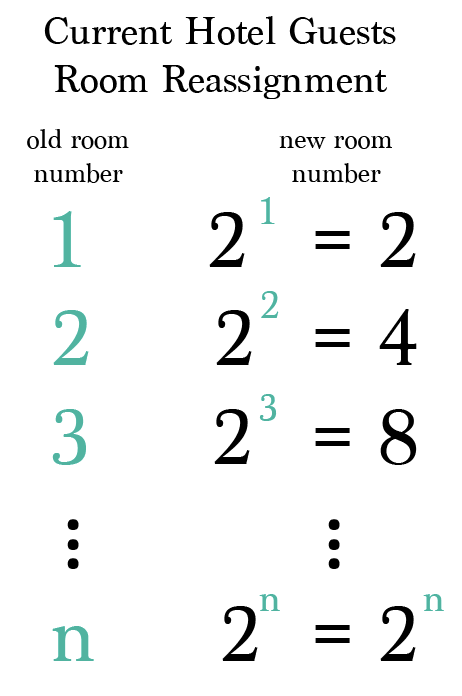
mapping for current hotel guests

Bus #1’s Room Assignments

Then we’ll take the guests from the first bus and assign them to powers of the next prime number, which is 3, using their seat numbers as the powers.

For example in this first bus we’ll move the guest from seat 1 to 3¹ = 3, the guest from seat 2 to 3² = 9, and so on.
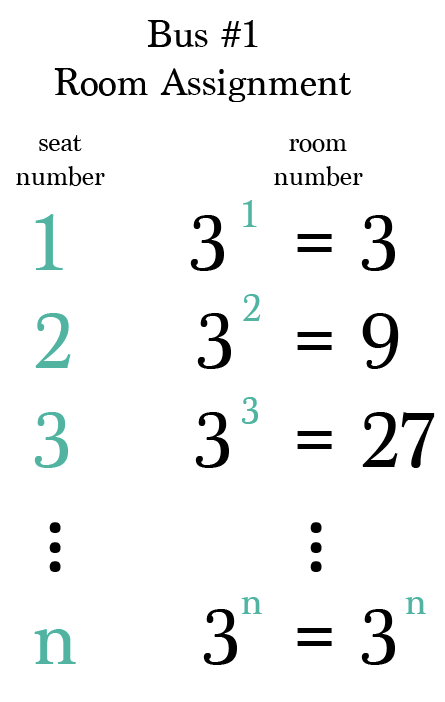
mapping for guests on bus #1

Bus #2’s Room Assignments

We’ll continue this pattern using the next prime number as the base for the next bus.
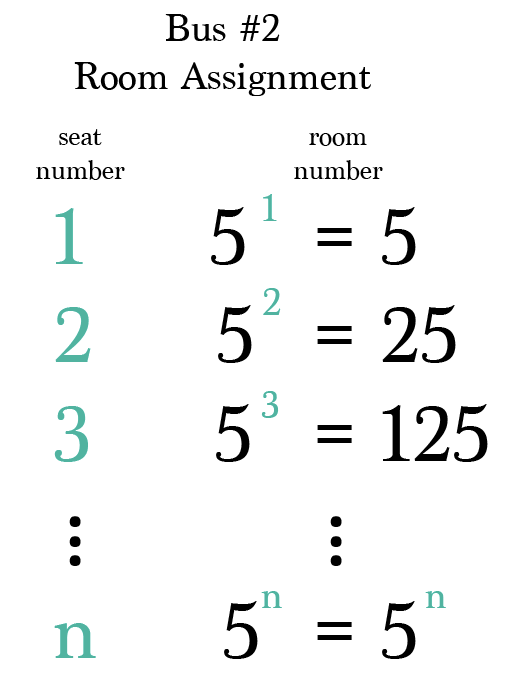
mapping for guests on bus #2

And So On…

Because we have an infinite set of prime numbers, theoretically we can continue using the next prime as the base for each of the countably infinite busses. And since raising the prime number to a new power produces a brand new room number, we can locate rooms for the infinite guests on each bus.

We did it! We’ve found a way to ensure a unique room for an infinite number of infinite guests!! And crazy as it may seem, we’ll leave a lot of rooms unoccupied in the process.

Other Puzzling Problems

Mathematics
Math
Riddles
Problem Solving
Infinity
Recommended from ReadMedium