
Solving an advanced probability problem with virtually no math
The Airplane Probability Problem
The following seems like a difficult problem, one you might find in an extra credit section of college statistics exam, but don’t be fooled the trickery lies in a common trap. In fact once you see past the trap, you can solve the problem with very little mathematics at all! Just simple logic.
Ready?
The Airplane Probability Problem
100 passengers board an airplane with exactly 100 seats. Everyone has a ticket with an assigned seat number.
However, the first passenger has lost their ticket and takes a random seat. Every subsequent passenger attempts to choose their own seat, but takes a random seat if their’s is taken.
Suppose you are the very last passenger to board the plane. What is the probability that you will get your assigned seat?
Did you figure out what the trick is??
The author of this problem uses one hundred passengers to confuse you! It’s an arbitrary number.
It’s too large of a number to compute the probabilities of by hand but not so large that you feel it’s impossible. Thankfully the underlying pattern exists whether we have a plane of 100 passengers, 1000 passengers or 10 passengers.
And that, my friends, is the key to solving this bad boy → reduce the number of passengers, play out the scenarios and see what patterns we find.
2 Passengers
Let’s start by using the minimum number of passengers: 2.
Let the following diagram represent the 2 seats on our imaginary plane:
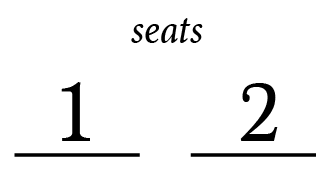
And these represent the boarding passes:
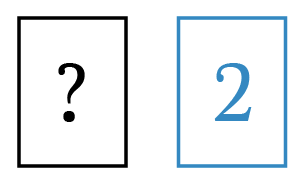
You have the blue boarding pass, which happens to have seat number 2. And our friend, who lost their ticket, has a boarding pass with an unknown number.
Our friend boards first. Not knowing which seat to sit in, he randomly chooses a seat.
Scenario 1: Suppose he chooses seat #1. That leaves you with seat #2, which is the correct seat! Yay!
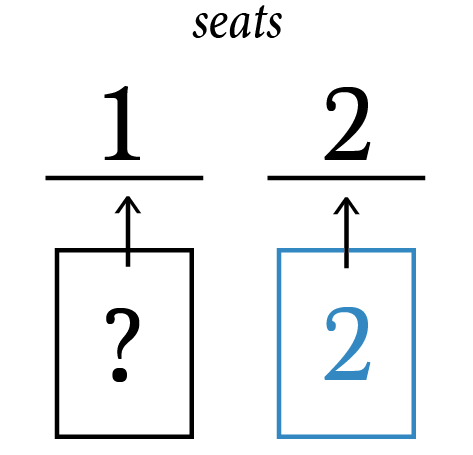
Scenario 2: He chooses seat #2, which leaves you with seat #1, the incorrect seat.
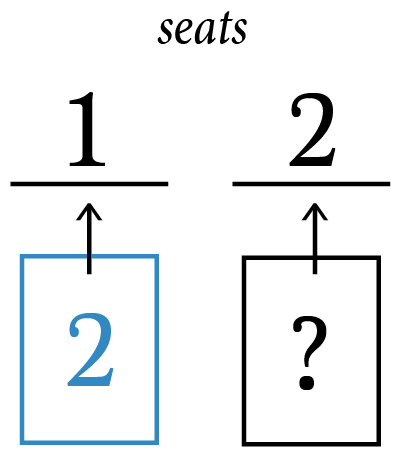
So for our super-simplified example, we have a 50% chance of getting the correct seat.
3 passengers
Okay, so that was a boring example.
How about 3 passengers? What happens then?
Again assume you have the blue boarding pass and are last to board.
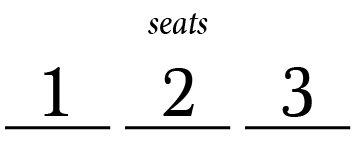
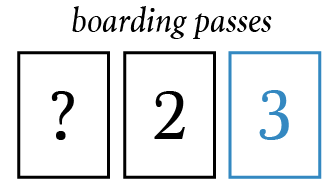
Scenario 1: The first passenger with the mystery ticket takes seat #1. Now passenger 2 will correctly take seat 2, leaving you correctly with seat #3.
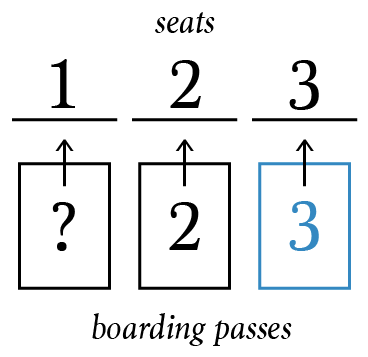
Scenario 2: The mystery ticket holder gets on board and in this scenario chooses seat #2. Now when the passenger with boarding pass 2 boards, she has the choice between seats #1 and #3. Let’s suppose in this case, she sits in seat #1. Now when you board, you are left with the correct seat #3.
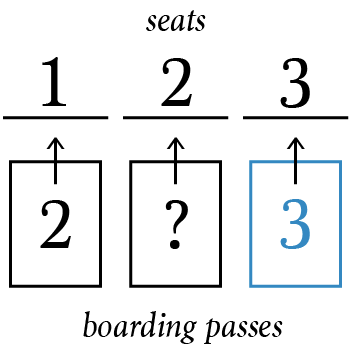
Scenario 3: Again mystery ticket holder chooses seat 2, but this time the passenger with boarding pass 2 selects seat #3 to sit in. When you board, you are forced to sit in the last available seat which is seat #1.
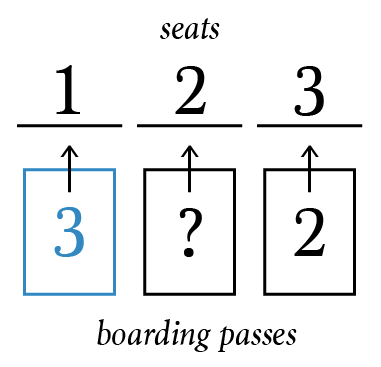
Scenario 4: The last scenario left is if mystery ticket holder chooses seat #3 to sit in. Then the passenger with boarding pass 2 will chooses seat #2 and you’ll be forced to take seat #1.
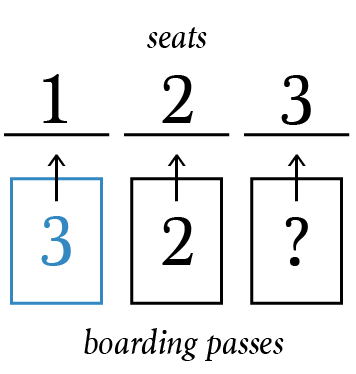
So overall, we had 4 possible scenarios. In two of the scenarios you end up with your designated seat, and in two you don’t. So with 3 passengers you still end up with a 50% chance of sitting in your assigned seat.
??? Passengers
If you’re still uncertain about the pattern, you can play it out with 4 passengers and so on, but at this point I think we can use our noggins to agree that adding more passengers won’t affect the outcome.
This arises from the premise that each passenger will choose the correct seat if available. Now if passengers were boarding and simply choosing seats completely at random, then the chance of you getting the correct seat would be 1 divided by the number of seats on the plane.
For example, in a plane with 100 seats you’d have 1/100 chance of getting your own seat if everyone was choosing at random. But under the conditions of this riddle each person is not choosing randomly, they are only choosing at random if their seat is taken.
This means half of the scenarios will sort themselves out (i.e. somebody takes the mystery ticket holder’s assigned seat allowing every passenger afterwards to take their assigned seat), while half will end unsorted with you in the wrong seat making the probability 1/2 for any plane occupancy.
See no formulas, no big numbers, just some sound logic, reasoning and a little counting.


