
Incredible New Photo of Uranus Reveals its Magnificent Ring Structure
A recently captured image of Uranus with the Webb Space Telescope has provided us with a fresh perspective on the seventh planet in our solar system. The photograph offers a clear view of Uranus’ ring system as well as the enigmatic polar cap situated at its northern pole.
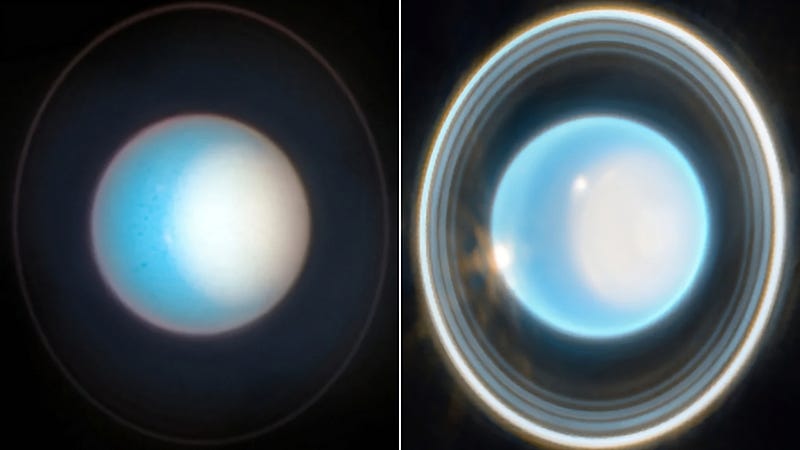
In a new photograph taken by the Webb Telescope, the planet Uranus looks like a strange cosmic eye. Fans of the books and TV series “The Expanse” may associate it with the ring formed by a protomolecule behind — nomen omen — the orbit of Uranus.
In the Webb Telescope image, the planet on a strong blue coloration. It is illuminated and surrounded by regular rings. This is only the third time they have been photographed directly. The first time their images were taken by Voyager 2 in 1986. Further photographs of Uranus with rings were taken in 2004 thanks to the Keck Telescopes working in Hawaii.
How many rings does Uranus have?
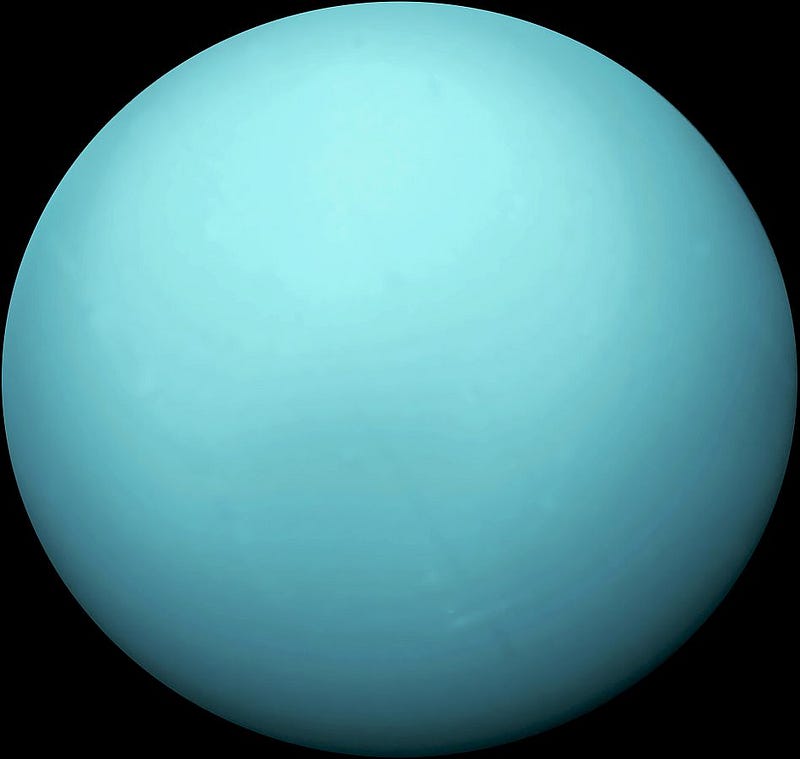
In the photographs of Uranus taken by the Voyager 2 probe, the lack of detail is striking. Uranus is light blue, slightly dappled with gray. The colors are not saturated. Virtually no special features are visible. Other shots show the thin rings of this planet. With Voyager 2, two additional rings of Uranus were discovered, and their total known number at the time reached 11.
In images from 21 years ago — that is, taken thanks to the Keck Telescopes — Uranus is already revealing some of its secrets. The globe is covered with stripes in various shades of blue and blue. One ring, resembling a thin rim, is clearly visible. However, after a careful look, one can also spot another, much thinner ones.
New photographs from the Webb Telescope perfectly show the rings of this globe. In total, as many as 11 of Uranus’ 13 rings can be seen in the image. Some are so bright that they have blended together in the photograph. The photograph was created using the Near-Infrared Camera (NIRCam).
.jpg)
Is Uranus the strangest planet in the Solar System?
Uranus stands out from the other planets of the solar system by one very unusual feature. Namely, it rolls in its orbit as if it were lying “on its side.” In other words, it spins at an angle of 97 degrees to the plane of orbit.
The result of such an alignment are strange — from the Earth’s point of view — seasons. On Uranus during the solstice, the sun is at the zenith above one of the poles. The other is plunged into total darkness. Day and night occur exclusively over the equator. Since Uranus orbits the Sun in 84 years, each pole has a polar day for 42 years and a polar night for another 42.
A photo taken by the Webb Telescope shows the north pole on Uranus.
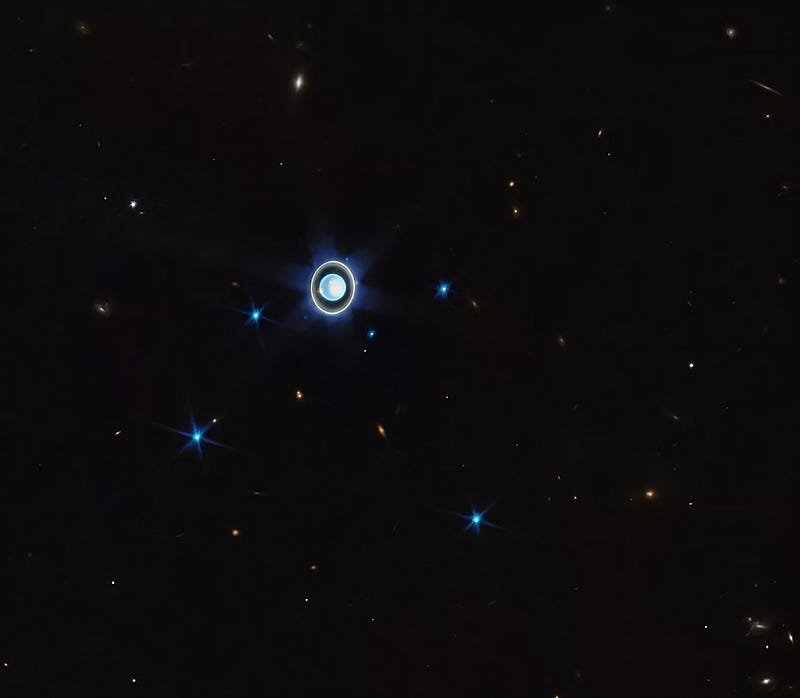
The mysterious ice cap at the north pole
In addition to the rings, the photograph taken by Webb allows scientists to take a closer look at the globe’s atmosphere, its clouds and some special features. Such as the polar cap (the large white spot on the right). It is unique to Uranus.
Researchers believe that it appears in summer, when the pole is directly illuminated by the Sun. In contrast, it disappears in autumn. Why does this happen? So far it’s not known, but a new photograph may help find the answer to this question.
The image also shows two clouds. One is at the edge of the polar cap, the other at the upper left corner of Uranus. Beyond them, in the wider view, some of Uranus’ 27 known moons are visible. Six of them are highlighted in the photograph below.
Cool that you made it to the end of this article. I will be very pleased if you appreciate the effort of creating it and leave some claps here, or maybe even start following me. It would be nice if you also left a tip! Thank you!