
IT HAPPENED TO ME
In the Path of a Catastrophic Tornado
I survived Black Friday in my hometown
The storm was now moving overhead. We were being hammered by driving rain, lightning, thunder, powerful winds, and hail the size of baseballs. If it wasn’t for the adrenaline, I would have been terrified. In the distance, we could now see that those skinny twisters had consolidated into a massive funnel that was moving toward us. Someone wondered if we should consider getting out of the glassed-in newsroom to find emergency shelter.
But we had a job to do.
Edmonton was hot and humid — two words you don’t often hear to describe this place. We had a few days of sweltering weather, oppressively hot during the day, with violent thunderstorms in the evening. That week, rainstorms dumped more than 12 inches of rain which caused flooding in low-lying areas and in underpasses. The rivers rose by as much as 26 feet up their banks.
We got our first taste of the violent power that these summer storms can pack just the day before. Powerful winds had brought down huge trees, some of which had been standing for generations, along with towering electric power poles. As a result, we all experienced blackouts while people cleaned up the mess the storm left behind, shingles torn from roofs, broken trees, and windows.
My friend stood at the back of his apartment just as the wind caught the glass screen door. He made a grab for it but shards of glass fell crashing onto his arm. He was bleeding heavily.
His roommate called me from his work and quickly said, “Don just called saying he’s bleeding a lot after some glass fell, I think from the door, and cut him. I’m at work. Can you check on him?”
I lived just around the corner so I jumped into my car and picked him up. He was in a lot of pain and blood was leaking through the towel he had wrapped around his hand.
The wind was howling as we drove through sheets of pouring rain. I drove far below the speed limit, afraid that a big tree branch would fall on my car. Despite a harrowing ride, we made it to the hospital safely, and he was now able to get checked out by a doctor and get stitches.
The next day, now known as Black Friday in Edmonton, was July 31, 1987.
I went in to work as usual at the radio station where I was a news announcer and reporter. It was a top 40 station with short news hits at the top and bottom of each hour. They were long enough to tell people what they needed to know but short enough that listeners didn’t get bored and change the station. While my job was primarily as a news writer, announcer, and reporter, everyone in the newsroom was able to pick up any of the other jobs like sports, weather, and traffic.
On this day, I was filling in for the traffic reporter. It was the start of a long weekend and the middle of summer and everyone wanted time off.
We were so short-staffed that my boss, the News Director would be handling the news segments that afternoon. He went by the initials CR on the radio, and like all one-name celebrities, everyone knew his name. We were allowed to call him Cec, like cease and desist, but no one ever called him by his real first name. Cecil would never fly in top-40 radio.
It was a typical summer Friday in the newsroom, relatively uneventful, but we knew we had the next big storm to talk about. After the bad weather the day before, there were warnings that it could be even worse because of the hot temperatures.
A Severe Weather Watch had been issued for the city a couple of hours earlier. Along with flooding from heavy rain, we were told there was the potential for tornados. Up until that day, we didn’t really play up the tornado threat during our weather reports because they are rare around the city but are more common further south.
At 2:45 pm the bells started ringing on our newswire teletype machine. Environment Canada was now upgrading the Severe Weather Watch to a Severe Weather Warning. Bad weather is now imminent.
My boss and I looked at each other, he rolled his eyes, shrugged his shoulders, and he calmly said “Here we go.”
There was no time to chat, we had a job to do. We pulled out our emergency phone list so we wouldn’t have to go searching for our experts when we needed them. This was before mobile phones or social media. We’d have to do what we could to keep everyone safe and up to date on what was happening.
My boss spoke to the deejay on the intercom, “We have breaking news and have to go Live after this song. We can’t wait for 3 o’clock.”
He trusted us, especially since the head of the newsroom was making the call. The loud, staccato percussion of the breaking news intro would grab everyone’s attention.
CR very calmly began with the latest information about the weather warning while I got the meteorologist from Environment Canada on the phone for a LIVE interview. He didn’t play anything down. He was watching the radar closely and told us that conditions “are ripe for some extremely vicious and violent weather.” That’s not something you hear from a meteorologist every day. And then came his warnings. “Stay away from windows. Stay indoors and consider waiting out the storm in your basement.”
Instead of just doing a normal traffic report, I had the police on the phone but they couldn’t add much to the story yet. There were no significant traffic issues to report but he told us to prepare for possible flooding in the underpasses. This wasn’t anything new, it’s something we had been saying all day. I quickly wrapped up the interview and threw back to the deejay for another song or two before our 3 o’clock newscast.
Our newsroom had a wall of glass facing south with a large, empty field across the street to give us a view as far as the eye could see. The storm was moving in from the south and the sky was ink-black as the clouds swirled. If Hollywood was going to make a horror movie about a tornado (and I’m sure there have been many) this is what I’d imagine the sky would look like. Occasionally, we’d see a flash of lightning shoot across the sky. We could tell that the storm was moving fast.
I had never seen a tornado with my own eyes, so it was difficult to comprehend what I was actually witnessing. But suddenly there they were. Three or four skinny funnel clouds were dancing across the horizon, stretching from the sky to the ground. I could only imagine the damage they were inflicting.
I tried to remain calm but my adrenaline was pumping, and I was speaking in an almost breathless staccato. I had a few more minutes to calm down before we went on the air live again.
And then the sounds of the newswire alarms rang out but we already knew what it would say.
The weather office had now upgraded conditions to a Tornado Warning, the highest severe weather warning we would ever receive.
Both of us were experienced in news, especially CR who had more than a decade on me. While we never had to deal with a weather emergency like this, we knew what to do. We split up the list and began calling guests to get on the air as soon as we could. Our microphones were live and we just started talking, throwing back and forth to each other as we struggled to stay on top of this developing story.
The newsroom was buzzing with energy, the phone lines were lighting up, and the newswire alarm was going off every few minutes with new information. We would rip the wire copy directly from the printer and just start reading it cold, there was no time to preview our script.
Like a trigger, the more we talked about the emergency on the air, the more our phone lines lit up. They were now constantly blinking lights. People from other departments rushed into the newsroom offering to help us out. With the phones ringing nonstop, we had them answer the calls.
We had frantic callers describing what they were seeing with terror in their voices. Entire neighborhoods were wiped out. This was the middle of summer so luckily kids were on summer vacation, otherwise they would be heading home from school right now.
We heard from people in the town of Leduc and then in the nearby farming town of Beaumont. At least one F2 tornado had started to carve out a path of destruction. But just how many tornadoes were out there? One thing we did know. Edmonton was next.
The storm was now moving overhead. We were being hammered by driving rain, lightning, thunder, powerful winds, and hail the size of baseballs. If it wasn’t for the adrenaline, I would have been terrified. In the distance, we could now see that those skinny twisters had consolidated into a massive funnel that was moving toward us. Someone wondered if we should consider getting out of the glassed-in newsroom to find emergency shelter. My boss told the small group,
Anybody that wants to leave to find a safer place to wait out the storm can do that. But no I’m not going anywhere. I will stay as long as I can and get under my desk if I have to. There’s an important job to do.
The first-hand accounts were now pouring in. Homes and businesses were collapsing, and roofs were being ripped off buildings. Traffic was at a standstill with cars and trucks tossed across the main highway that crossed the tornado’s path. There was flooding on the streets, moving northward like a wave behind the storm front.
Witnesses described a series of explosions as homes and businesses were blown apart. There were flashes of light as electricity poles were snapped in half, in a shower of sparks plunging entire neighborhoods into darkness, even though sunset was still hours away. Later, survivors would talk about huddling in their basements for protection as their homes were being torn apart overhead.
Suddenly someone yelled out, “The tornado is changing direction!” A shiver went through me as I looked toward the wall of glass. But instead of seeing the monster bearing down on us, the giant funnel started drifting east as it continued its northern trajectory. It would miss us completely.
Unfortunately, I feared it was now heading toward Strathcona County where my family and friends all lived. That is where I grew up and I knew that nothing like this had ever hit my hometown before. Now my family was still there with a killer tornado headed their way. I just hoped they would be safe.
While we knew that the worst of the storm was now going to miss us, it didn’t put a damper on the energy in the newsroom. The phones continued to ring off the hook and we were Live on the air telling people everything we knew about the destruction. We knew that there were casualties but we had no idea how many. We kept repeating the warnings to stay inside, seek shelter in a basement if possible and stay away from windows and doors. Ironically we said that while we were staring out the massive windows in front of us.
This was a time when radio was at its best, better than TV. People were listening to us in their homes and in their cars, desperate for information.
The tornado actually skirted around our area, carving a path of destruction for more than 20 miles along the eastern edge of the city from the Southside to the Northside.
When it was over 27 people were dead and more than 600 others were injured.
I had to wait until hours later, but I learned that everyone in my family was okay. They all had their stories to tell, but no one was hurt. One of those seriously injured though was the younger brother of one of my best friends. He had been working in an industrial shop on the southside when the building’s roof caved in trapping him and breaking his back. But he was a survivor.
His was just one of the hundreds, no, thousands of stories being told in Edmonton that day. We heard many of them as we stayed on the air for more than seven hours straight. When the electricity shut off we were left with just emergency power, enough to keep us on the air, but we had to do all of our interviews live. We couldn’t roll our reel-to-reel tape recorders.
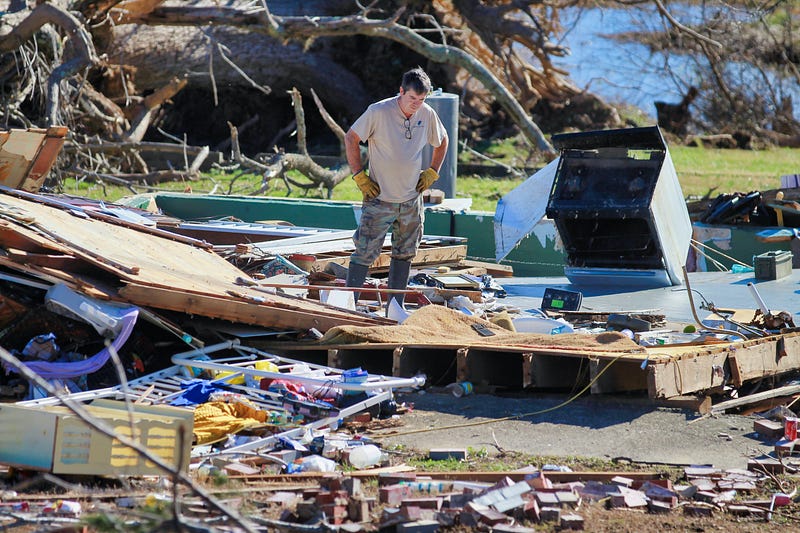
In the weeks that followed, a massive cleanup operation would get underway. Thousands of federal, provincial, and civic workers along with volunteers pitched in to help the city recover from this natural disaster. The extent of the damage was unbelievable.
I made my way out to my friend’s family farm to help them clean up their property. Near the farm were several oil refineries and as I slowly drove past, I was shocked to see some of the enormous oil storage tanks had been ripped off their concrete foundations and some had been flipped over like toys. There were huge swaths of trees that had been flattened and there was debris everywhere. Splintered wood, pink insulation, and twisted metal were scattered, even in areas where there wasn’t a home or building nearby.
I had never seen so much destruction. We learned that the winds had reached 418 km/h or 259 mph. It was an F4 tornado and it remained on the ground for about an hour, unleashing its fury on the city that had never seen anything like it before.
Here’s a story I wrote about another major news event that put me in the path of danger.