
In The Eyes of Love
A story of two American brothers, abandoned by their parents, adopted by residential care workers

Richie was unhappy with my choice of words, and so he threw his sneakers to the end of the couch, stood, and marched upstairs to his room. Laura put her arms around my neck, gave me a kiss, and said that somehow we would make it through this latest family crisis.
I breathed in deeply and realized she has had to say that to me quite often over the past ten years, and thankfully, so far — she had been right.
We were in the living room downstairs, and suddenly the lights flickered again. The wind gusted furiously against the sides of the house, causing a creaking from the strained wood. The snow was bombarding us now, building up at the rate of an inch or more per hour.
Ice had already encrusted the power lines, the streets, and the trees; and our Harris had left us for the night.
Harris was now eighteen years old, but I was still having a hard time letting him go.
His brother, Richie, was now fourteen years of age and was having similar, albeit different, separation anxieties due to his brother’s departure. Harris now had his own “pad” with two of his friends, which was an hour further inland from our home along the coast in Massachusetts.
The weather would be worse out there. Harris could not find it in his sense of life presently to spend the stormy night at our home. He had decided he needed to go “home” to his friends.
Laura was gently running her fingers through my hair to calm me, and then we heard a large crash from upstairs. I immediately considered that a branch had just crashed through the roof.
“Richie!” I shouted, grabbing the flashlight from off of the end table, just in case, and ran upstairs.
As I rounded the doorway to his room, expecting to see a snow-covered tree covering his bed, I found Richie in his closet, rummaging through an old suitcase. I recognized it as one which I had given to Harris years back. Richie had pulled it off the top shelf of his closet and let it drop to the floor.
“Harris said I could have his stuff,” Richie said, despondently. My first thought was that it was unlike Harris to give anything away.
I came over to Richie and knelt on the floor beside him and peered at the open suitcase. “What’s in there?” As he sorted through the items, he answered, “His old baseball trophies, his old uniforms … stuff like that.”
I began sorting through the vast collection of personal treasures to help my youngest to decipher this newly discovered archeological find, which chronicled his brother’s life.
There were baseball cards of Harris’s favorite players, the baseball from his team’s quest for the Little League World Series title from when he was only eleven, which had been signed by all the players and coaches; even his medals from Boy Scouts. Finally, I saw an odd assortment of magazines and old souvenirs and relics.
“I wonder why he didn’t take these with him?” Richie asked.
I could not think of an appropriate response. Finally, I said the first thing which seemed to make sense. “Maybe because he wasn’t ready to leave home altogether.”
“When he comes back for them, should I give them back or tell him they are mine now for keeping?”
I tousled Richie’s hair, then looked into his eyes and smiled, even though there was a sullen concern in my own eyes. “I know how much you are going to miss him, Richie. If it helps to know, we are going to miss him just as much.”
He looked up at me with his soulful blue eyes. “I guess so.”
I could see the moisture building in his stare and that familiar pained expression. I knew my youngest was a mere wisp away from crying but had been trying to hold it back.
I remembered when Laura and I first thought about adopting Harris and Richie. They had both been severely physically abused by their own father, which then laid the groundwork for further abuse and exploitation in their first few institutional placements.
Their mom had died from an overdose of meth, and their father had run away from the law.
Laura and I had positions at the residential childcare center when they were first brought there. Harris was nine, and Richie only five. We became bonded to them quickly, as we came to understand the extent of the trauma they had endured as youngsters.
Nobody else was in their lives, and soon, we knew we were the only two adults whom they could come to trust (and love?). After two years, we had become so attached to both of the boys, and it became apparent they had nowhere else to go.
“I hate him!” Richie said.
I wrapped my arms around him and embraced him. He finally lost the battle at keeping his tears at bay, and I realized that this was the first time since they had been taken from their parents that Harris had left Richie behind.
The phone rang, sending a chillingly ominous trill through the air.
Richie glanced up at me with fear in his eyes. My first thought was that he was having another of his premonitions that something had gone horribly wrong.
Our mutual instincts were instantly confirmed when we heard Laura shouting from downstairs, “MY GOD!” Presented with further evidence of my terrible decision-making as a parent, I shook my head and jumped up. It had become exceedingly difficult with Harris knowing just what to do when it came to allowing our eldest the space he required.
Laura and I had many discussions over this issue — we both wanted Harris to have the freedom necessary to pave his own way into adulthood, and yet there were plenty of risks involved with such an outlook.
“Harris has been in an accident!” Laura shouted to us. “They’re rushing him to Plainfield Hospital!”
We quickly dressed, and get our belongings, and then drove carefully, yet with as much speed as prudent, through the snow and ice to the hospital. The wind and snow pushed the car to and fro at will.
“The roads could not be any worse if we were in the Arctic,” Laura said. Richie sat forward from his post in the back seat, peering out the windshield at the foot-deep coverage of snow.
My stomach did continuous summersaults the entire way as I clenched the steering wheel. To calm me, Laura kept her hand clamped to my forearm. The police had not given us much information to go on. Just that Harris’s car had rolled over into a ditch.
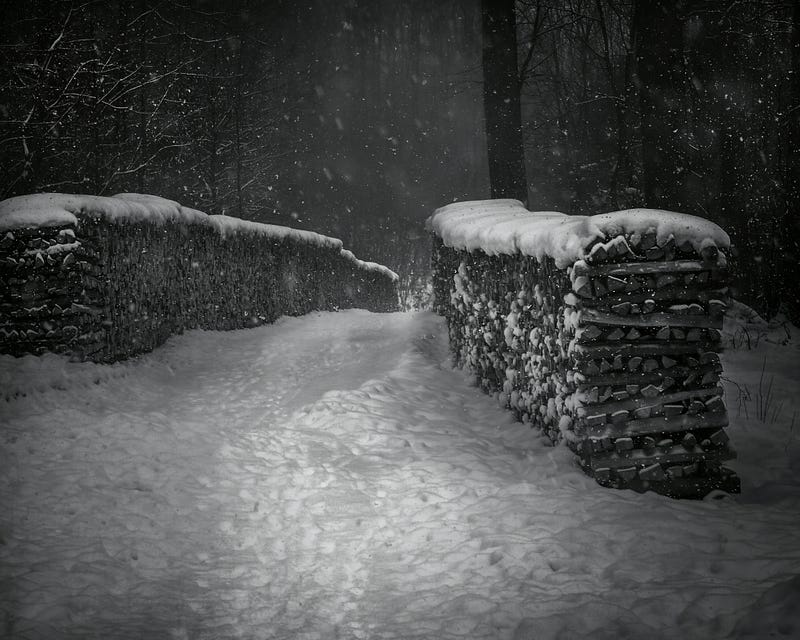
We wound up sitting in the emergency room all night while they worked on our boy. He was unconscious and had suffered a punctured spleen, three broken ribs, a broken leg, and a collapsed lung. There was also a possible concussion. The snow continued throughout the night, as God’s own omen regarding the condition our world was heading.
We drank weak and bitter coffee from the machine and tried paying attention to all those late-night talk shows.
Richie alternatively rested against my shoulder and stared out the large windows into the frozen parking lot. There were only a few other visitors to the emergency room that night. Most people had enough sense to stay safely at home.
Laura and I gave each other questioning glances, and I think we were both afraid of what the other wanted to say, or what we ourselves might say, and so we remained thankfully silent.
We had always allowed the boys to make their decisions and to learn about the consequences of their actions. Had we gone too far?
In the years we had them, so many things about their upbringing needed to be reworked and addressed. We often told ourselves that with all of our efforts, they were as normal as kids could be. Had it been our expectations, or was it our pride, that we should now blame?
Richie suddenly began to dig into his jeans pocket to check on something he hoped was still there. I was about to ask him what it was but decided not to.
The doctors had no news to report most of the night, and we tried to sleep. They would still not allow us in to see him.
At seven o’clock in the morning, as the deep winter sky began to initially brighten on a new day, the doctor rushed out from the unit to see us. Harris regained consciousness. We would now be allowed to see him.
We shuffled behind the doctor and rushed to his room. We came in and surrounded his bed.
“Harris!” Richie beamed.
Harris was in casts and traction, and both his eyes were black and blue. Nonetheless, he smiled and nodded to his little brother. Laura and I felt waves of relief flood over our souls as if we had just been released from a cold dungeon of despair back into the summer daylight.
He was okay.
Though months of convalescence lay ahead, his spirits were high, and the doctor said he should make a full recovery. He was ashamed of all of the attention which was being thrust upon him by us, the police, and medical staff.
Richie sat on his bed and combed his fingers through his brother’s disheveled hair.
Harris had protected Richie many times and had even saved Richie’s life once or twice in their home and at the residential settings, they had been placed before coming to live with us.
Laura and I took turns both asking questions, yet trying to be as supportive as we could.
The next few days were uncomfortable.
Harris came home and we all helped in his recovery. His first car had been destroyed, and he had to drop out of his college classes for the semester. On the third day of his rehabilitation, I walked into his bedroom. He was reading a comic book, and I noticed a red set of rosary beads with a crucifix hanging from the bedpost by his head. I did not recognize it and Harris saw me glance at it as I sat beside him.
“Richie put them there last night,” He said. I took the crucifix with Jesus into my hands and admired his strength. “Richie had taken it to the hospital the night of the accident. He found it in that old suitcase you gave me a long time ago.”
I stared down at Harris, and then let Jesus go, taking Harris’s hand into mine.
He continued, “Our mom had given it to me one Saturday after our dad had beaten all of us. I brought it to the foster home and the week after, when we were visiting mom at the apartment, she had been happy I still had it with me.”
Tears came to his eyes, and I had not seen Harris cry for over five years. “That was just a week before she had died.”
All of the trauma my boys had experienced in their young lives came to mind. I became filled with sorrow and anger.
“Harris,” I said, trying to find a tone of voice somewhere between empathy and authority. “You have to know something about the night of your accident.” He looked at me with complete attention. “I disagreed with Laura because she thought I was being foolish for allowing you to go out into the storm the way you did.” He became somber. I had his complete attention. “Do you think I should have stopped you from going?”
He immediately shook his head, limited as it was due to his casts. “No, dad …,” he stopped himself, suddenly aware of his own propensity for defensiveness.
He looked at me with the eyes of a small and hurt child, like the little boy he was when he and Richie had first come into the residential center.
On many occasions back then, when he thought he had disappointed either Laura or me with one of his learned and dysfunctional survival behaviors, of which there had been many between the two of them, I had been able to help him to move beyond them by staring at him with pure love.
He had seen for himself what it would take to learn to trust and depend upon others in a healthy way. Now, he turned my own question back on me. “What do you think?”
I found it exceedingly difficult to respond. I could have answered him directly, now with the hindsight of what would happen that night on the road, but that would be easy and unfruitful. Harris needed something more than to learn that common sense was best.
He needed the support to know that his own decision-making at this time was what counted. I realized this is what God Himself must think and feel when it came to answering prayers.
The truth was that we would not be there for many of the other important decisions Harris would be making in life. It was then I found the words he needed most to hear from me right now.
“I think it is important that you realize you are an adult now. Your mom and I can’t make your decisions for you anymore.”
I saw a sudden look of realization wash across his swollen face. Feeling relief, he answered, “You never really did, dad. You used to allow Richie and me to make our own decisions when we could. We mostly learned right from wrong.”
He smiled, and then paused reflectively. “Dad, I think it was stupid for me to drive out in that weather. I was trying to prove to everyone that I was a man now. That I didn’t need to stay home anymore ….”
My first instinct was to say, “Who were you really trying to prove this to?” Instead, I nodded, smiled, and then reached over and kissed him on the forehead.
About four months later, Harris had fully recovered and was back at college. I have questioned myself many times about having made the right decision that stormy night and Laura has helped me.
We are firm believers in the inherent goodness of our children — they are smart, loving, and have a great capacity to absorb truth and use their heads.
Some lessons in life are tough; others are dangerous, and God help us all, but some may even be fatal. We cannot protect our children from life itself.
They must learn the hardest lessons by themselves or else we diminish their maturation, progress, and autonomy. We can only be there for them as sounding boards, many times even in light of their youthful ignorance.
About a year later, Harris was visiting us for the weekend from college, and Richie wanted his brother to drive them both to the lake to go ice skating. Harris had spent a good deal of time during the weekend with his high school friends and had promised Richie he would take him this Sunday before he had to return to college. It was snowing and getting increasingly heavy.
Harris had always been Richie’s ultimate hero, and he hated to disappoint his younger brother in any way, and so when he had promised Richie they would go ice skating at the lake this weekend, it had become a priority for both of them.
I could tell Harris was debating the best course of action. He went so far as to get his coat and skates from the closet. Laura gave me a stern glance, ready to protest. Richie was waiting by the front door, skates in hand. Harris looked back at me with uncertainty, and then suddenly he peered out the living room window.
I could see the wisdom of maturity lighting his face in an instant.
He staunchly shook his head, saying, “Richie, would you mind if we stayed home tonight. I don’t think it’s safe to be out there right now. The roads are looking way too bad for us to go out.”
Richie looked at me, ready to protest. Disappointment washed through him, but then suddenly relief. I realized Richie had the benefit of learning through Harris’s trial and error.
Richie smiled and pulled his coat off. “I think a good movie is coming on anyway.” He looked at me with his priceless smile. “Pop, can you make us some of your famous hot chocolate?”
In past years, this kind of disappointment could have led Richie to hours of pouting, and perhaps a tantrum or two. I silently thanked Jesus for having given my sons the ability to learn as they grow, along with the blessings of having brought me such a wonderful family. “Of course!” I said.
As I poured milk into a pot, Laura came in and gave me a hug and kiss. “That was a close one!”
“Maybe not as close as Harris made it appear,” I said.
Thank you for reading and for your time, which I know is valuable. If you enjoyed this, please share and applaud (up to 50 times!). Also, please follow me to see more of my new articles and stories.
If not already a member, join Medium for other extremely insightful articles and stories. Use this link below to support me and other great writers when you join:
Here is another of my short stories published in The Masterpiece.
And one of my articles on political commentary and satire:
To see more of my stories and articles, or to follow me, just click below:
Blessings of peace to you!


