
Improve your Trading with Elliott Waves — 2. Patterns
How to use patterns to “predict” the market
After talking about the basics of the Elliott Wave Theory in this story, I’ll talk about the Elliott Wave patterns. You’ll see how they can be used to “predict” the market.
How to “Predict” the Market Using Patterns
We can’t really predict the market using patterns, that’s why the word predict is between quotation marks. All we can do using patterns is increase our edge of making a profitable trade.
According to Elliott Wave Theory, patterns are well defined and must respect some strict conditions to be considered valid. These conditions don’t come from anywhere and have a meaning related to Fibonacci and human psychology.
That’s why we can use patterns to find a target where the price may go with high probabilities. Because it is not related directly to price, but more to psychology, and as a trader, you should know prices are impossible to predict, but human behaviors are.
Diagonals
Diagonals are patterns moving within two channel lines drawn from waves 1 to 3, and from waves 2 to 4. There are two types of diagonals, leading or ending, depending on where they form. If they form at the start of a wave, they’re called leading diagonals, else they’re called ending diagonals.
Diagonals follow the basic Elliott Waves rules, with some more rules:
- Leading diagonal subdivides into 5–3–5–3–5 structures (5 sub-waves, 3 sub-waves, 5 sub-waves, etc…).
- Ending diagonal subdivides into 3–3–3–3–3 structures.
- Leading diagonal can only form in wave 1 in an impulse wave, or in wave A in a zigzag (I’ll talk about zigzags later).
- Ending diagonal can only form during wave 5 or wave C of a zigzag.
- Diagonals must move within the two channel lines or be within 10–15% of the total movement.
- The trend lines must converge, slope in the same direction.
- Cannot be horizontal.
Contracting Diagonal
A contracting diagonal is a pattern where wave 3 should be shorter than wave 1, wave 4 should be shorter than wave 2, and wave 5 should be shorter than wave 3. In the following picture, the diagonal is the black line. The blue line represents the subdivisions.
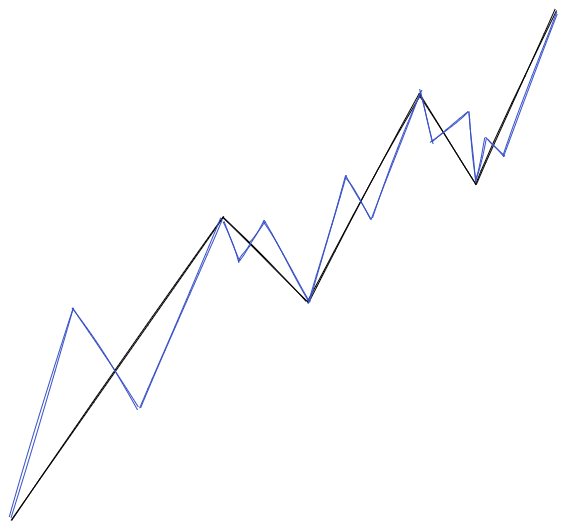
As you can see, a diagonal can be a complete impulse wave, depending on the scale you’re looking at it.
Expanding Diagonals
They’re the opposite of contracting diagonals, meaning wave 3 should be longer than wave 1, wave 4 should be longer than wave 2, and wave 5 should be longer than wave 3.
Predictions Using Diagonals
- If wave 1 is a leading diagonal, wave 3 may be extended.
- Chances are that after an ending diagonal, a strong reversal may follow.
- If wave 5 is smaller than wave 3, a strong reversal may follow a contracting diagonal. It’s called a truncation.
- Diagonals follow Fibonacci ratios. It can be used to forecast their target price and the length of their waves.
Zigzags
Zigzags are corrective structures.
Simple zigzags are composed of 3 waves labeled A-B-C. There are also double zigzags and triple zigzags. They are just two or three zigzags bonded together with small impulsive waves between them.
Simple zigzags follow some rules:
- Wave B may not move beyond the start of wave A.
- Waves A & C must subdivide into 5 sub-waves.
- A zigzag can include one diagonal, either in wave A or C.
- Wave B can be any 3-wave corrective pattern.
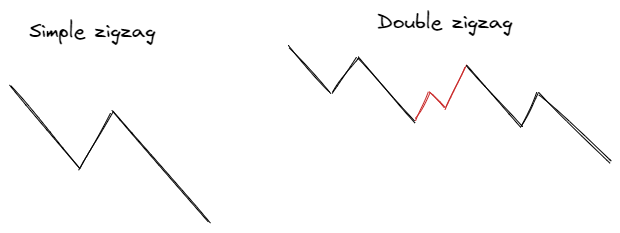
Predictions Using Zigzags
- Wave A is usually the same length as wave C.
- Zigzags follow Fibonacci ratios. It can be used to forecast their target price and the length of their waves.
Flats
Flats are corrective patterns labeled A-B-C. They can be used to know if the trend is strong or not as the stronger the trend is, the shorter they are.
They follow some rules:
- They subdivide into 3–3–5 structures.
- Wave A cannot be a triangle (the next pattern I’ll talk about).
Regular Flat
A horizontal flat because wave B ends at the start of wave A and wave C ends at the end of wave A.
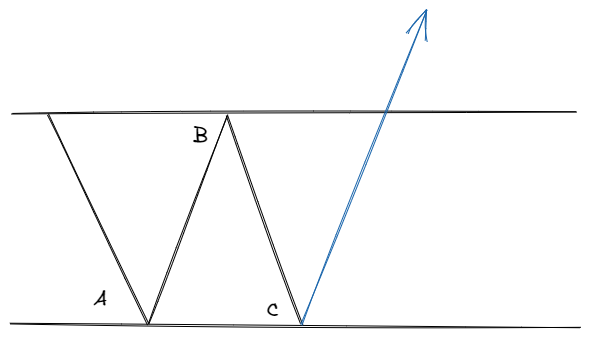
Expanded Flat
Wave B ends beyond the start of wave A and wave C ends beyond the end of wave A.
Lengths of the waves follow Fibonacci ratios (Wave C is between 123.6% — 161.8% of wave A-B and wave B is between 105% — 138% of wave A).
Running Flat
Wave B ends beyond the start of wave A and wave C fails to end beyond the end of wave A.
Lengths of the waves follow Fibonacci ratios.
Predictions Using Flats
- After the end of a flat, the main trend is usually back.
- Flats follow Fibonacci ratios. It can be used to forecast their target price and the length of their waves.
Triangles
Triangles are corrective patterns labeled A-B-C-D-E. Triangles move within two channel lines drawn from waves A to C to E, and from waves B to D.
Triangles follow some rules:
- Most of their subdivisions are zigzags.
- They can include a maximum of one complex corrective structure (a flat for example).
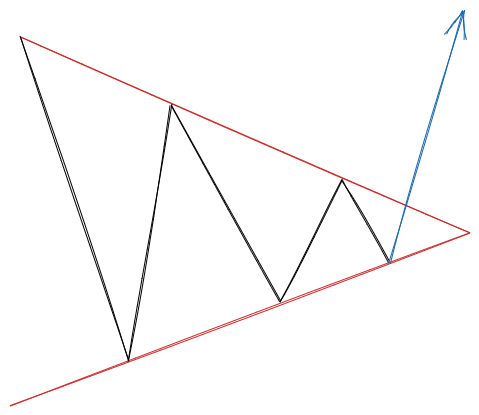
Predictions Using Triangles
- After the end of a triangle, the main trend is often back. But it can also reverse as triangles traduce some uncertainty.
- Triangles follow Fibonacci ratios. It can be used to forecast their target price and the length of their waves.
Final Note
As you can see, there are a lot of patterns with many rules to know. But once you master them, you will be able to make predictions or at least use them to validate the trend.
You’ve also seen they follow Fibonacci ratios. For more information about retracements and extensions following Fibonacci ratios, check the previous story of the series.
To explore more of my trading stories, click here!
If you liked the story, don’t forget to clap and maybe follow me if you want to explore more of my content :)
You can also subscribe to me via email to be notified every time I publish a new story, just click here!
If you’re not subscribed to medium yet and wish to support me or get access to all my stories, you can use my link:
A Message from InsiderFinance

Thanks for being a part of our community! Before you go:
- 👏 Clap for the story and follow the author 👉
- 📰 View more content in the InsiderFinance Wire
- 📚 Take our FREE Masterclass
- 📈 Discover Powerful Trading Tools