
Improve your Trading with Elliott Waves — 1. Basics
Have you ever heard about Elliott Waves Theory? It is interesting to know it because it can greatly help in making your trading decisions.
What is Elliott Waves Theory
According to Ralph Nelson Elliott, market prices move cyclically in impulsive and corrective waves.
Each impulsive movement is followed by a corrective movement; it corresponds to one cycle. When a cycle ends, another begins. This is true at any scale, any timeframe.
How Elliott Waves help trading decision-taking
Elliott Waves analysis provides a context for market analysis. They help you to identify the trend and can even be used for forecasting.
Elliott Waves analysis is universal (even if it works less well with some assets) and timeless. It has always worked and should continue to work in the future.
It is based directly on price action. You don’t even need to check Japanese candlesticks through your analysis (even if it’s better to check them to confirm or help decision-making).
Eliott Waves basics: a complete cycle
As I said earlier, a cycle is composed of an impulsive movement followed by a corrective movement. A cycle forms a sub-wave on a bigger scale: this is the scale principle.
In a cycle, an impulsive movement is composed of 5 waves, and a corrective movement is composed of 3 waves.
Impulsive movement
In an impulsive movement, 3 waves are impulsive waves going towards the main direction of the impulsion, and 2 are corrective waves. We label these waves from 1 to 5.
These waves follow some rules:
- Wave 1 is impulsive.
- Wave 2 is corrective. It cannot retraces more than 100% of wave 1.
- Wave 3 is impulsive. It cannot be the shortest of the impulsive waves.
- Wave 4 is corrective. It cannot overlap with the price territory of wave 1 (except if it is a diagonal triangle pattern, but I won’t talk about it today).
- Wave 5 is impulsive.
In the image below, you see how an impulsive movement looks. You can check if you want, waves follow the rules I’ve talked about above. Thanks to Elliott Wave analysis (and supply/demand analysis), I opened yesterday a position on EURUSD that was closed today with profit, I’ve let it on the graph.
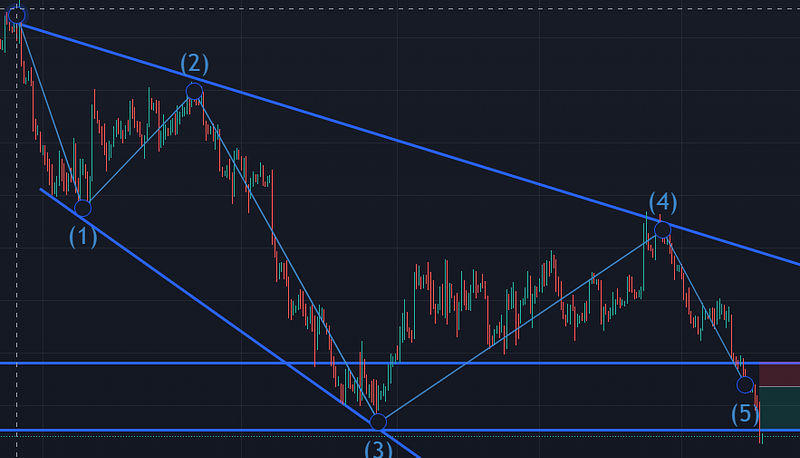
This picture is also a way of understanding the scale principle. Indeed, you can decompose each wave into multiple sub-waves following Elliott Waves Theory.
Corrective movement
A corrective movement is composed of at least 3 waves. 2 going towards the direction of the correction, and 1 going towards the other side.
The labels for the waves of the corrective movement are letters and depend on the pattern (but we’ll talk about patterns later).
A basic corrective movement is composed of 3 waves following rules similar to those of an impulsive movement (wave B cannot retrace more than 100% of wave A).
Extensions
In an impulse movement, one of the impulsive waves may be extended, meaning it will be longer and composed of more sub-waves.
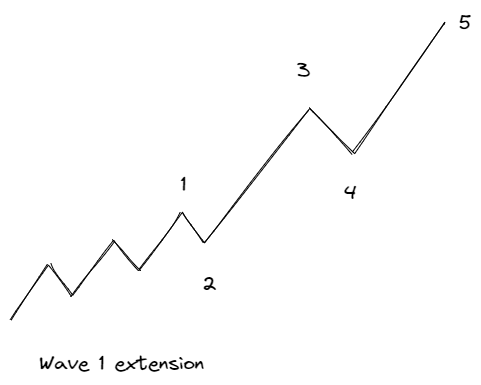
For example, above, wave 1 is extended so is composed of 5 sub-waves.
Fibonacci ratio
Elliott Waves Theory works along with the golden ratio. I won’t make a course about it, but know in nature we can find a lot of references to a particular number: 1.618.
This number is useful in Elliott Waves Theory because you can project the beginnings and ends of waves using either 0.5, 0.618, 1.618, or 2.618 ratios.
- Wave 2 — Retracement: 50%, 61.8%, 65%, 78.6%, or 88.6% of wave 1.
- Wave 3 — Extension: 161.8%, 200%, 261.8%, or 323.6% of wave 1.
- Wave 4 — Retracement: 14.6%, 23.6%, or 38.2%, 40% of wave 3.
- Wave 5 — Extension: Equal (100%) to wave 1 or 61.8% of waves 1+3.
Final note
There is so much to say about Elliott Waves Theory that I can’t say anything in one article. Now you have the basics.
In another story, I will talk about patterns. Be sure to follow me so you don’t miss this story!
To explore more of my trading stories, click here!
If you liked the story, don’t forget to clap and maybe follow me if you want to explore more of my content :)
You can also subscribe to me via email to be notified every time I publish a new story, just click here!
If you’re not subscribed to medium yet and wish to support me or get access to all my stories, you can use my link: