avatarRay Carnes

Free AI web copilot to create summaries, insights and extended knowledge, download it at here

4496

Abstract

h some definitions for context, then discuss some related behaviors and how to distinguish them.</p><figure id="7660"><img src="https://cdn-images-1.readmedium.com/v2/resize:fit:800/0*0aBe02dpxEjqth2U.png"><figcaption></figcaption></figure><h1 id="4d43">Context</h1><p id="fa4f">Here are a couple of working definitions that we’ll user within this article:</p><ul><li><b><i>Exposure</i> </b>(good) — management reporting on emergent needs and issues exposed during program execution.</li><li><b><i>Visibility</i> </b>(great) — proactive development program insights and continuous over-communication with other leaders.</li></ul><p id="97e0">Good managers work to <i>expose</i> issues and drive resolutions. Great leaders seek early <i>visibility</i> into potential challenges and work to mitigate them. Being a good manager isn’t a bad thing, but could you aspire to be a great leader?</p><p id="28df">So, the theme of this article is: <i>good managers excel at solving problems that great leaders avoid</i>. And although great leaders are more proactive, it’s not possible to anticipate every problem and solve it before it arises; great leaders need to be proactive AND implement lessons learned to avoid repeating mistakes. Great leaders also change the system when it doesn’t work. When a problem arises, they take action to ensure it doesn’t happen again.</p><p id="6b2a">Great leaders also create a culture of transparency, which encourages the system to identify problems early. They also create mechanisms for early idea generation. They are constantly questioning the <i>status quo</i> and they drive their teams to do the same.</p><div id="8c40" class="link-block"> <a href="https://medium.com/@jr.carnes.jr/58-leadership-visibility-and-management-exposure-f4d36f2cea11"> <div> <div> <h2>58. Leadership Visibility and Management Exposure</h2> <div><h3>Good Managers excel at solving problems that Great Leaders avoid.</h3></div> <div><p>medium.com</p></div> </div> <div> <div style="background-image: url(https://miro.readmedium.com/v2/resize:fit:320/1*HHEwLlyplZzyW1VyG2eG_w.png)"></div> </div> </div> </a> </div><h1 id="dd4f">59. Death by a Thousand Meetings</h1><p id="0b70"><i>How to avoid the dreaded “Death by a Thousand Meetings” by replacing your <b>total meeting oversubscription</b> with a set of <b>meeting productivity disciplines</b>.</i></p><p id="fda8">About twenty years ago, I worked on a large-scale program with many distributed, major teams and a large (also distributed) customer set. I led one of the major teams. I spent the bulk of my time in meetings. (Arg!) Meetings with the team members, meetings the team leaders, meetings with program peers, and meetings with customers.</p><figure id="650c"><img src="https://cdn-images-1.readmedium.com/v2/resize:fit:800/0*KW9SkTc_IUPKlEc3.png"><figcaption></figcaption></figure><h1 id="67a8">Total Meeting Oversubscription</h1><p id="209c">As the program ramped up, the number of meetings increased. I began tracking the amount of time I spent in meetings and was surprised that it (only) added up to 63 hours per week. (And because of the critical nature of the program delegation was not possible.) <i>What!</i></p><p id="58c9">My first meeting of the day was at 0515 PT (start of the day on the East Coast) and my last meeting ended at 1800 PT (end of the day on the West Coast). And as the team was widely distributed across the country, almost every meeting was virtual, via Webex.</p><p id="a638">The <i>good news</i> is that many of the meetings were overlapped on my scheduled, so I did have some time to actually work during the day. (<i>Wait, that was the good news?</i>) My assistant was constantly amazed (and amused) to see me in the office participating in up to three simultaneous Webex meetings. One on my conference table phone, one on my desk phone, and one on my mobile phone… with a separate window for each on my laptop.</p><p id="77b4">The meetings dragged out for hours. I was constantly time-dividing and listening for concerns or issues, and waiting to provide my team status or input on a change request. They were unproductive experiences. Unorganized gatherings with unprepared people providing status on projects or asking for decisions without proper supporting work or forward recommendations.</p><p id="b1e1">The tit

Options

le of this article, “Death by a Thousand Meetings” isn’t much of an exaggeration. In this mode I went through a thousand meetings about every four months. The really bad news is that this was a ten-year program. Something had to be done.</p><p id="4114">I was always wondering, “<i>why do I need to be in this meeting?</i>” The experience drove some valuable lessons-learned and improved practices. At first, I applied them to the meetings I organized, followed by collaborative efforts to influence discipline in the meetings called by others. It took some time, but we finally made an impact with a <i>set of</i> <i>schedule and</i> <i>meeting disciplines</i>.</p><p id="5f52">Moving forward to today… ‘yes’ some meetings are necessary, but we need to make them a <i>useful </i>tool for <b><i>communication </i></b>and <b><i>collaboration </i></b>rather than a <i>useless </i>time sink. If you’re in a similar situation, focus your improvements in two areas: the first is an overall model for scheduling of meetings, and the second is a set of ground rules for the conduct of meetings.</p><div id="169f" class="link-block"> <a href="https://medium.com/@jr.carnes.jr/59-death-by-a-thousand-meetings-70c717fecced"> <div> <div> <h2>59. Death by a Thousand Meetings</h2> <div><h3>How to avoid the dreaded “Death by a Thousand Meetings” by replacing your total meeting oversubscription with a set of…</h3></div> <div><p>medium.com</p></div> </div> <div> <div style="background-image: url(https://miro.readmedium.com/v2/resize:fit:320/1*vbCdd-NHAxHMAo0mTh0JyA.png)"></div> </div> </div> </a> </div><h1 id="ca53">61. How Leaders Answer Tough Questions</h1><p id="d239"><i>I have all the right answers… if you only ask the right questions?</i></p><p id="420c">I’ve been in countless meetings where I asked a simple ‘<i>Yes</i>’ or ‘<i>No</i>’ question? And I’m always surprised (and disappointed) that most presenters can’t help themselves. Perhaps they want to show how smart they are… and begin to elaborate the full background… and five or so minutes later… if you are lucky… they may finish their response with ‘yes’ or ‘no’.</p><figure id="c19c"><img src="https://cdn-images-1.readmedium.com/v2/resize:fit:800/0*UsWyXr28KMc1SHbK.png"><figcaption></figcaption></figure><p id="2b28">As a leader, I already trust that you know the details. That’s why I hired you. Now, your job in this meeting is to just <i>answer the question</i>. Say ‘yes’ or ‘no’, and then ask if I’d like any additional background. Otherwise, let’s move on and get back to work.</p><p id="6f14">Now, it isn’t always that easy. Over the years, I’ve been asked a wide range of questions. In this article, I’ve compiled some helpful tips that have worked for me in a variety of situations.</p><div id="2b52" class="link-block"> <a href="https://readmedium.com/how-to-answer-tough-questions-5acc81b34e37"> <div> <div> <h2>How to Answer Tough Questions</h2> <div><h3>I have all the right answers… if you only ask the right questions?</h3></div> <div><p>medium.com</p></div> </div> <div> <div style="background-image: url(https://miro.readmedium.com/v2/resize:fit:320/1*wyRlVaquVS6F5xpBdYY_3Q.png)"></div> </div> </div> </a> </div><h1 id="51a3">Thanks for reading…</h1><p id="5f76">If you like what you’re seeing, don’t forget to add <b>claps</b> and <b>follow </b>me on Medium. You can also <b>subscribe </b>to get an email for new stories.</p><p id="4d7e">And check out my book, it’s published as a collection of stories on Medium.</p><div id="fc34" class="link-block"> <a href="https://medium.com/@jr.carnes.jr/model-build-learn-lead-chapter-index-3d9832133fd3"> <div> <div> <h2>Model, Build, Learn, LEAD! (Book Chapter Links)</h2> <div><h3>Lessons from a Lifetime of Developing Leadership Disciplines.</h3></div> <div><p>medium.com</p></div> </div> <div> <div style="background-image: url(https://miro.readmedium.com/v2/resize:fit:320/0*4pJ7t3NPBuQxq4H5.png)"></div> </div> </div> </a> </div></article></body>

Improve your Disciplines for Communicating like a Leader

Let’s face it… Communicating effectively and efficiently is hard… but it’s an essential skill for leaders and leadership.

Are you interested in improving your disciplines for communicating with or as a leader? Explore multiple dimensions of these disciplines through this collection of articles.

It’s an excerpt from my book on software development leadership and a good starting point for anyone interested in refining their leadership abilities. (The embedded link to the full chapter index is at the end of the article.)
Disciplines for Communicating like a Leader

The following four articles can help sharpen your disciplines for Leaders Communicating with Leadership.

  • (57) How Leaders Establish Confidence and Build Trust
  • (58) Leadership Visibility and Management Exposure
  • (59) Meetings, Meetings, Meetings
  • (61 How to Answer Tough Questions

You can read the abstracts in this collection, below. Click on any embedded link jump to the full article. If you like what you’re seeing, please spend a few minutes reading and thinking about the content. Comments are always welcome.

57. How Leaders Establish Confidence and Build Trust

Confidence and trust of customers come from your understanding of and ability to communicate your development baselines.

The real world is incredibly complex and we’re developing solutions for increasingly complex problems that need to interoperate within this complex world. With that as context, mastering complexity, managing programs, establishing confidence, and building trust are all big challenges.

As a leader, your confidence comes from *your* understanding of the program baselines. Let’s focus on the major baselines that define every program — technical, schedule, and cost — and pose the following questions.

  • How complete is each of these baselines against the required scope?
  • How consistent are these baselines when compared to each other?
  • How well do you understand the underlying details of each baseline?
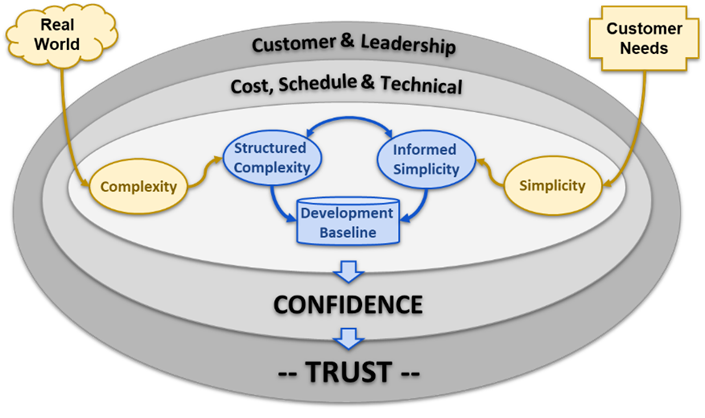
As a leader, you are accountable for communicating reliable insights on program performance. As you convey progress to commitments and quality of outcomes, your baseline confidence will translate into increasing stakeholder trust. (Conversely, your lack of confidence will manifest in a lack of trust.)

So, what can leaders do to better (1) model customers’ needs and real-world complexity, (2) define the executable baselines of a development program, and (3) leverage all that to build trust with senior leadership and customers. Let’s look at complexity and simplicity and describe the models you’ll need to construct and refine program baselines with confidence.

58. Leadership Visibility and Management Exposure

Good Managers excel at solving problems that Great Leaders avoid.

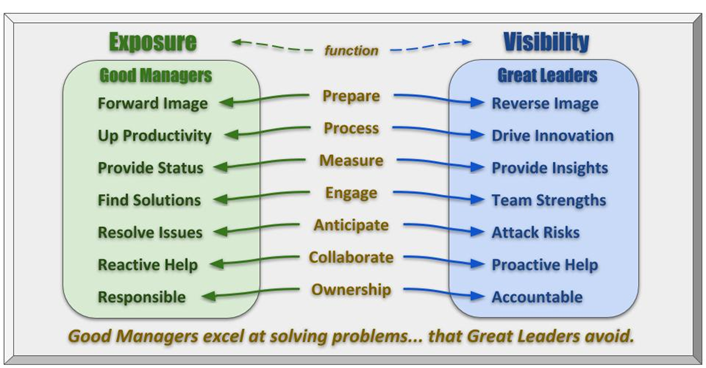
Let’s look at a couple of interesting concepts — visibility and exposure — and discuss relationships between and interaction with other leaders, both inside and outside the team. We’ll start with some definitions for context, then discuss some related behaviors and how to distinguish them.
Context

Here are a couple of working definitions that we’ll user within this article:

  • Exposure (good) — management reporting on emergent needs and issues exposed during program execution.
  • Visibility (great) — proactive development program insights and continuous over-communication with other leaders.

Good managers work to expose issues and drive resolutions. Great leaders seek early visibility into potential challenges and work to mitigate them. Being a good manager isn’t a bad thing, but could you aspire to be a great leader?

So, the theme of this article is: good managers excel at solving problems that great leaders avoid. And although great leaders are more proactive, it’s not possible to anticipate every problem and solve it before it arises; great leaders need to be proactive AND implement lessons learned to avoid repeating mistakes. Great leaders also change the system when it doesn’t work. When a problem arises, they take action to ensure it doesn’t happen again.

Great leaders also create a culture of transparency, which encourages the system to identify problems early. They also create mechanisms for early idea generation. They are constantly questioning the status quo and they drive their teams to do the same.

59. Death by a Thousand Meetings

How to avoid the dreaded “Death by a Thousand Meetings” by replacing your total meeting oversubscription with a set of meeting productivity disciplines.

About twenty years ago, I worked on a large-scale program with many distributed, major teams and a large (also distributed) customer set. I led one of the major teams. I spent the bulk of my time in meetings. (Arg!) Meetings with the team members, meetings the team leaders, meetings with program peers, and meetings with customers.

Total Meeting Oversubscription

As the program ramped up, the number of meetings increased. I began tracking the amount of time I spent in meetings and was surprised that it (only) added up to 63 hours per week. (And because of the critical nature of the program delegation was not possible.) What!

My first meeting of the day was at 0515 PT (start of the day on the East Coast) and my last meeting ended at 1800 PT (end of the day on the West Coast). And as the team was widely distributed across the country, almost every meeting was virtual, via Webex.

The good news is that many of the meetings were overlapped on my scheduled, so I did have some time to actually work during the day. (Wait, that was the good news?) My assistant was constantly amazed (and amused) to see me in the office participating in up to three simultaneous Webex meetings. One on my conference table phone, one on my desk phone, and one on my mobile phone… with a separate window for each on my laptop.

The meetings dragged out for hours. I was constantly time-dividing and listening for concerns or issues, and waiting to provide my team status or input on a change request. They were unproductive experiences. Unorganized gatherings with unprepared people providing status on projects or asking for decisions without proper supporting work or forward recommendations.

The title of this article, “Death by a Thousand Meetings” isn’t much of an exaggeration. In this mode I went through a thousand meetings about every four months. The really bad news is that this was a ten-year program. Something had to be done.

I was always wondering, “why do I need to be in this meeting?” The experience drove some valuable lessons-learned and improved practices. At first, I applied them to the meetings I organized, followed by collaborative efforts to influence discipline in the meetings called by others. It took some time, but we finally made an impact with a set of schedule and meeting disciplines.

Moving forward to today… ‘yes’ some meetings are necessary, but we need to make them a useful tool for communication and collaboration rather than a useless time sink. If you’re in a similar situation, focus your improvements in two areas: the first is an overall model for scheduling of meetings, and the second is a set of ground rules for the conduct of meetings.

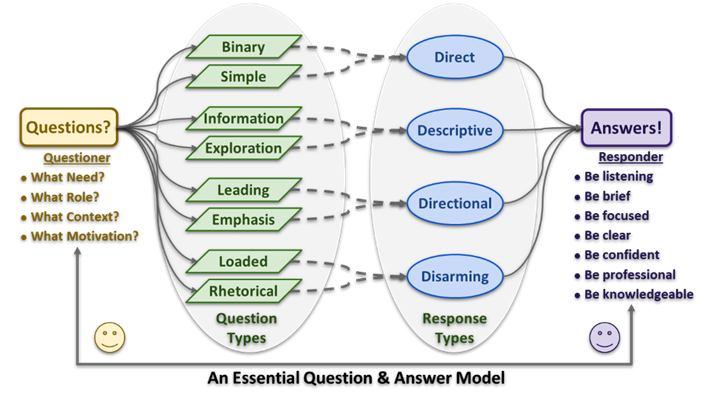
61. How Leaders Answer Tough Questions

I have all the right answers… if you only ask the right questions?

I’ve been in countless meetings where I asked a simple ‘Yes’ or ‘No’ question? And I’m always surprised (and disappointed) that most presenters can’t help themselves. Perhaps they want to show how smart they are… and begin to elaborate the full background… and five or so minutes later… if you are lucky… they may finish their response with ‘yes’ or ‘no’.

As a leader, I already trust that you know the details. That’s why I hired you. Now, your job in this meeting is to just answer the question. Say ‘yes’ or ‘no’, and then ask if I’d like any additional background. Otherwise, let’s move on and get back to work.

Now, it isn’t always that easy. Over the years, I’ve been asked a wide range of questions. In this article, I’ve compiled some helpful tips that have worked for me in a variety of situations.

Thanks for reading…

If you like what you’re seeing, don’t forget to add *claps* and *follow* me on Medium. You can also *subscribe* to get an email for new stories.

And check out my book, it’s published as a collection of stories on Medium.

Leadership Development
Communication Skills
Communication Style
Effective Communication
Recommended from ReadMedium