
How to Answer Tough Questions
I have all the right answers… if you only ask the right questions?
I’ve been in countless meetings where I asked a simple ‘Yes’ or ‘No’ question? And I’m always surprised (and disappointed) that most presenters can’t help themselves. Perhaps they want to show how smart they are… and begin to elaborate the full background… and five or so minutes later… if you are lucky… they may finish their response with ‘yes’ or ‘no’.
As a leader, I already trust that you know the details. That’s why I hired you. Now, your job in this meeting is to just answer the question. Say ‘yes’ or ‘no’, and then ask if I’d like any additional background. Otherwise, let’s move on and get back to work.
Now, it isn’t always that easy. Over the years, I’ve been asked a wide range of questions. In this article, I’ve compiled some helpful tips that have worked for me in a variety of situations.
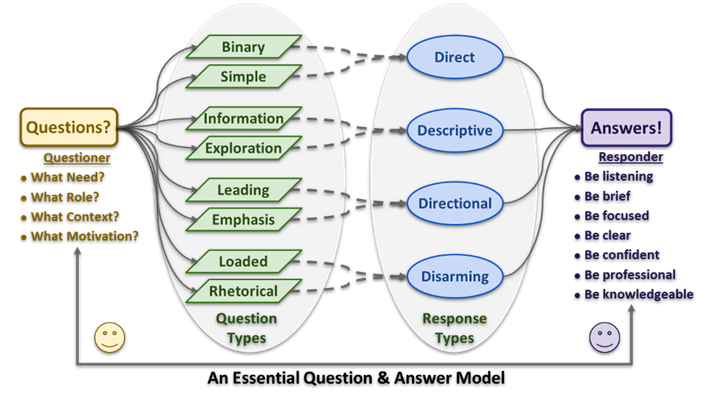
1. Simple Q&A Model
Answering questions is a valuable communication skill, and like many other skills, it starts with context and listening. Here’s a brief outline of the Q&A mental model and a definition its essential elements.
- The Questioner — Who is asking? Why do they want to know? What is their context?
- The Question — Listen carefully to the question. What type of question is it?
- The Responder — Do I know the answer? How should I respond?
- The Answer — Brief statements formulated for the questioner’s context.
2. Response Types
Below we’ll discuss four types of responses (direct, descriptive, directional, and disarming) that should cover the way to answer in most common question scenarios.
2.1 Direct Response
I use a direct response approach when asked the following.
- Binary Questions — require a one-word answer, such as ‘yes’ or ‘no’.
- Simple Questions — require a little more thought, but still a focused, direct answer.
When I’m asked a binary question, I provide a direct answer. ‘Yes’ or ‘No’. It’s harder than you think and usually requires pretty good discipline. For simple questions, I’m still give a simple, direct response and maybe with a little more background. Also, it’s tough to master. The key is to be short and to the point.
2.2 Descriptive Response
I use a descriptive response approach when asked the following.
- Information questions — access your knowledge about a particular topic.
- Exploration questions — clarify, get broader context, or delve into a specific topic.
These questions pull from my knowledge base, but they are *not* opportunities to provide a data dump. I’m working to understand who is asking the question and their perspective, then gauge the appropriate scope and level of detail for my response.
2.3 Directional Response
I use a directional response approach when asked the following.
- Leading questions — drive discussion in a particular direction or toward a specific result. Don’t get pressured into following the questioner’s track.
- Emphasis questions — are asked when the questioner knows the answer already, or an answer isn’t actually required. Such a question is used to emphasize a point or focus the audience’s attention.
I’m working to figure out where the question or line of questions is going, then I target an answer to short-cut to *my* objective without foot-stomping or derailing the flow. To be effective, I’ll need to use my insights into the questioner’s perspective (what is their context) and where they are attempting to lead the answers.
2.4 Disarming Response
I use a disarming response approach when asked the following.
- Loaded questions — are often posed as direct questions. Be sure to listen carefully. They may be attempting to drive you off-course to a different answer or result.
- Rhetorical questions — don’t really require an answer. They’re simply statements phrased as questions to make the conversation more engaging for the questioner.
My response will be a short statement of fact addressing the ‘real’ answer I need to provide, or even no-answer. I also use this approach when someone is angry and emotional. The phase, “have you considered xxx?” can work to get back on track. It’s also good when someone is bullying or attempting to prove to how smart they are. The goal isn’t necessarily to respond to the question but rather disarm the situation and move on.
3. Overall Approach
Taking a step back, I’ve used the following overarching approach to answers. With each question, consider these three options.
- If I know the answer, and I’m at liberty to respond, then I provide an answer as per the above.
- If I don’t know the answer, I say, “I don’t know” and that I will find out (and always follow-up).
- If I do know the answer but I’m not at liberty to respond, I tell them I can’t respond. (Most people will understand there are some things in business that you need to hold close.)
Additionally, I approach each question with the following qualities to ensure I’m always providing efficient and effective answers to even the toughest questions:
- Be professional… conduct yourself with decorum.
- Be listening… hear what is asked in context.
- Be knowledgeable… know your stuff.
- Be brief… crisp with your answers.
- Be focused… on-point with your answers.
- Be clear… respond from the questioner perspective.
- Be confident… confidence is contagious.
4. Leadership Challenge
No matter how well-prepared and well-disciplined I am, sometimes I get questions that aren’t quite on topic or are somewhat ambiguous. Don’t just jump-in and answer without the right context. Ask clarifying questions, then provide answers as discussed above.
And, occasionally, I get surprised by a ‘what’s the meaning of the universe’ question. I take a few seconds to compose myself and organize my response. I like to say ‘thanks’ and compliment the questioner. “Thanks for asking” or “That’s a great question”. Then I remember the lessons from above and engage the questioner.
Finally, over time, people may not remember the answers you give, but they will remember well you responded to the question. Good luck!
. . .
Thanks for reading!
If you like what you’re reading and want to see more, please add *claps* and *follow* me on Medium.
And don’t forget to check out my new book, Measure, Model, Learn, LEAD! It’s published as a collection of chapters on Medium.