
Imminent Collision of Two Supermassive Black Holes Discovered
Researchers have detected the impending collision of two colossal, singular entities known as supermassive black holes. Never before have these objects been captured when they were so close to each other.
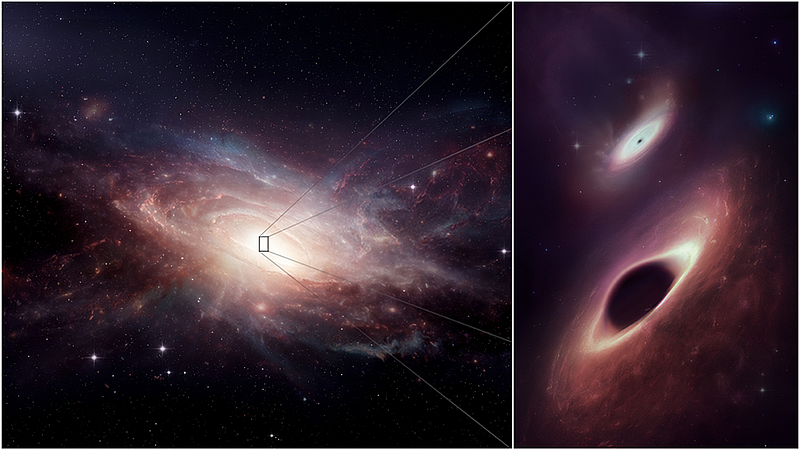
What does “close” mean on a cosmic scale? Supermassive black holes, which you can read about in the scientific journal The Astrophysical Journal Letters, are 750 light years apart. This is very little — at least in terms of the capabilities of the instruments with which we determine the distance separating such objects located in other galaxies.
The distance between them “is close to the limit of what we are able to measure, which is why the discovery is so exciting,” comments Chiara Mingarelli, one of the paper’s authors.
Both supermassive black holes are really powerful. The mass of one is as much as 200 million solar masses. The other is 125 million times heavier than our star. To provide context, the size of Sagittarius A*, a supermassive black hole located at the center of our galaxy, is estimated to be 4 million times the mass of our sun.
The location of these objects is well known
The discovery of the existence of colossal entities, known as supermassive black holes, in a specific location has been made by experts in the field. These behemoths have been observed within a galaxy, which was created through the coalescence of two separate galaxies, referred to as UGC 4211. The collision of these galaxies occurred at an astronomical distance from our planet, approximately 480 million light-years away. Interestingly, similar to our own galaxy, the Milky Way, these black holes are situated at the center of the merged galaxy.
They attracted all the surrounding matter — gases, dust, stars — as well as other, smaller black holes. This is how they reached such enormous sizes. It was not possible to observe them directly. However, both were surrounded by huge and very bright clusters of stars and heated matter that could be detected.
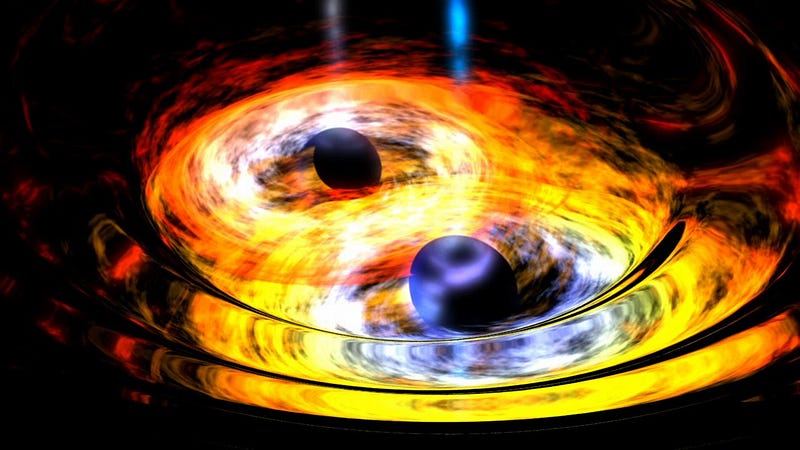
As the galaxies of origin collided, a gravitational pull was initiated between the black holes. What will happen to them next? They will begin to spin around each other, and their orbits will shorten. They will emit gravitational waves — or “wrinkles” of space-time — stronger than any ever measured. Until they eventually merge to form a single gargantuan black hole.
How were supermassive black holes discovered?
Detecting two black holes located simultaneously close to each other and very far from Earth was difficult. It required the use of as many as seven telescopes, both on Earth and in orbit. Previously, observing merging galaxies, scientists detected only one supermassive black hole in them. This is because, using a single telescope, it was difficult to say definitively what was at the center of the area under study.
This time the researchers made as many as twelve observations. And only by analyzing the data obtained from all of them did they determine that the distant galaxy contains as many as two giants much larger than Sagittarius A*.
How many pairs of supermassive holes are there in the Universe?
Scientists believe that there may be quite a few pairs like the one discovered 480 million light-years from Earth throughout the cosmos. They are probably the source of the strongest gravitational waves propagating through the Universe.
This indicates that the discovery is highly relevant to the gravitational wave astronomy that is currently developing. If supermassive black holes also frequently merged in the past, such events could enhance the so-called gravitational wave background. This is a hypothetical relic left over from past gravitational waves, similar to the microwave background radiation.
Scientists are trying hard to record the background of gravitational waves. It may provide us with information about the Universe even older than that provided by the microwave background radiation.
Source: EurekAlert, The Astrophysical Journal Letters
Cool that you made it to the end of this article. I will be very pleased if you appreciate the effort of creating it and leave some claps here, or maybe even start following me. It would be nice if you also left a tip! Thank you!


