Imagine I’ve Been Drinking
A song for us
Three days and nights later and I still feel hungover, except that the last alcohol I consumed was on Thursday night — about 20 ounces of beer, mainly Guinness.
No bounce in my step, and even my dog Max feels lethargic today, only his is due to being stung yesterday and having some Benadryl as a chaser. He’s eating and drinking fine (I say this to calm my anxious brain) and very alert. Maybe he also senses my own descent into something akin to despair.
Without trying to be offensive, I am done with religion. Not that I had much to do with it before last Friday, but I try to be open-minded about others’ beliefs — others, that is, who don’t try to push theirs on me or anyone else. Or others who ask me to pray for something. Not sure what I would pray to, since when I think of God, I see a small bust of a man in a straw hat — likely a Gay 90’s figure — with long sideburns, a pointy nose, and extremely piercing eyes that used to sit on my Jewish grandmother’s coffee table.
My association came from all the admonitions about God seeing everything I did. I don’t know. It feels like a helpless spiral of subjectivity and guilt. God sees; God punishes, and still, we have evils like T***P and his kin poisoning us with courts packed with “true believers.”
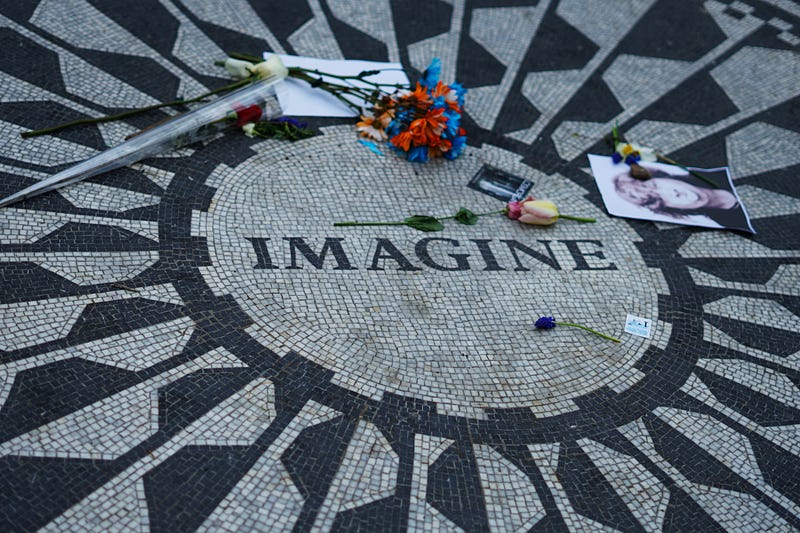
I don’t know if I’m becoming an atheist or not. So for now, I’ll stick with John Lennon’s anthem:
“Imagine there’s no countries It isn’t hard to do. Nothing to kill or die for And no religion, too.”
I know I could have chosen R.E.M.’s popular “Losing My Religion” for this piece, but I never had it in the first place, so I’ll stick with Lennon and his imagination.
I know that John Lennon was a problematic figure. When I first heard “Imagine,” a former English teacher of mine proclaimed it a “Marxist anthem,” and sure, it espouses that sort of classlessness-based equality. I was only fifteen when it was released, and I worried that my father would catch on and ban it from our house. But he never listened to the lyrics much. A big band guy, he didn’t understand why songs had to tell stories — why we didn’t just listen to the beautiful melodies and harmonies.
I don’t recall my mother’s saying very much about the song, or about a very rich artist advocating giving up “possessions.” She tended to favor romantic ballads, and thus ended up loving Elton John, Willie Nelson, Chicago, and Billy Joel (whose “I Love You Just the Way You Are” also appealed to my Dad, who clearly listened when he wanted to).
For me, the opening piano to “Imagine” has always been the killer. If we can imagine back then a song that ran so counter to the heavy beats and screaming guitars, the “Singing Winds and Crying Beasts” of rock music, then we might perceive that Rock and Pop and Soul have always allowed musicians and writers to work in some subversive idealism on us.
Think of that anti-capitalist №1 single from 1967, “Sitting On the Dock of the Bay”:
“I left my home in Georgia Headed for the Frisco Bay ’Cause I’ve had nothin’ to live for It look like nothin’s gonna come my way
So I’m just gon’ sittin’ on the dock of the bay Watchin’ the tide roll away, ooh I’m sittin’ on the dock of the bay, wastin’ time….”
Wasting time is like turning one’s back on possessions in our exceptional America, though for many “time-wasters,” they never had much to begin with. Was it Otis Redding’s voice that did it, that made this №1?
Or was it the notion that struck many of us as more true than we’d like to think? What is there to live for in a world — an America — where, depending on who you are, you might and do have lesser rights than someone else?
What has become — or perhaps always been — “self-evident” to those who can and want to see (which includes those who DO see and who have created and entrenched our inequalities) is that whether or not “all men were created equal,” “Life, liberty, and the pursuit of happiness” mean so little when your body isn’t your own; when you’re considered a bum for not wanting to work for nothing, aka, minimum wage; when “God and Guns” rise above mere sloganeering.
So, those opening bars of “Imagine” have always held a promise to me that if I listen long and hard enough, I’ll reach a deeper place; I’ll see and experience something I never thought I would.
And so I did.
The nearness of July (and you) put me in this frame. July marks the commemoration of these loved ones’ passing: my maternal grandmother; my father-in-law; my mother.
Without getting into all the details (except for these: my grandmother passed the day before my 15th birthday, so no “imagine’ there; my father-in-law passed just a month after we discovered we were having a baby, so no tangible grandfatherhood there, but at least he knew), my mother’s end came suddenly, which in so many ways was a blessing (can I still use that word?).
Just before she passed, I asked her what songs she’d like played/sang at her service, which would be in the Methodist church she loved and which so greatly comforted her, and even me in the end.
She closed her eyes for a few seconds — this was our only acknowledgment that her end was near — and then said,
“I want Sallie (daughter of her late companion John) to play that Beatles’ song, ‘Imagine,’ on her saxophone.”
I didn’t correct the artist because she was close enough. Besides, my shock at her selection overwhelmed everything else.
So of course Sallie played “Imagine” at Mom’s service. I remember sitting on the dock of the front row pew thinking of the time all this song said, all we were, and that on this day, there was a funeral, a church, and an extended family, but inside me, only love, grief, and all the memories of my past.
And no religion, too.
Thanks to Christopher Robin and KiKi Walter for publishing.
From the vault:


