Daytona Sand: Back to a Saddle
Chaps, spurs, buddies, and a killer song
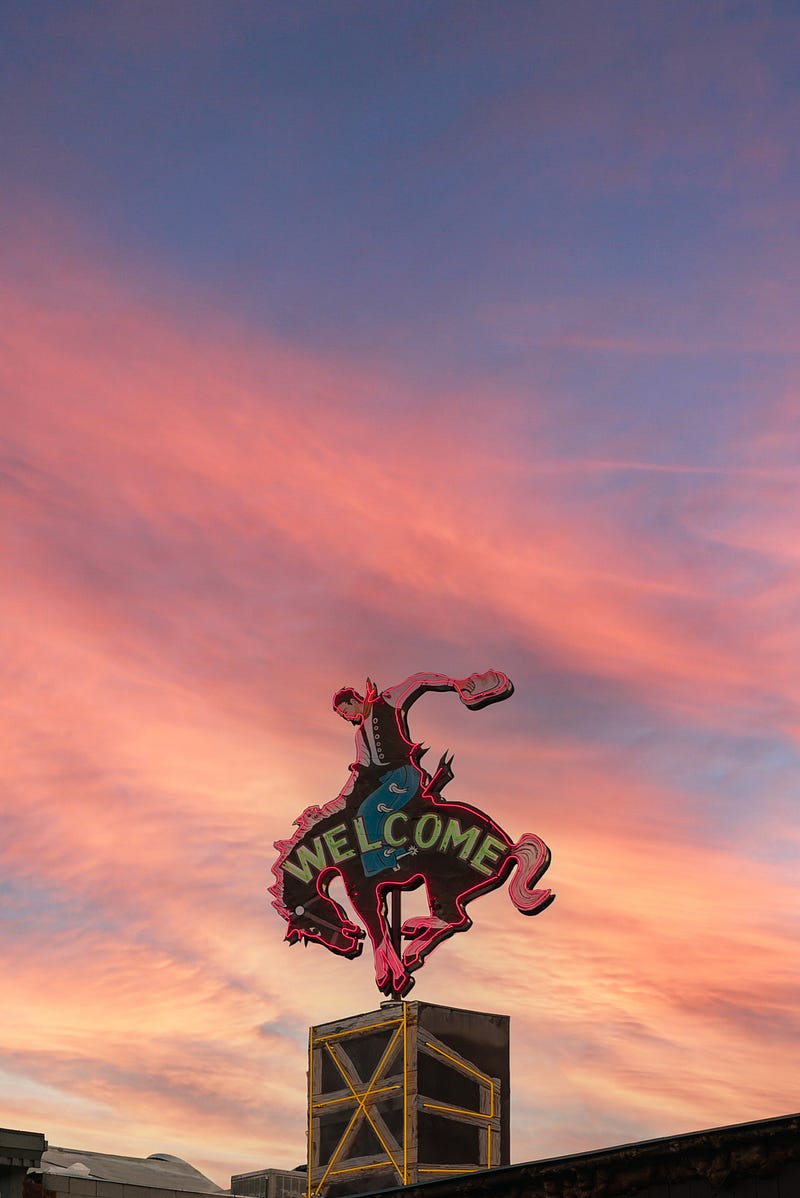
One of the perks of driving long distances for work is listening to a variety of Sirius-XM stations, all depending on my mood and whether some student has knocked an essay out of any park you care to name, like my student Kiersten did yesterday in contemplating how and why documentary films like Paris Is Burning, RBG, and Harlan County, USA, can help us see American darkness and the need to look at ourselves more closely. You know, the reality that an American dream for some is beyond a nightmare for others.
True, my mood dampens when someone gives mere plot summary, but I try my best to keep us both from feeling that unwanted blandness.
So, some days it’s Outlaw Country; others, it’s Little Steven’s Underground Garage; and for the past month or so, it’s back to XMU. What I love about all of these is their willingness to genre/gender bend. Listen to Dallas Wayne, Shooter Jennings’ Saturday evening “Electric Rodeo,” followed by Steve Earle’s “Hardcore Troubadour” on OC; or Palmyra Delran’s “Trash Pop Shindig” whenever you can on Little Steven’s; or Josiah, Jenny, or Jaron on XMU, and I swear you’re not going to be able to distinguish always who’s playing who.
Maybe you want the easy signifiers, but I don’t.
Soraia, Cigarettes After Sex, The Ronettes, Elizabeth Cook, Jack White — truly, on the tunes I hear, here, “I don’t know what to do with myself,” as I cruise through palace places like Fountain Inn and Grey Court.
Sometimes, though, I get lost because one of these stations introduces me to someone, something, I don’t know but so very much want to.
Someone like Orville Peck.
If you don’t know him, and even if you do, consider what he said here to Apple Music:
“The misconception is what I do is a character,” he said. “This is the most sincere thing I’ve ever done. The point is combining ultra-sincerity with a heightened version of who you are at your core.” And for Peck, that means positioning his gay identity front and center in aching serenades — like “Dead of Night” and “Big Sky” — that put a pronounced spin on traditional country-ballad tropes.”
His voice has been likened in quality and timbre to Roy Orbison’s, and I get that, especially if you consider the mystery in Orbison songs like “In Dreams” and “Only the Lonely.”
When I first heard Peck sing back on 2019’s Pony, I wondered if I could like him, get behind him. That was on the tunes “Dead Of Night,” “Big Sky,” and most of all, “Queen of the Rodeo.” And not only his voice, those lonely guitar strums, chords, all taking me back to my youth and the country/western stars I heard each week on Porter Wagoner’s show, or The Wilburn Brothers’. Or maybe in the old westerns my daddy would have me watch with him — westerns whose names actually are lost to me, because I tended to watch my daddy more than the film.
It might seem funny to you to consider a Jewish father and son enraptured by the American West in film — Daddy didn’t care for the music so much given his Big Band bent — but I also give you Kinky Friedman as an example of all we cannot explain.
In any case, as much as I loved Pony, when Peck released his follow-up, Bronco, last month, and particularly the first single from it, “Daytona Sand,” I heard the hard-corish troubadour voice, the shimmering persona of a guitar I knew as a kid — the one I keep hearing in the dream-romance of the dying western sun. That echoing guitar refrain kills me in ways I can’t describe. If you want to understand what an archetype is, start here.
You know I’m from Alabama, where country music was orphaned, so of course I would respond to a country/western song about a guy from Florida, a state much in the news for all the wrong reasons today. And if you’ve ever traveled through its northern terrain to get to some beach, you’ll understand why Stranger Than Paradise is one of my favorite films.
And then, there are the lyrics to “Daytona Sand,” some of which go like this:
“Buddy we got major blues Another suitcase in your hand I hope you brought your walkin’ shoes Cause it’s quite a ways from what I understand. So, rack em up, big blonde, I think I could have been your man.”
I imagine all the folks I know who wouldn’t keep listening to such a song sung from such a guy, and that’s like refusing to listen to Merle cause he’s rural and a convict; or Stevie cause he’s both blind and Black; or Taylor cause she is popular and keeps shifting genres and can’t help writing achingly compelling songs.
Or maybe I don’t know what I’m saying or asking of you.
What I do know is that while listening to “Daytona Sand” and much of the rest of Bronco, I feel as if I’m six again and either sitting beside Daddy, riding in the car as he or Mom tries to find a radio station that isn’t playing some yokel tune, or trying to stay still in out local BBQ joint — Cliff’s or the Super Sandwich Shop — as the jukebox, for the ten-millionth time, plays a forgotten song, or one that will be someday.
I know that certain guitar chords, notes, make me see the past clearly, echo in my brain as they’ve always done, and keep me navigating the now, knowing that the next Orville Peck is truly out there, just beyond the rainbow horizon.
“I’m gettin’ tired of this earth but they say some stones are better left unturned.”
Thank you to Songstories and its new guide, KiKi Walter, for publishing, and to the founding spirits, Christopher Robin and Samantha Drobac for always being there. If I can, I’d like to tag David Acaster, Steven Hale, Chris Zappa, and Jessica Lee McMillan because they, among others, always understand.
Here’s an earlier song story for you: