
I’m the Librarian With the Rainbow on Her Wrist
Feel Free to Join Me
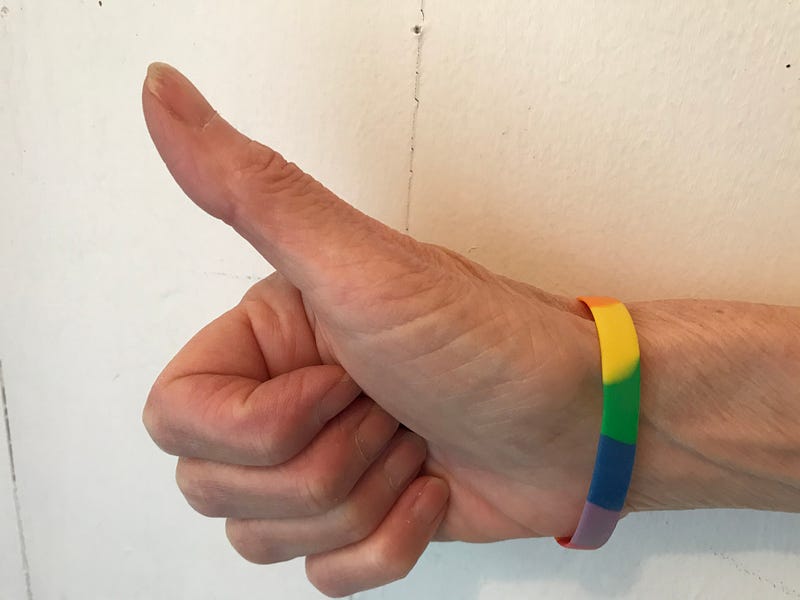
I’m a humor writer, and I laugh a lot, but I’ve got a deadpan face. Combine that with the fact that I always wear black and I could seem a little dour. But? I always wear a rainbow wristband. That small splash of color sends a signal: I’m not as dull as you might think.
But it’s really there to send another, more important, signal: I support LGBTQ rights.
I always have.
Maybe it’s because when I was growing up in the 1960s, my father, a psychoanalyst, didn’t agree with the then-prevailing notion that you were sick if you weren’t straight, and counseled his homosexual patients to accept themselves as they were.
Maybe it was because, when the bullies at school tormented me, they usually called me “queer.”
Maybe it was that so many of the writers and artists whose work I’ve always loved were gay.
For whatever reason, LGBT rights always seemed like a no-brainer. Alas, we’re living in a world where not everybody shares this view.
Wearing a rainbow bracelet is an easy way to let LGBTQ folks, especially LGBTQ kids, know you’ve got their back. I work in a public library, a place where every kid should feel safe and supported. So, when I heard about rainbow bracelets over a decade ago, I sent away for one.
When it turned up in the mail a week later, I put it on. I’ve worn it ever since.
Mostly, I forget that I’m wearing it. Once in awhile, I’m reminded.
I’m walking down the street in Chelsea. A drag queen strolling toward me sings out, “Gay rights! YEAH!”
A sales clerk at a local pharmacy quietly says, “Love your bracelet!” before reaching into her pocket and bringing out her rainbow key chain. Her boss is a bigot, she says, so she’s not out at work.
“Are you family?” she asks.
“Just a friend of the family,” I say.
“Cool,” she says. “Thanks.”
In line to catch a train at 30th Street station, I notice the teen in front of me also wears a rainbow bracelet. Then he glances back and sees mine. His face lights up. “Gay pride! High five!” he calls out. Grinning, the two of us high five.
But I’m happiest about my bracelet when a teen approaches the circulation desk at my library to check out Simon vs. the Homo Sapiens Agenda, Kings, Queens, and In-Betweens, or The Essential Dykes To Watch Out For. Is it just chance that they’ve chosen my line? Or did knowing they have my support give them the confidence to check that particular book out?
Wearing a rainbow isn’t the only way I support LGBTQ rights. I’ve spent decades writing checks, phoning politicians, signing petitions, speaking out, and marching. (In 1993, when our son was just 4, his father and I brought him along to Washington with us to march — or in his case, be strolled- for gay rights.)
Compared with taking action, wearing a wristband is just a small gesture. Even so, I like knowing that as I go through life, 24/7, I stand for something.
How long will I continue to wear my rainbow bracelet? Until LGBTQ kids can trust that everyone, from their teachers at school to the librarians behind the circulation desk to every last judge on the Supreme Court, has their back.
That day will be here sooner than you think. I was born in the fifties. I remember the Bad Old Days, when being gay didn’t mean you were out and proud — it meant you were mentally ill. Things have changed so much. And they’re still changing. Fast. If you want the day when we can all enjoy equal rights to arrive a little faster, you can always wear a rainbow bracelet yourself.
Human rights are always in fashion.
(This essay appears in Our Bodies, Our Shelves: A Collection of Library Humor by Roz Warren, who writes for everyone from the Funny Times to the New York Times and is also the author of Just Another Day At Your Local Public Library. If you want to buy inscribed copies or just want to say hi, you can reach her at [email protected])