
COVID-19
I’m Being Evicted From My Floating Home
My experience as a crew member on an empty, quarantined cruise ship while my industry suffocates from COVID-19
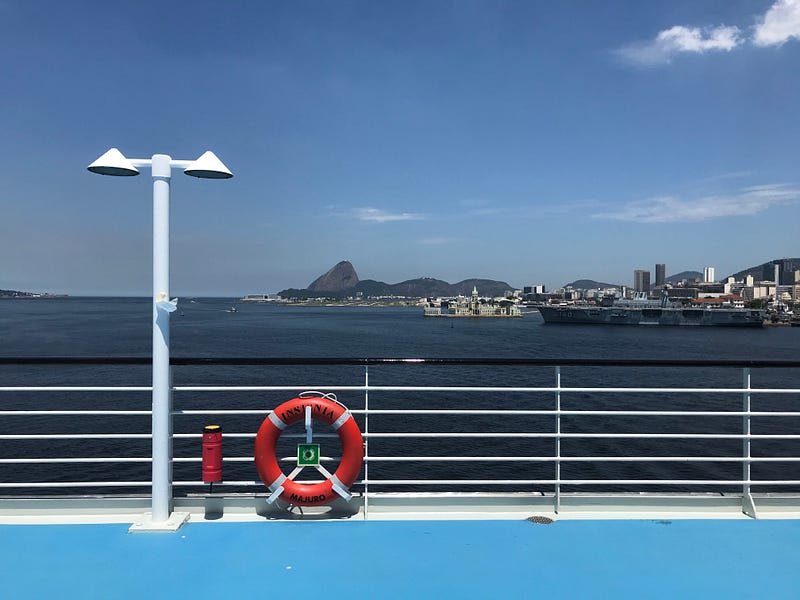
There are approximately 390 of us floating out here on a ship built for 1,100 people. For 17 days now, the ship has been empty, except for us crew. My cruise line announced its temporary cease of all operations on March 13. At the time, they said it would only be for 30 days, but now the pause has been extended until mid-May. Let’s hope everything in the world is starting to get back to normal by then.
When we found out about the closure, it took a couple days for us to disembark all our guests. All of those arrangements had to be made simultaneously, and immediately. It was a chaos that seemed like it would never end — yet, strangely, I think most of us would love to live through it again. It felt more normal.
Most guests didn’t want to leave their home-away-from-home, but we were forced to send them back to their permanent residences. We did that without knowing what was going to happen to us crew — where we were going to go, when that would be, how we would get there, or when we would get to start working again.
The world is shutting down all around us. Ports are denying clearance, flights are being grounded, borders are closing, rights are disappearing, economies are suffering, services are stopping — and fear is growing.
Like so many other people across the globe, we are currently isolated in a preventative quarantine. We just spent 12 consecutive days at sea, stopping only a few days ago for supplies and fuel, with no one allowed ashore. Now we are en route to Tampa, our final destination. At that point, crew will begin to be disembarked until operations resume, but there aren’t many of us who actually want to leave this safe haven from the outside world.
As noted, many crew are not sure how they will be able to get back to their own countries — or when they’ll be permitted to leave them again. Conversely, some people just want to return to their land-lives, to be with loved ones in this unprecedented time of uncertainty. Regardless of our preference, we don’t have much choice; our fates are currently dictated by the transit situation in our countries of origin. If we can go, we must go.
While we’re here, we are keeping ourselves occupied with variations on our normal work. (Since there are no guests, everything is operating at a slower pace.)
I’m not gonna act like this is a difficult isolation; it’s one of the best situations anyone could possibly be in, especially considering the circumstances that surround us. I’m sure a lot of people would envy us if they knew about our personal experience of self isolation, because it’s not a lonely or dormant one.
Since we’re a closed environment, and everyone is healthy, we do get to interact with each other. However, we are more conscious of how close we stand, and how many surfaces we touch. (We still wash our hands obsessively, just in case, but that’s nothing new.)
We are encouraged to spend time outside in the sun and fresh air. We get to relax a bit, we can go to the gym or fitness track, and up until a few days ago, we could also visit the salon and shop in the boutiques. (Now, they’re closed to prepare for an indeterminate period of disuse.)
It’s crazy how things that would normally be considered absolutely mundane now feel so luxurious, since we know that elsewhere, such privileges no longer exist during this time of crisis.
The company has also gifted us with free WiFi during this period, so we can stay in communication with our loved ones, who are all living different levels of struggle. This means that now, if we want to, we can walk around the ship without ever disconnecting from the Internet. We can receive messages and phone calls at any time of day, just like normal people! How crazy is that?!
I’m still getting used to seeing people walk around while using their phones. Part of what I enjoy about living here is the fact that constant connectivity isn’t a thing, under the usual circumstances. The ship is normally quite isolated by default, so in this regard, our environment actually feels a lot more open. I do appreciate that.
We are extremely fortunate to have food and beverages prepared and cleaned up for us each day — but I must admit this was already our norm. The biggest difference is that we now try to conserve those things a lot more, because we understand how limited they are. Therefore, we also have a greater appreciation for everything that goes into keeping us fed. And whatever meal we eat, whoever we sit with, part of the conversation inevitably consists of updating one another on the situations in our native countries. At the same time, we’re trying so hard not to think about the world outside of our little bubble. It’s horrifying.
We’re trying so hard not to think about the world outside of our little bubble. It’s horrifying.
From what I read in the news and hear from fellow crew members, it seems life on land has changed so much since I signed on to this contract three and a half months ago. That’s always the case, but this time, those changes are quite different than usual. I’ve seen many pockets of the world since joining Insignia, of course, but it didn’t seem too foreign out there.
Well… there was that group of locals who yelled at us to “tow away” as they sailed by in their boat. And there were a few ports in which all of the officials wore masks. One such port even made everyone stop to have their temperature taken before stepping off the gangway. The levels of skepticism we sailed into were all extremely unusual.
And then there was all the news about other ships having infected passengers and crew, and us changing the second half of our Around the World Voyage to bypass Asia altogether as a precaution, and sister ships terminating their voyages because they couldn’t find another port to let them dock, and other cruise lines ceasing operations temporarily, one by one …
And then, that happened to us, too.
Even with the gradual buildup of all the industry news, that decision took us all by shock. By being on this ship in particular, we had somehow felt immune to it all. “They wouldn’t stop the world cruise!” (It’s six months long, and full of extremely loyal and enthusiastic guests.) Well, yeah, they would, and they did. And I’m sure it was not an easy decision, or one the company was happy to make, but it was certainly the wise choice to be cautious.
I must admit that this experience of being “trapped” on a cruise ship is unparalleled in its aspects of comfort and respite amidst the insanity. I fully appreciate how fortunate I am to be “stuck” out here with these wonderful people, in this amazing place, protected from any threats.
I realize I have probably made it sound like paradise onboard at the moment — and it is indeed the best isolation one could hope for — but please don’t think we are unaffected by the global crisis. We are experiencing its effects directly, first-hand, just like you. We are here on an empty ship, and although we have found ways to enjoy this temporary reality, we know that’s not how it’s supposed to be; something has to go extremely wrong in the world for such circumstances to take place. We are now simply trying to make the best of a truly terrifying situation.
I sense mass panic in every direction across the sea. Like I said, I’m used to the world changing by the time I sign off, but I’m not used to it changing this much, or in this manner. I’m also accustomed to stepping off the gangway into foreign cultures, and figuring out how to adapt, but I’m not sure of the societal norms in a universal culture of fear. It seems the standards of social etiquette have been amended. I’m not looking forward to learning them.
The world onboard looks different from its normal, too. It’s just a different kind of different than what’s going on ashore.
A few days ago, I opted to spend the evening in, on my own, rather than at the crew event. (Throughout our empty voyage, there has generally been some type of activity each evening, to maintain morale and to give us all something to anticipate. Such is somehow our normal life now, during an international pandemic.) I found a decent movie looping on one of the crew TV channels. After the program ended, and I powered off the screen, I was struck by a sensation that we’re all still trying to get used to out here:
Absolute. Silence.
My corridor is normally somewhat energetic. Frequent foot traffic. The absence of door slams and elevator dings, followed by loud breaks of laughter in foreign sentences, was clearly noticeable.
See, crew life feels very much like a college atmosphere: There are rules that often don’t make sense, there’s childish giggling at stupid stuff, there are parties, there is dancing, there is drinking — responsibly, of course — and in case you’re wondering, yes. There’s definitely lots of sex.
Okay, I know I’m interrupting my own thought, but let’s talk about the sex for just a moment, because I have a feeling you want to hear more about it.
This ecosystem is practically made for frivolity. Everyone is healthy—we have to pass thorough medical exams and rigorous safety training to accept the job—and everyone is some degree of lonely and/or emotionally lost and/or adventurous. Crew members also find a deep sense of understanding in one another, because the intricacies of this lifestyle are very hard to relate to with other people.
What’s more, everyone here innately carries their own level of intrigue simply for being from a different country than you. They probably have an interesting accent, too, and occasionally slip into words you don’t understand. It’s undeniably alluring.
Besides that inherent sex appeal, everyone here is in some state of leaving — meaning your lives might only overlap for these few months, and then you’ll probably never see each other again, unless there’s some sort of rotation miracle (or curse, depending on how you look at it). The sense of urgency, and the speed at which you can establish a bond with another crew member, accelerates any relationship you do get involved in onboard—and the notion of scarcity intensifies it.
All manner of relationships can and do begin and end in the time it takes us to complete a single voyage. Imagine how much … experience … can be had in a contract that lasts for months on end. Or how deep the feelings of one relationship can reach.
Furthermore, any behavior that people feel like they can’t get away with in their native culture — or in what they might consider their “real lives” — will be somewhat accepted out here in the culture between cultures; the one that lives in international waters. Promiscuity, homosexuality, bisexuality, affairs… You name it.
These elements combine to form the foundations of countless stories and secrets. Every crew member has them. Whether you decide to tell them or keep them hidden at the end of the contract is up to you, and most people onboard won’t fault you for that, because they have their own stories to protect. “Loose lips sink ships,” right? I guess we take that to heart. The mutual non-disclosure is a code amongst us all — one which, until this paragraph, had remained unspoken.
But those unspoken understandings were the form of silence I had grown accustomed to out here — not the kind I heard in my cabin that night.
I chuckled in acknowledgment of the absence of sound, and shook my head at the irony: When the ship was full, all I wanted was some dang peace. Now, I wish for that familiar form of noise.
When the ship was full, all I wanted was some dang peace. Now, I wish for that familiar form of noise.
I don’t know why it was less noisy that night; I live in a crew area, and almost all the crew are still here … I guess we’re just more spread out now? Anyway, it wasn’t until those sounds weren’t there, that I realized they were an essential part of the onboard experience. Without that set of sounds, this familiar place feels foreign. (Was that the concept Simon & Garfunkel were trying to express when they wrote “Sound of Silence”? Hmm, I wonder.)
Hotel corridors that are normally bustling and full of energy are now empty and lifeless. There’s something incredibly cold and sterile about making your way down an extensive, silent hallway, peeking into the open doors of so many vacant rooms, and seeing bed after bed stripped of their linens.
Those were intimate spaces before, off-limits to everyone except the designated steward and the guests themselves. Only a few weeks ago, personalities were displayed in various forms on these doors. Guests had hung signs, magnets, flags … Now, the doors are just fixtures, and these are just rooms. And they all look disturbingly uniform in their vacancy.
The body of the ship is still alive, but her soul seems to have faded away.
Elsewhere on the ship, appliances and electronics that have always been used on a daily basis — on every contract and every ship for as long as we can remember — are instead powered off and wrapped in plastic for storage. We have shut down entire sections of the ship, putting her to sleep, because she needs guests in order to wake up and come to life. We are taking her apart and waiting for the day we can put her back together.
I know the feeling of packing things away in preparation for an adventure. This isn’t it. This is different. It’s like the eerie sensation of walking through your own house after it’s been put up for sale, seeing everything in the process of being either packed or sold. Your home — a physical embodiment of your identity and safety, and your most sacred place in the entire world — is starting to feel like it doesn’t belong to you anymore. That’s how this feels. It’s disconcerting.
At the end of each contract, when I have to figure out how all my belongings squeeze back into a suitcase, that familiar form of frustration is alleviated by visualizing what adventures await me next. I know all the places I’m going to hit during my vacation, all the friends and family I’m going to visit — and I know exactly how long that’s all going to last. I leave one ship knowing the sign-on date for the next, so I pack my things in anticipation.
I have the reassurance that I’ll be back again soon, surrounded by my friends once more — even if I’ve never worked on that next ship, and even if I don’t know a soul onboard. It’s still the same cruise line, so it’s familiar. Same finishes on the furniture and fixtures, same names of the venues, same set of rules in the handbook, and same uniforms — but on a different mix of coworkers. The unfamiliar faces are not strangers at all; they’re just friends I haven’t met yet.
Those are the emotions I carry with me as I pack away all my things at the culmination of every five-month-long era. I’m sad to end one adventure, but already excited for the next. So now I’m going to vocalize what many of us in the cruise industry are probably thinking …
When is that next contract? When does all of this madness go back to our unusual notion of normal?
Our entire industry is struggling, and help doesn’t seem to be on the way. All the arguments made against a cruise industry bailout are completely valid, and that’s coming from an American crew member. However, I still support the longevity of a lifestyle which — for myself and for many of us — is rewarding in ways that cannot be quantified, and which vastly outweigh the inherent challenges. Why wouldn’t I want that to continue? Why should anyone else be denied the opportunity to experience these challenges and rewards for themselves?
This was Contract #5 for me, and I was ecstatic to receive the Around the World Voyage as my assignment. I was finally going to see Africa and Asia, entire continents that I have yet to explore and experience. I was going to circumnavigate South America to get there, too, which meant I would finally sail around Cape Horn, as I had wanted to do for years.
We didn’t make it farther than Rio. We lasted two and a half months, but our trip was cut short before we could even cross the Atlantic. (And although we did get to circumnavigate South America, and I did get to practice the hell out of my Spanish that whole time — as well as eat ungodly amounts of steak and alfajores — we didn’t get to sail Cape Horn after all. The weather was too rough that day, so we had to take an alternate route.)
I realize all of this must make me sound incredibly spoiled, especially to people who don’t travel for a living. It’s quite audacious to complain about not seeing enough of the world, or not getting to do so in a way that meets your liking.
I do acknowledge that there are much bigger issues to concern oneself with — especially now, for God’s sake — but I wonder if I will look back on this contract as nothing but broken promises. Not just the promises of adventure to ports we never visited, but promises of the stability of a job that is, at the moment, nonexistent.
I know that the cruise industry isn’t a necessary one. I admit you can live your whole life, quite happily, without ever setting foot on an ocean liner — and without feeling like you’re missing out on something. But taking a break from work for a period of relaxation and rejuvenation, that is a necessity. And having exposure to other cultures and ways of life, and visiting new places — I personally consider those necessities, too. While they’re not essential for your body to live, they are essential for your soul to thrive. They’re necessary for you to understand and empathize with more of humanity as well. And while you’re experiencing all of that, wouldn’t you like to have someone there, watching over you, making sure you get safely and comfortably from one place to the next?
We are those people. We take care of all your concerns during that necessary vacation, so that you can fully relax and remember who you are when work and life don’t get in the way. It’s a massive team effort to make sure that every detail is planned for you, and that your every concern is resolved before it can even be addressed. That’s why it frustrates us, too, if something about your experience goes wrong — we put in a lot of work to make sure everything is perfect. But it is our pleasure to do that, because we’re happy to make your life more enjoyable, and to be part of a fond memory for you. We are anxiously awaiting the chance to do so again.
For now, though, just like the rest of the world, we each have to go home and isolate ourselves while we wait out this uncertainty. It’s in the best interest of literally the entire global population.
There’s just one problem with that directive … How can I “go home,” when I’m already here?
That realization is what hit me while I was alone in my cabin the other night, listening to the literal sound of silence. It took me five contracts to realize it.
No, it took a lot more than that.
It took me 11 cities of residence, one of them on another continent. It took a lifetime of feeling like I didn’t fit in anywhere I went, and hoping the next place was the one where I would finally feel like I belonged. It took me 33 years of jumping from one dot on the map to another, starting and ending chapters as though my life story was a f***ing page-turner. It took me 6 different job titles in 6 different companies, essentially living 6 different identities. It took me quitting this very job and starting a new one on land, where the only thing I could see outside that office window every day was just how green the grass was at sea.
It took me by surprise.
For most of my adulthood, I had thought there was something wrong with me for moving around so much, and for never being quite satisfied with whatever my life situation was. It seemed relatively easy for everyone else around me, everywhere I went, to feel happy and at home in their given city.
Two years ago, when I was unwittingly in between contracts, I moved into my apartment in New York City. When I finished unpacking, I realized I had no idea when I would move out again. While most people might have considered that a reassuring stability, I saw it as a terrifying uncertainty.
It was the first time in years that I didn’t know the end date of my stay somewhere. It felt wrong for me to live in one place for so long that there was no end in sight. That’s when I realized that the reason stationary life doesn’t feel right for me is because I am at home in transition.
Inside all of us is a part of our soul that withers and decays like a delicate flower if we don’t get to do what makes us happy. A Compass Rose is the only kind of flower that needs adventure instead of roots in order to thrive. That must be what blossoms inside me, because the moment I unpacked my last item in that Manhattan apartment, I felt my spirit start to wilt. I was indescribably relieved when, a little more than a year later, Oceania resuscitated me before the last petal could fall.
A Compass Rose is the only kind of flower that needs adventure instead of roots in order to thrive.
Admittedly, there are many ways I could live in transition, many vehicles and vessels in which I would be happy. I know, because I’ve enumerated as many as I could think of; they’re on my list of future addresses. So what is it that makes this transitory situation feel like home? Why a cruise ship?
I looked around at each fixture of my cabin, trying to figure out the answers to those questions, and attempting to soak up the details of this place while they still exist in front of me. (Soon, the only way I will be able to access my home is through my memory. Therefore, I must memorize its every nuance.)
It’s more than just the tangible aspects, I understood. It’s the combined experience of the environment, and the lifestyle that surrounds it.
It’s the gentle rocking of the entire room — and it’s the times when the rocking is not so gentle. It’s being woken up by the drawers and closets sliding open and slamming closed on the nights I forget to lock them in place. It’s watching the shadows underneath the edges of each photo on my wall as they stretch and contract while the pictures sway with the motion. It’s the way my denim rainbow of a jacket — covered with the patches and pins of almost every country and territory I’ve visited — drifts back and forth in a slow, lonely dance across the wall beside me.
It’s the white noise of air whirring through the vent above me, and the vibration of a motor beneath me. It’s being surrounded by magnetic walls that are painted the blandest shade of beige you can imagine, seemingly in an unsuccessful attempt to suppress personality and original thought. It’s that blank canvas of a cabin which I always find a way to fill beautifully and in a manner that makes me smile.
It’s finding comfort in the sound of the occasional creaks as this structure fluctuates ever so slightly to accommodate the motion. It’s getting some use out of the giant world map that I always display proudly above my bed, no matter what contract I’m working, or what apartment I’m living in. It’s the fact that I actually look at that map every day when I’m onboard, because I’m always going somewhere.
It’s feeling like I live in a tight-knit, remote community while I’m on the ship, yet in every city there is when I step off the gangway. It’s running into people I know no matter where I am in the world. It’s waking up and wondering aloud, “Where are we again today?” and momentarily panicking while I try to remember the answer.
It’s forgetting to set my clock before sailing through another time zone the previous night. It’s checking my wallet for the proper currency before I go out to lunch. It’s determining hours in sets of 24, and direction by Port and Starboard. It’s measuring time in countries and continents. (E.g., “I haven’t been ashore since Monte Carlo,” or “When do you sign off?” / “Hong Kong.”)
It’s the particular brand of annoying rules and restrictions that go along with living in this group scenario. It’s the absence of fruit and dairy products in my mini-fridge, because perishable items are prohibited. It’s the single bottle of wine, because it’s against regulations to have more than one. It’s having to follow privilege packages which dictate things like what parts of the ship one can enter, which elevators one can use, and the venues where one can eat. It’s not setting foot in a kitchen for 5 months at a time (only because I don’t work in the Galley). It’s feeling like that is normal.
It’s the ancient technology such as the actual phone with a curly cord and a keypad, which my friends use in order to ring me and say, “Let’s do something!” It the pager — yes, a pager in 2020, you read that correctly — which beeps less frequently each contract, because people only try to get a hold of me when there’s an issue, and I keep learning how to do this job better and better. It’s using my smartphone as a camera and a memo-pad instead of as a communication device 90 percent of the time, because Internet is expensive, spotty, and limited, and logging on to it feels laborious.
It’s the configuration of the photos on my wall — a collage I always display differently when I move into a new place. It’s that unique mosaic which tells me what chapter of life I’m currently living, and which ones only exist in my memory. It’s the fact that I get to display those photos, and that map — and my vintage calendar, and the most recent additions to my currency collection, and my language collection … Things that are only unpacked for long-term stays because they’re non-essential for daily life, but essential for daily happiness. It’s the fact that those beloved belongings don’t have to stay buried in my bags while I’m here. It’s the privilege of being given a long enough welcome to justify unpacking those possessions, and having the rights to arrange them in whatever space I’m in.
It’s the fact that this tiny little cabin is the one place in the entire world that is mine, and no one else’s.
Here, I can unpack my things and access them easily in drawers and a medicine cabinet and a closet, rather than having to rummage through a partially-unpacked suitcase on someone else’s floor. How unspeakably luxurious that is.
Here, I’m not in the way. Here, I’m not a visitor; I’m a resident.
Here, I’m not weird for having only what can fit into a suitcase, and for keeping the rest of my possessions in storage in my parents’ basement. Here, I’m not considered a total failure for my lack of deeded property or a car, or my choice not to have a husband or children. Here, all of that is relatively on par, depending on your position and your age, which means that here, I can pass for normal. Here, I fit in.
That’s what makes it my home, I realized. That above all else. It’s not the incessant blur of scenery outside my porthole, or the funny realities of living on a moving vessel. It’s the fact that here, in this culture, I am accepted.
I’m not sure I can fully convey the significance of that discovery, or the warm-and-fuzzy feeling it brings. My journey for acceptance had lasted all my life until I started working onboard, sparked by an adolescence in which I was bullied.
When I moved from California to Tennessee at age 11, my classmates mocked me for being new, and foreign, and weird. Even once the newness wore off, I was still foreign and weird, so there was plenty of material left over for them to turn into jokes. Kids threw food at me, taped signs to my back, and laughed at my accent for being squeaky-clean instead of multi-syllabic. They seemed to call attention to my differences only to make fun of them. That lasted, in varying degrees, for all six years I had left of school. It felt like serving a sentence.
I don’t know why my existence had seemed to bother everyone around me in Tennessee. It hadn’t in California.
That caused me to question everything about myself. My abrupt change in self perception had a drastic effect on my personality; I went from initially reserved to cripplingly shy. Perhaps I thought that if I didn’t say anything, there was less they could make fun of me for — but ironically, they often made fun of me for being too quiet. I began to suffer from social anxiety and depression — as a Seventh-Grader. And I didn’t grow out of it; I grew up with it. This even exhibited itself as selective mutism at times.
An identity which had previously felt so stable was viciously torn apart. I felt the shreds getting ripped smaller on a daily basis. How could I possibly feel confident about myself when I was constantly mocked, just for being me?
I concede that perhaps such treatment wasn’t limited to middle-schoolers in the South; there’s a good chance I would have had a similar Seventh-Grade experience anywhere in the country, including California. But that was my first experience with Southern culture. Therefore, I never felt welcome in it. Maybe that’s a large part about why I’ve never felt like I belong in it either.
That was my first experience with Southern culture. Therefore, I never felt welcome in it. Maybe that’s a large part about why I’ve never felt like I belong in it either.
I tried to adapt to my new culture over the years. I tried to like it, too. But it seemed the harder I tried to fit in, the more I found ways that I didn’t. Tennessee was a riddle I could neither solve, nor felt like I had permission give up on, since my family still live there. I became increasingly frustrated, and in the process, I grew to resent that entire region of the country. Anytime I hear that accent now, I feel a strange combination of nostalgia and dissonance.
Moving away hadn’t been an option while growing up, but it seems that once I was old and independent enough, moving is all I would do. On the surface, it would be to attend a new school or to start a new job, but underlying it all was my desire to find the place where I felt a sense of belonging and acceptance.
Even when I moved as an adult, I still felt like a misfit no matter where I went. Making friends felt like fighting an uphill battle. Regardless of the subject matter I spoke about, or what common interests I could find, I couldn’t seem to connect with people in a way that felt effortless. It always felt like work. I thought that’s just how friendships were.
I couldn’t seem to connect with people in a way that felt effortless. It always felt like work. I thought that’s just how friendships were.
I wanted desperately to find the place where I fit in seamlessly with my community; where conversation came easy. Where I connected quickly, and felt comfortable being myself, and wasn’t teased for any differences. Where I got to reveal the weirder aspects of my personality, layer by layer, and be welcomed for it — or at least not criticized for it.
That’s what I found here onboard. My Promised Land was at sea. I didn’t realize it right away, I confess, but I felt it quite soon after I arrived.
In true Janna fashion, I was socially awkward in this culture, too, initially. I unwittingly made a fool of myself by arguing about things that only make sense on land, without knowing all the nuances of ship life, or the words of ship lingo. There were a lot of times I didn’t quite know where I was in the world, or even where I was on the ship — but I learned that all of that is what first contracts are for. And every crew member shows you mercy when they discover it’s your first contract ever.
The people here were warm and forgiving. They didn’t laugh at me; they laughed with me. They didn’t want to exclude me; they wanted to assist me. They didn’t call me out; they called me over. It’s possible the reason everyone is so welcoming is that no one is born into ship culture; everyone who is part of it had to adapt to it themselves at some point.
During that formative period, I learned so much about the world. I saw so many parts of it that I hadn’t known existed, and I saw how differently so many people lived. I learned so much about myself, too, because I was challenged in ways that I had never been challenged before. I was exposed to situations I had never been aware of. I grew a lot stronger because of all that.
But the area of growth which I’m most proud of is conversation — a skill which everyone around me, in every culture I sampled, had seemed to innately master. Something that had eluded me ever since age 11, when I had unknowingly left it behind in California, along with my self esteem.
The area of growth which I’m most proud of is conversation — a skill which everyone around me, in every culture I sampled, had seemed to innately master.
This was the first time in my life — the first place in my life — that I didn’t have to try to have conversations. They happened naturally, anytime someone new sat across from me in the Mess. (And everyone there was new to me, just like I was new to everyone there.)
The first thing that person would ask about was where I was from — which is actually a question I abhor, because my answer isn’t neat and tidy like everyone wants it to be. I would tell them some of my back story, and I was surprised when they inevitably wanted to hear more. They were interested in hearing the parts I was generally ashamed of—like how many times I had moved, and how I didn’t feel like I was “from” anywhere, and how many jobs I had worked, and basically how many times I had failed at figuring out how to live my life in a way that made me happy and fulfilled.
I quickly discovered that one reason crew members were so interested in hearing about those aspects of my life was because most of them had similar journeys.
There was one who talked about his former life as a police officer, and how it was too dangerous for his liking. There was another who told me about his previous career as a lawyer, and how it had made him miserable. There was one who once ran a hotel of his own, and who had progressed through almost every job title you could name onboard. And then there was the former educator who once tutored Macaulay Culkin.
There were so many origin stories with so many fascinating components that I couldn’t keep up with them all. The only thing I knew was that many of these people had life color palettes with a hundred different hues, just like mine — and that even if we didn’t have a single shade in common, we shared the truth of a technicolor backstory.
Many of these people had life color palettes with a hundred different hues, just like mine — and even if we didn’t have a single shade in common, we shared the truth of a technicolor backstory.
It was also refreshing for me to discover that many other people here feel like they don’t belong in their native culture either. There’s the Brazilian who skips Latin Night, the Russian who loves to smile, and the Frenchman who despises French people for being “too snobby” — and those are just the ones I can remember off the top of my head. That is how I knew I had finally found my flock.
When I felt that magic on the first contract, I thought maybe it was just a fluke. That didn’t happen to me; I didn’t get to fit in. It must have been some weird anomaly of stars aligning and just the right mix of personalities, I rationalized. But when I felt it again the next contract, and the one after that, I thought maybe it was a sensation that happened every contract — and I was right.
Here, I can sit down across the table from a stranger who comes from a completely different corner of the world, and be met with a smile of anticipation, rather than raised brows of suspicion, or a glare of perceived intrusion. Here, I learned how to reverse my social conditioning of fear to start talking. Here, I feel welcome to share and am eager to listen. Here, I don’t run out of things to discuss, because if nothing else, there’s always a new port outside the window, with its own unique geography, history, and points of interest.
Here, by the time we get up from that table, that crew member and I are not strangers anymore; we’re buddies. And most buddy-ships have great potential to turn into friendships.
Here, I can go into port with a handful of friends, and feel so at ease with one another that it seems like we’ve grown up together — and then realize we’re actually from different continents. Here is a shared understanding that even though we may have passports from different countries, or licenses from different states, it feels like we’re all from exactly the same place: Everywhere at once.
As these realizations set in, I looked around my quiet cabin in a sad happiness. The emotions that had been buried inside of me for a lifetime began to spring forth in physical form — warm tears formed in my eyes and trickled slowly down my cheeks and into my lips. Salty but sweet; fitting of the proud sailor I’ve become.
It was incredible to finally understand something which had perpetually perplexed me about myself. I only wish I had come to the realization sooner, so that I could have more time to enjoy this new perspective of my reality.
I gradually moved my misty gaze from one sentimental possession to the next — things I’ve saved from previous chapters of life, that were so dear to me I now carry them wherever I go. It didn’t take long to make my round of observation, because I don’t have many things. That’s why I rely on my snapshots. The reason I’m so attached to these photos and to these inanimate objects in particular is because they’re each tied to a memory with people who always seem to be somewhere that I am not. More tears came as I realized that the people right outside this cabin door will soon fall into that category, too.
Our paths could cross at sea again, but even if we get assigned to the exact same ship, and go to some of the exact same places, none of us will ever work with the exact same people. There’s no such thing as exactly the same contract, because the mix of crew is always changing. That dynamic element is part of what makes contracts simultaneously exciting and depressing.
The impermanence of ship life is its defining characteristic. The only thing reliable about it is variability; the only thing constant about it is the myriad of ways it continuously changes, yet somehow remains the same. All of that is what makes it a perfect fit for me; what makes it feel like home.
I understand that the details I consider familiar are probably foreign for most people. My home was never a normal home; it’s merely a floating hotel — and one of a thousand others just like it. A temporary home for other people, but a permanent home for me. Doesn’t matter that the address changes on a daily basis, or that my notion of “permanent” means five months at a time (plus or minus 30 days depending upon the needs of the rotation, as per fine print of the contract). This fleet is my home, these crew members alongside me are my community — and this period of quarantine is my eviction notice.
This fleet is my home, these crew members alongside me are my community — and this period of quarantine is my eviction notice.
Now, I have to pack up my life and move it somewhere else for the millionth time. (Ha, I act like the thought of that doesn’t absolutely invigorate me … ) While the rest of the world might feel trapped inside their own homes, wondering when they’ll ever be free, I am packing to leave from mine, and wondering when I’ll be welcome back.
So if you’re one of those people, isolated inside the one place in the world where you feel like you truly belong, where you’re probably surrounded by people you love, and by possessions that you don’t have to pack away, don’t you dare complain about such good fortune. Try to remember that being stuck at home is not a curse; it’s a privilege, and it’s one I envy you for.
My Insignia chapter is rapidly coming to a close. Just like anything else in life, the fact that the ship experience doesn’t last forever is part of what makes it so precious — but this isn’t the way things were supposed to end. Now that I’ve finally discovered how my story needs to go, all I want is for this part to continue. This chapter wasn’t meant to be over yet.
The interim won’t last forever, I remind myself; it’s just another plot twist in my personal adventure tale. After all, any interesting story is full of obstacles — they’re opportunities for change and growth, disguised as uncertainty and seemingly-insurmountable odds. This heroine will overcome them all, and so will Insignia. We are both strong ladies, and although we may feel a bit lost at the moment, we will only find ourselves stronger on the other side of this.
I hate to spoil it for you, but that’s how my story is always gonna go.
Janna Barrett is now a flight attendant, writer, and lettering artist based in Washington, D.C. She creates to explore her passions for people, place, and emotional expression. See her artwork here. 🍌


