
MEMOIR
Becoming a Guest in My Own Home
The day I visited my childhood home for the last time
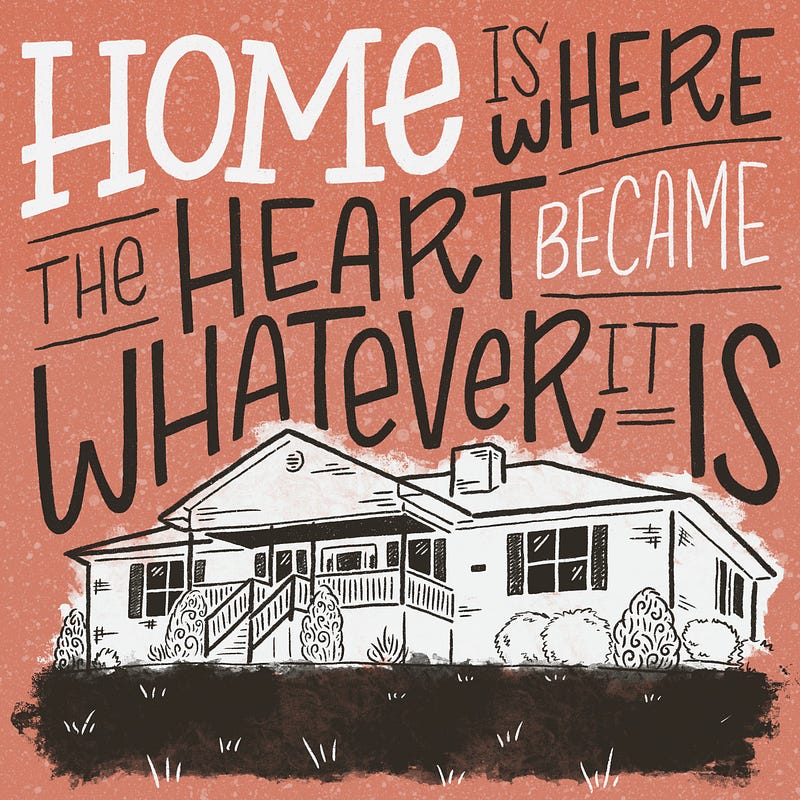
I dragged my suitcase down the red brick steps of the front porch, cursing each one as I went. It wasn’t gravity’s fault, it wasn’t the house’s fault for being perched at the top of a hill, and it certainly wasn’t my fault for going somewhere, or for packing so much—it was obviously and unequivocally the steps’ fault, for existing in so great a number. And they’d been doing it for years.
Finally, out of breath, yet still quite able to grumble, I rolled my baggage down the walkway, lifted it into the trunk, and let my frustrations vanish into an excited smile as I took a seat in the car.
It was the summer of 2015, and I was off for another adventure—this time, to study abroad.
We pivoted the car so we could head forwards down the long driveway. I took one last look at the house as we drove off. It made me happy to see that everything was exactly the same as it had always been—except the For Sale sign in the front yard.
An empty house is not a home
I finished my study program and had planned to do some traveling afterward since I was in Europe.
My parents’ house had been on the market for a few months. It sold while I was away, and they had to be completely moved out before I was due back.
The sights I wanted to see and the experiences I wanted to gain would always be available, but soon, I would no longer be welcome in my own home.
The decision was a no-brainer. I cut my trip short because I wanted to visit home one last time instead.
By the time I got there, the knick-knacks that had made the house a home had mostly been scraped off the shelves and stowed in boxes. The majority of the furniture had either been loaded up or sold. We were left with dust bunnies, impressions on the carpet, and faint silhouettes on the wall where the sun had shone around the same shapes for more than a decade.
What was this place? How dare it pretend to be my home?
When I reached adulthood, my life was reliably different every time I visited. (Though, perhaps that’s to be expected of wherever you’re living from ages 12 to 28.) Schools. Friends. Jobs. Addresses. Partners. At least one of those things would have changed every time I walked through the door.
But everything inside the door was the same. Even the door was the same.
Something I’d greatly appreciated about my own continual evolution was that home was the one thing about my life that would never change.
But suddenly, there it was… Changing. Becoming just a house.
That place had been my safe harbor in the sea of uncertainty I’d been navigating for 15 years. My port was closing itself off.
I was there in the original space, but the structure didn’t feel the same without the furnishings. I was suddenly aware that home was just as much about what was on the walls as it was about the walls themselves, and the corner of the earth where they propped up a roof.
Then I realized I’d never actually be in my home again. It was already gone. I was standing in the shell.
I knew I’d see most of our belongings again, but many had been sold, and the rest were being hauled away in box after box. Next time I’d see them, they’d be on display in my parents’ new house—not my home.
Different structure, different experiences; same people, same things…
But things were never going to be the same.
One thing affected me more profoundly than anything else.
My family has passed down several traditions and possessions over the years. The gift of piano is one.
My great-grandfather played, my grandmother played, my mom plays, and both my sister and I learned it while growing up. There’s always been a piano in the household in that half of the bloodline.
(I can’t vouch for any of my ancestors beyond that, but I like to think the tradition stretches back even further.)
We’d had a piano at my original home in California (more about my split childhood here and here), but it was too expensive to move across the country. For that reason, my folks left it behind during our transition to Tennessee in 1998.
My grandma — who had lived in California for decades by then, but was from the same part of Tennessee where we’d moved — had a family heirloom piano she’d never been able to part with. Like my parents, she hadn’t been able to justify the expense of transporting it across the country in the opposite direction, so she’d left hers in storage in Tennessee.
It was serendipitous to then find ourselves in the same region, but without a piano. So, when we moved into that house, we took it in.
I was told the piano had been slathered with several layers of paint as the fashions evolved over the last century, but Grandma had it lovingly restored to its original, gleaming cherry wooden finish. It was a beautiful antique, but it was usually a little endearingly off-key—just like our family.
It stood right in the center of the house on a wall directly across from the main entrance, in the middle of the living room, on the one section of the wall that connected all parts of the house to each other.
Almost as though it was an anchor to keep us from drifting apart.
For 17 years, we had made mistakes all over that piano—and all around it—but it didn’t mind. It reflected our progress, both in the harmony and complexity of the notes being played as we grew up and in the family photos and seasonal greeting cards displayed on top. It seemed proud to witness our growth.
That day, I watched as it was laboriously pushed out of the house by a bunch of strangers.
It wasn’t being moved.
It was being taken.
The same piano my grandmother had grown up playing, and that her father had composed music on. The one my mom had played when she visited Tennessee as a kid. The one my sister and I had grown up playing together for the second half of my childhood. A piece of furniture as immense as the memories my family had attached to it for four generations.
It was decades of my family’s history those absolute strangers were hauling away. Something priceless had been reduced to a transaction—one my dad had ultimately listed for free, just so someone would take it.
It wasn’t even a blip on a bank statement.
People had to be enticed by the digital equivalent of a glaring yellow starburst with the word “FREE!” just to take something off my parents’ hands, and away from my identity.
Our history was worth a lot more than what it had just become.
Those strangers understood all that, didn’t they? They appreciated everything behind it? They felt all the memories inside?
I didn’t get that impression.
I just hope they value it and take care of it. I hope they use it to glue their own family together through the years.
Maybe that’s why they needed it.
It hurts that I can’t even remember the last song I played on it. I don’t recall the final experience at all, which leads me to believe I hadn’t realized it would be the last time. I would’ve savored it if I’d known. I’d have given the piano a proper acknowledgment and farewell, with the gratitude it deserved.
I take comfort in the fact that I can still play some of the song my sister and I practiced the most on those keys—“Carol of the Bells.” We had both played it so often that we inadvertently committed it to memory at some point. We played it all throughout the year because such a beautiful composition shouldn’t be stored away with the Christmas decorations.
(Note: Our arrangement was far less advanced than the one I linked to, but still very pretty.)
Sometimes, it was dittered absent-mindedly as we’d walk by, almost as if to remind ourselves we still possessed the ability to play. Other times, we’d twinkle it as a way to nonverbally communicate to each other that we were still close, even if we were angry or emotionally distant. Occasionally, we’d even sit down for a duet—at which point, smiles and laughs happened automatically, no matter what was going on in our lives.
And then there were the moments when it was actually Christmastime, and the song made sense again.
I’ve forgotten most of the muscle movements by now, but several happy memories still come to life whenever I hear that tune. Memories of both ordinary days and Christmases that we can never have again, because we’re different people now, with different lives, in different houses.
Time peace
At least the grandfather clock was still there. It will always be there. My parents will never sell that.
The clock has been the singular constant of our entire lives since they got married in 1983. It came with us across the country in 1998 and has continued to tick faithfully as the metronome for our household rhythm. It has stood proudly behind us in photos of every single milestone, during both childhood and adulthood.
It’s only fitting that a timepiece serves as the backdrop for our rites of passage.
The clock is one of the few remaining possessions we’ve had in every house. It feels wrong to use that word for it, though; it’s part of the family.
The final tour
Once the house was empty, I walked through each room and reminisced about some of the memories that had taken place there. Fond ones, painful ones, silly ones. Some were so vivid they still played out right before my eyes, as though I’d entered a cloud where everything was still there, and time had never passed.
Makes sense, I guess—the clock wasn’t there anymore, so time was frozen.
But time was also up.
I took note of the sounds, scents, and tactile sensations I’d never be able to experience again—many of which were already gone.
The distinct, resonant echo of the grandfather clock’s ticking and chime whenever the adjacent basement door was open. The faint singing of the cuckoo clock downstairs that would consistently happen a moment later, not quite synchronized.
The four rhythmic beeps that the alarm system would chirp anytime an exterior door was opened or closed. The ding-dong of the doorbell — and the barking I could still hear our family dog make immediately afterward, even though it had already been seven years since he’d died.
The cavernous sound of the basement door being opened and shut. The creaking noise it would make as it swung on the hinges. The squeaking floorboards of my bedroom. The piles of beige Berber carpet.
The daylight trickled through the window blinds of the sunroom, where I savored my morning coffee as an adult. The same sunroom that had been a kitchen eating area when I was a kid—the place we’d gather for family meals.
All those parts of me were gone now.
My final lap through the house was my way of saying goodbye to each one.
Then, I walked out the front door for the last time.
We never used the front door to leave (unless it was to haul things like heavy suitcases since the porch had fewer steps than the basement). That entrance was either for sitting on the porch to enjoy the view or for bringing guests in and escorting them out.
In an instant, I had gone from resident to guest — the kind that’s not even welcome there anymore.
I looked across at the lake, knowing I’d long since memorized the contours of our corner of the skyline, but also knowing I’d miss getting to see it in person. I walked down the same red brick steps I’d silently cursed at so many times. (Sometimes may have been out loud, too.)
My parents and I pulled out of the driveway, all of us glancing back over our shoulders before driving off for good.
I told myself I was just on another adventure — one that never ends.
The only way I can visit now is in my memory.
It’s been nearly eight years since I last set foot in that house, yet it still feels like it’s just within my grasp. I know it so well that I can visit it in my mind at any moment — and I sometimes do.
It wasn’t just brick and mortar to me. Just like any other treasured belonging, I don’t really see it for what it is (or what it was). I see it for the memories attached to it.
It makes me happy to document memories. That’s my way of never really losing things. I’d be honored to take you on a tour of my home as I remember it.
Like a true hostess, I just need a moment to get things together. But once it’s ready, you are welcome there anytime — and so am I.
Janna Barrett is a flight attendant, writer, and lettering artist based in Washington, D.C. She creates to explore her passions for people, place, and emotional expression. Read her bio here or see her artwork here. 🍌


