
Illinium
An element by any other name…
Today’s New York Times Spelling Bee letters:
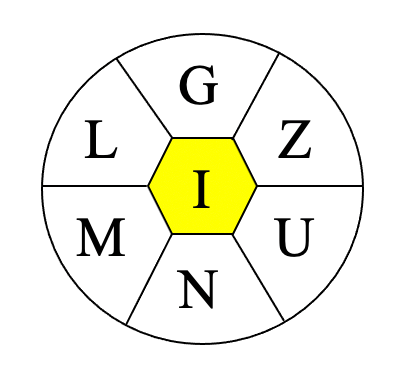
G, L, M, N, U, Z, and center I (all words must include I)
Merriam-Webster says…
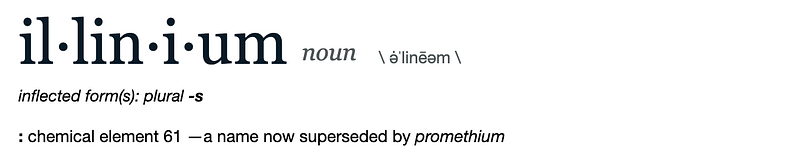
Silly little dictionary! Don’t you know illinium can’t possibly be a word if the New York Times says it ain’t?
For further fascinating facts, check out the Spelling Bee Master.
What’s your favorite dord* from today’s puzzle?
My Two Cents
The dictionary explains that the word illinium comes from the word Illinois and the suffix -ium, which indicates a chemical element. What is this chemical element from Illinois, you may be wondering. Well, about a hundred years ago, the epitome of exciting news in the science world was the discovery of a new element.
And chemical element number 61 was briefly known as illinium, but could have also ended up being named florentium. Thanks to the wife of one of the discoverers of the element, it’s now called promethium, after the Titan who fashioned humans out of clay and then gave them fire so they could turn themselves into ceramic.
Chasing 61
In this case, we’re not talking about the race Mickey Mantle and Roger Maris had in 1961 to be the first to break Babe Ruth’s then-record of 60 home runs in one baseball season.
As Wikipedia explains:
In 1902, Czech chemist Bohuslav Brauner found out that the differences in properties between neodymium and samarium were the largest between any two consecutive lanthanides in the sequence then known; as a conclusion, he suggested there was an element with intermediate properties between them. This prediction was supported in 1914 by Henry Moseley who, having discovered that atomic number was an experimentally measurable property of elements, found that a few atomic numbers had no known corresponding elements: the gaps were 43, 61, 72, 75, 85, and 87. With the knowledge of a gap in the periodic table several groups started to search for the predicted element among other rare earths in the natural environment.
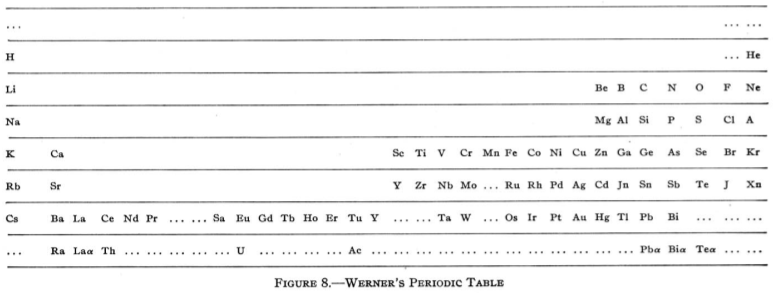
In order to better understand what was going on, here is Swiss chemist Alfred Werner table as he drew it up in 1905:
And here is the latest periodic table, fresh off the today’s printing press:
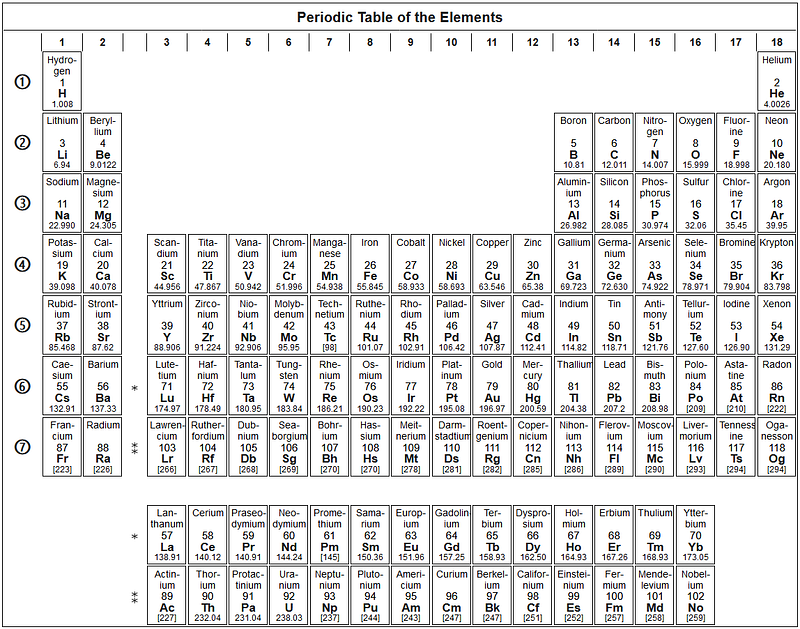
You can see the similarities as well as the gaps… and even symbol changes.
For example, in the 1905 table, if you go down to the fifth row (I’m not counting the empty top row), slightly past the middle, you’ll see an ellipsis (…) between molybdenum (Mb) and ruthenium (Ru). That’s element 43, predicted to exist nine years later by Henry Moseley.
Element 61 appears “missing” in the next row, the one that begins with cesium (Cs) on the left. In the 1905 table, 61 is supposed to be located between praseodymium (Pr) and samarium, which was written as Sa back then but has since been changed to Sm.
Today we know element 61 is Promethium and is located between Neodymium (Nd) and Samarium (Sm). Many years ago, however, it was almost named for a city or a state.
in 1926, two separate research groups published their results claiming they had discovered and isolated element 61. The first claim was published by Luigi Rolla and Lorenzo Fernandes of Florence, Italy. They separated a mixture of a nitrate concentrate with rare earth elements from the Brazilian mineral monazite, and analyzed it with x-ray spectroscopy. The result was samarium and element 61. In honor of their city, they named element 61 “florentium”.
A group of scientists from the University of Illinois at Urbana–Champaign also claimed to have discovered element 61. They named it “illinium,” after the university... and their state. However, both reported discoveries were proven to be erroneous because the spectrum lines thought to belong to element 61 were in reality just indicating some impurities (barium, chromium, and platinum).
It took almost twenty more years for element 61 to be produced and characterized. Jacob A. Marinsky, Lawrence E. Glendenin, and Charles D. Coryell, who worked at Oak Ridge National Laboratory obtained the element by irradiating uranium fuel. Because the lab was named Clinton back then, the proposed name was clintonium. Can you imagine how the presidential campaigns in the 1990s would have been if there had existed an element by that name?
Thankfully, Grace Mary Coryell, wife of the third of the three chemical tenors mentioned above, suggested “prometheum”, in honor of the ancient Greek mythology character. Eventually the official name was changed to promethium, in accordance with chemical naming conventions.
Remember the Titan?
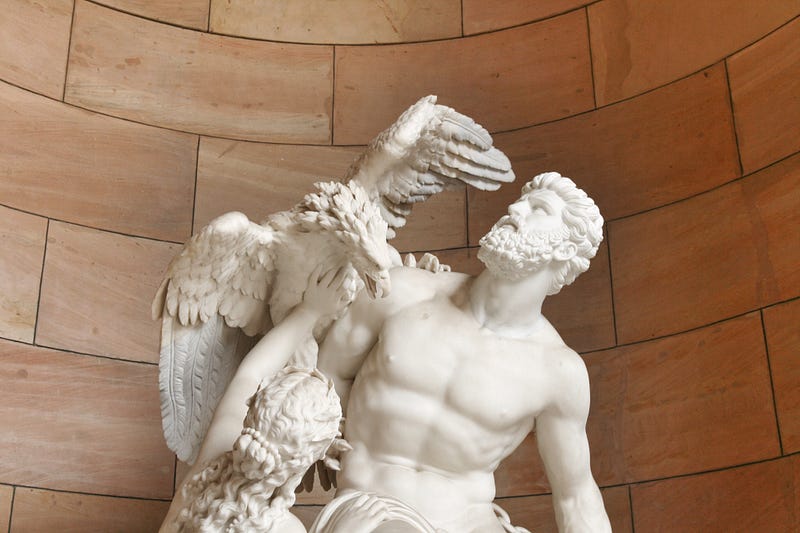
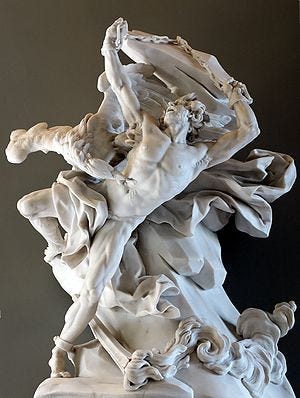
Prometheus is best known for gifting us humans with fire, according to Greek legend. Also for having his liver pecked at every day by an eagle as punishment. The liver would grow back overnight, and the eagle would come back the next day to feast again.
That’s what the photo at the top of today’s column shows. It’s a closeup of a 1762 sculpture by Nicolas-Sébastien Adam that’s in the Louvre museum in Paris, France. Here is the artwork in its entirety.
Dutch painter Dirck van Baburen had his Greek and Roman gods completely mixed up, so he painted the Roman god Vulcan chaining the Greek Prometheus while (Roman) Mercury enjoys the show.
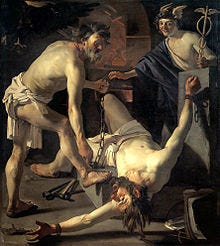
Oh, yeah, and apparently van Baburen thought Vulcan enjoyed having his toes sucked by others.
Prometheus was eventually freed by Heracles, who is the Greek equivalent of the better-known (and Disneyfied) Hercules. Or as he’s known in the United States, Kevin Sorbo.

There you go. Despite a former TV hunk being involved in today’s convoluted explanation of a word, the editors of the Spelling Bee decided that illinium is a dord*.
You can check out my previous entry on another dord* here:
*What the heck is a dord, you ask? Here’s the answer: