
Ikat
Not the online feline people rave about
Today’s New York Times Spelling Bee letters:
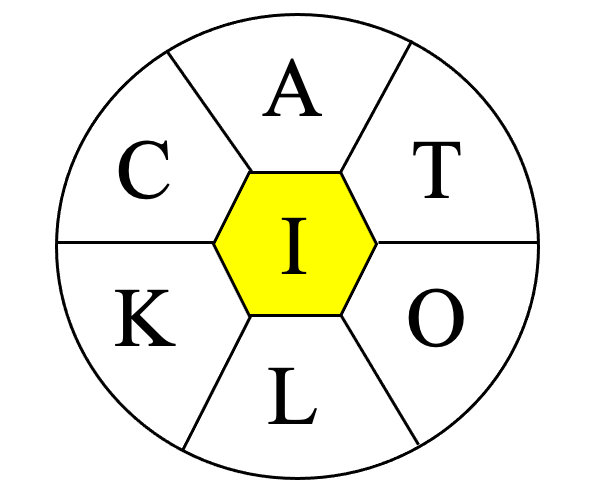
A, C, K, L, O, T, and center I (all words must include I)
Merriam-Webster says…
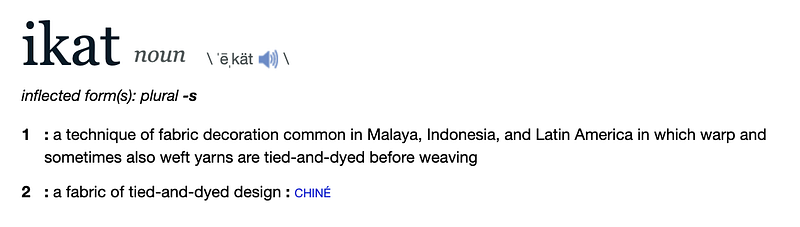
Silly little dictionary! Don’t you know that ikat can’t possibly be a word if The New York Times says it ain’t?
For a complete list of rejected words, check out the Spelling Bee Master.
What’s your favorite dord* from today’s puzzle?
My Two Cents
My very limited experience with fabrics as an art comes from when I was in third gird, give or take a school year. In art class our teacher decided we should learn how to tie-dye shirts — it was the 1970s, after all — and so we did. Today I can still vaguely remember bunching up several parts of the white t-shirt I brought, and then tying off those sections with rubber bands. I don’t remember what dyeing process we used, only that my result was a multicolor splatter that I wore maybe once. I did keep the shirt for a few years, tucked away in a drawer.
Back then I thought tie-dying was a fad; I wasn’t aware it was millennial technique known as resist dyeing, widely used in Asia and Africa since ancient times.
Dyeing to resist
First things first. Ikat is not pronounced EYE-cat. The “i” is pronounced like a long “e” (as in “be”), while the “a” in kat is closer to the sound it makes in “card” than in “cat”. And our friends at Merriam-Webster tell us that the word is borrowed from the Malay language, where it means “tying-up” or “fastening”, in reference to what is done to the yarn before dyeing it.
Resist dyeing is not what vampires do. It’s a traditional method of dyeing textiles with patterns. Methods are used to “resist” or prevent the dye from reaching all the cloth, which creates a pattern. The most common techniques use wax, paste made from starch or mud, or a mechanical method that manipulates the cloth, such as tying or stitching.
In ikat, the resist is formed by binding individual yarns or bundles of yarns with a tight wrapping applied in the desired pattern. The yarns are then dyed. The bindings may then be altered to create a new pattern and the yarns dyed again with another colour. This process may be repeated multiple times to produce elaborate, multicolored patterns.
A characteristic of ikat textiles is an apparent “blurriness” to the design. The blurriness is a result of the extreme difficulty the weaver has lining up the dyed yarns so that the pattern comes out perfectly in the finished cloth. The blurriness can be reduced by using finer yarns or by the skill of the craftsperson. Ikats with little blurriness, multiple colours and complicated patterns are more difficult to create and therefore often more expensive. However, the blurriness that is so characteristic of ikat is often prized by textile collectors.
Different styles and designs of ikat can be found all over the world, depending on the culture that is creating the weave. There are three basic categories that depend on the weaving technique used: warp, weft, and double ikat.
In warp ikat it is only the warp yarns that are dyed using the ikat technique. The weft yarns are dyed a solid colour. The pattern is clearly visible in the warp yarns wound onto the loom even before the weft is woven in. Warp ikat is, amongst others, produced in Indonesia; more specifically in Kalimantan, Sulawesi, and Sumatra by respectively the Dayaks, Torajans and Bataks.
In weft ikat it is the weaving of weft yarn that carries the dyed patterns. Therefore, the pattern only appears as the weaving proceeds. Weft ikats are much slower to weave than warp ikat because the weft yarns must be carefully adjusted after each passing of the shuttle to maintain the clarity of the design.
In double ikat, both warp and the weft are resist-dyed prior to weaving. Obviously it is the most difficult to make and the most expensive. Double ikat is only produced in three countries: India, Japan and Indonesia. The double ikat made in Patan, Gujarat in India is the most complicated. Called “patola,” it is made using fine silk yarns and many colors.
Here is a video showing two different types of ikat weaves made by Khmer in Cambodia:
All for mom… and mum for all
Although ikat traditionally been done manually in old-fashioned weaves, a few decades ago one Indian man decided to help his mother modernize her work. As an article from The Hindu explains:
As a young boy, Chintakindi Mallesham would watch as his mother Lakshmi, a handloom weaver, laboured for hours, winding metres of silk yarn on to a large frame — a process called asu that is integral to the creation of the exquisite Pochampally Ikat sari. In this often painful process, the weaver has to stretch her arms continuously to wind yarn around two sets of pegs on either end of a four-foot structure before the sari is woven. Lakshmi’s shoulders and elbows would ache from the repetitive work, and Mallesham, a Class VI dropout from Aler village in Telangana’s Yadadri district, made up his mind to ease his mother’s pain.
Mallesham had no prior technical or engineering knowledge, but his trial and error approach over the course of most of the 1990s proved fruitful when he finally finished his device and brought it to his village to try out. It was a success and, over the years, Mallesham improved on the machine’s design by incorporating electronic components. He also learned basic computer programming to automate some of the machine’s processes.
Malleshan became so famous that a movie about his life and invention came out in 2019. Here is the trailer:
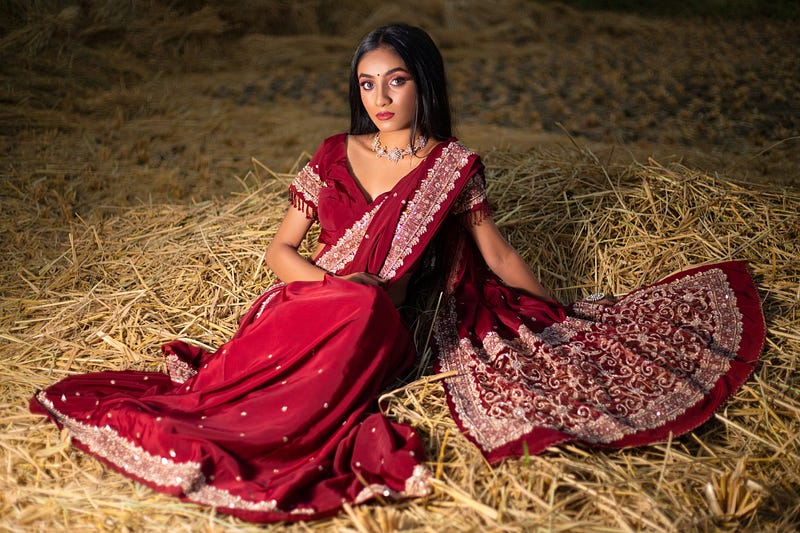
Now you know. Next time you’re shopping for a sari in a traditional Indian market, you can show off your knowledge by asking if they can show you one with a double ikat. Don’t be surprised if no one knows what you’re talking about, though… because the editors of the Spelling Bee decided that ikat is a dord*.
You can check out my previous entry on another dord* here:
*What the heck is a dord, you ask? Here’s the answer: