
IDIOMS | LANGUAGE AND CUSTOMS
Idioms From Our Childhood or Pithy Remarks From Mom or Grandma
The meanings and how they differ in cultures
A US-born male friend is married to a naturalized citizen whose native home country is El Salvador.
Despite having resided in the States for decades, American idioms drive her crazy. Not raised with similar pithy advice, of course, they’re non-sensical to her. I’d never thought about it until his off-the-cuff remark.
Cogitation led me to meander a few memory lanes, recalling these classics that remain vividly imprinted from my youth and growing up in the States.
Whether they are universal in other mainly English-speaking countries or not, I’m unaware.
Because the US is a big country, regional idioms vary. For example, in the South — Texas comes to mind —many are hysterical and of an entirely different realm that I, as a non-southerner, understand few. (Josh H. from Mississippi, another southern state — the section of the USA with its own language by the way 😏 — may have some additions to the list).
These, though, are universally familiar and used throughout all regions and the fifty states. It’s a brief introduction if you visit the US and hear odd remarks.
— — — — — — — — — — — — —
The sayings: How I interpret them
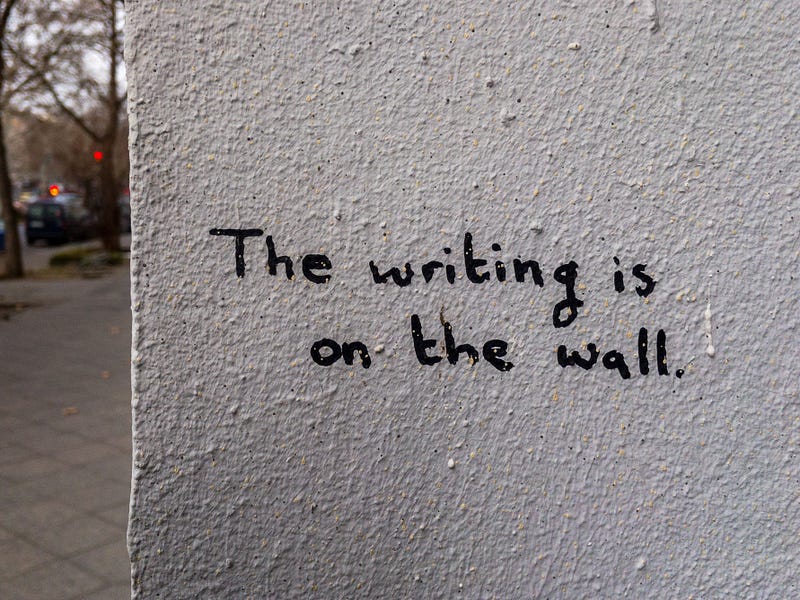
✓ The (hand)writing is on the wall: Something is inevitable, usually something bad
✓ Not till hell freezes over: It’s not going to happen...ever!
✓ Over my dead body: Same meaning, It won’t occur! (I don’t particularly like the connotation of this one)
✓ Hungry as a horse: Ravenous or famished
✓ Through thick and thin: To be loyal through good and bad times
✓ You’ve made your bed, now lie in it: You get to live with your choices…or screw-ups
✓ Straight from the horse’s mouth: Information from one in the know or an authority
✓ Once in a blue moon: Rarely or infrequently
✓ Running around like a chicken with its head cut off: Scatterbrained or frenzied (by the way, chickens do this when killed)
✓ Put in your two cents' worth: To offer an opinion, often unsolicited (ala an Instagram or YouTube influencer😉)
✓ Hit the hay: Go to bed
✓ The ball is in your court: It’s your decision
✓ Up in the air: The matter is unresolved or unclear
✓ Kill two birds with one stone: Achieve two goals with one action (out of favor today for obvious reasons)
✓ Raining cats and dogs: A torrential downpour
✓ Under the weather: Feeling ill or unwell
✓ Spill the beans: Disclose a secret
✓ Pull someone’s leg: Play a joke on a person
✓ Crooked as a dog’s hind leg: Dishonest or deceptive
✓ A day late and a dollar short: Someone’s actions are too little, too late
✓ Not until the cows come home: A very long time and unlikely to occur
✓ A piece of cake: Easy or simple
✓ Hit the nail on the head: Accurate or correct (“I nailed it”)
✓ A dime a dozen: Commonplace or ordinary and of little value
✓ For the birds: Something silly or ridiculous
✓ It takes two to tango: Both parties are responsible or contributed
✓ Elephant in the room: Something everyone is aware of but tend not to discuss
✓ Beauty is painful: My Mother’s reply as I screamed while she tightened the permanent rollers into my girlish locks, soon to be curly (a standard means of accepted child torture of the era)
And, my favorite. I had to research its origin because the meaning is counter-intuitive.
✓ Break a leg: Good luck (often used to wish performers well before going on stage)
There isn’t a consistent explanation of its derivation. Here are a few from Wikipedia:
The earliest published example in writing specifically within a theatre context comes from American writer Edna Ferber’s 1939 autobiography A Peculiar Treasure, in which she writes about the fascination in the theatre of “all the understudies sitting in the back row politely wishing the various principals would break a leg”.[15]
American playwright Bernard Sobel’s 1948 The Theatre Handbook and Digest of Plays describes theatrical superstitions: “before a performance actors never wish each other good luck, but say ‘I hope you break a leg.’”[16] There is some anecdotal evidence from theatrical memoirs and personal letters as early as the 1920s.[2][17]
Other popular but implausible theories:
The performer bowing. The term “break a leg” may refer to a performer bowing or curtsying to the audience in the metaphorical sense of bending one’s leg to do so.[9][6]
The performer breaking the leg line. The edge of a stage just beyond the vantage point of the audience forms a line, imaginary or actually marked, that can be referred to as the “leg line”, named after a type of concealing stage curtain: a leg.
For an unpaid stand-by performer to cross or “break” this line would mean that the performer was getting an opportunity to go onstage and be paid; therefore, “break a leg” might have shifted from a specific hope for this outcome to a general hope for any performer’s good fortune.[18][19]
Even less plausible, the saying could originally express the hope that an enthusiastic audience repeatedly calls for further bows or encores. This might cause a performer to repeatedly “break” the leg line,[20] or, alternatively, it might even cause the leg curtains themselves to break from overuse.[21]
Allusion to David Garrick. During a performance of Shakespeare’s Richard III, the famed 18th-century British actor David Garrick became so entranced in the performance that he was supposedly unaware of a literal fracture in his leg.[22]
Audience chair legs. Various folk-theories propose that Elizabethan or even Ancient Greek theatrical audiences either stomped their literal legs or banged chair legs to express applause.[20]
https://en.wikipedia.org/wiki/Break_a_leg#Theatrical_origins
Are these familiar in predominantly English-speaking countries? How about in others around the globe? India, Greece, France, Italy, Asia, Africa, South America?
I’m curious about the advice from your elders.
Thanks for your time. 😎