
ENVIRONMENT
I Worked for Big Oil and I’m Sorry
Recent Cali spill disgusts me; it should anger all of us
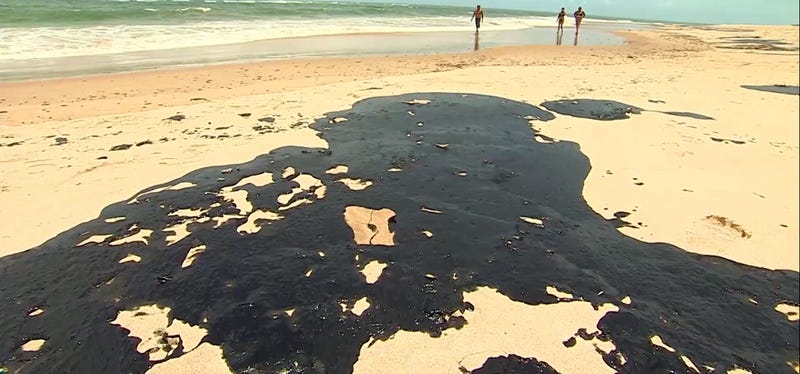

I need to be up front about this: I’m from Texas.
My family roots go back several generations.
I don’t live there anymore, but I’m proud of the Lone Star State — most of the time. Well, recently it’s been a little up and down with me and my homeland. But you should know I love where I’m from.
Yes, we’re often a foil of those who call themselves “progressives”. Face it: Our politicians have never been the most forward-thinking — not by a long shot.
Unlike a lot of y’all, I can’t blame Texas or Texans for everything. But the recent massive oil spill out in Southern Cali has got me thinking, and I do want to own up to one thing.
My high school standing as a founding member of the Ecology Club aside, I haven’t always been a good friend to Mother Nature.
You see, I worked for Big Oil once. No, I didn’t jackass a rig out in far West Texas, as my Daddy — who was from out there in the impossible-to-love but hard-to-give-up-on far reaches of the state — would say. I wasn’t a roughneck in Midland/Odessa, nor a company executive in my hometown, Dallas.
I spent five years with an outfit in D.C. called the American Petroleum Institute. API, as it’s known, is technically a “trade association” in political parlance — one of 3,000+ such “professional” organizations representing every special interest you can think of, from turkey producers, to drone manufacturers to the footwear industry, to state and local municipalities.
My job, basically, was to make Big Oil — and its affiliates — look good.
The general public, as most of you are known, calls companies like API “lobbyists”. That’s not 100 percent accurate — since most of us were not registered as such — but the close to 700 employees at the organization’s offices near Capitol Hill are most definitely interested in convincing Congress to pass laws that help out the oil and natural gas industry.
I labored in API’s communications shop. Those are the folks — most of us formerly connected with politics and the press — who “shape” API’s “message”.
That means I spent most of my time talking to reporters, taping video and audio packages for small-town news outlets, writing speeches and crafting congressional testimony, all designed to put the best face on for some 600-odd “energy” companies who were API members.
So, I didn’t really lie, but I also didn’t always tell the truth.
And for that, I’d like to issue the most public of apologies.
I can blame my youth — all of 33 at the time when I hired on — or I could blame my Texas roots. When I was growing up — and continuing close to the early ’90s, when I helped craft API’s “good guy” image — a combo of various energy sectors operating in my state could at any given time account for close to half of the Texas economy.
That’s no longer the case, but things still get all whompy-jawed, as my Nana used to say, when the price of crude oil plummets.
So, my job in D.C. was to make sure that we pushed the importance of American energy independence (Exxon-Mobil, good; OPEC, bad), while putting a pretty face on the occasional “oopsie” — i.e. a tanker “mishap” like the Exxon Valdez in 1989, or a drilling platform spill like the Deepwater Horizon in 2010.
I was around for the tanker crash up in Alaska, but not for the rig disaster in 2010, praise the Good Lord, (thank you, Nana). It’s interesting to note that the Exxon Valdez was our worst domestic oil spill until Deepwater Horizon came on the scene 21 years later.
Needless to say, I had to become familiar with the lingo. A disaster like an oil spill could be anything from an “unfortunate occurrence” to “an opportunity to demonstrate API members’ commitment to the environment”. We pushed America’s dependence on oil and natural gas hard, without mentioning the commodities “oil” or “natural gas”. We pressed our interest in “policy issues”, without saying our goal was to shift the conversation to a platform that would put us on more steady, shall we say, ground.
I was all on board with the goals of the industry I represented until, of course, I wasn’t.
But it was a painfully long process. I knew, for the longest time, that oil and natural gas paid the bills back home in Texas, and I wasn’t ready to shuck that belief. Even the most progressive of progressives down there — and don’t let anyone tell you there aren’t any — knows that Big Oil was a big deal back in the day.
I left representing American energy interests for a more rewarding vocation — stay-at-home-mom. From there, as the kids grew up, I moved on to education, completing an incredibly fulfilling job as a high school publications adviser and English teacher when I retired.
I didn’t, overtly, give a lot of thought to Big Oil once we parted ways, or the euphemistic “energy sector” or the ramifications of building offshore rigs close to my beloved Outer Banks in North Carolina. Until, of course, my son-in-law brought it up over dinner.
Offshore drilling has been part of the national discussion in recent years, and I thought I was OK with that.
My SIL mentioned his opposition to rigs drilled just offshore in places like California, Texas and Louisiana. He pointed out, in his low-key way, that the State of Florida won’t allow those rigs — even in a predominantly conservative and GOP-dominated state — because it just takes one big “oopsie” to wreck the tourist economy.
Of course, AJ isn’t all that interested in tourism. His focus is on the environment. And Mother Nature is getting less and less kind to those of us who want to do her harm.
I cut him off that day by saying I didn’t agree. His face registered not just shock — I don’t think he’d ever met a perfectly reasonable person like me who happened to hold perfectly unreasonable views. Pro-Big Oil, you say? My daughter told him he wasn’t going to change my mind, and we went on to sunnier conversation.
But that look on his face has stayed with me.
They say late is better than never, and I agree.
I’ve had some time since that family discussion to reassess my thoughts on the environment, Big Oil and my SIL’s thoughts on drilling. Part of it is that I’ve been out of Texas for a good, long while, and the old arguments just don’t ring true anymore. Part of it is that Texas’ economy is so diversified now — of recently ranked industries driving the state’s financial well-being, “energy”, aka “Big Oil”, is a paltry Number 8.
Part of it is I’ve done my research, and my SIL is right.
Texas politicians — for a variety of reasons — are finally recognizing the benefits of an economy that pulls from many sectors. They’ve still got a long way to go — the best example recently, of course, is the energy grid’s complete meltdown this past winter — but I do believe they’re getting there. Fully 21 percent of electricity generation in the state comes from renewables like wind, solar and hydro power. If you add nuclear — yeah, I know, problems up the wazoo, but aren’t they working on it? — the percentage goes up to 32 percent, with natural gas and coal making up the rest.
And I’m glad North Carolina — which is where I now live — has been taken off the offshore drilling list, for the time being. And I recognize that drilling operations in the Gulf of Mexico aren’t going to end anytime soon. But the recent California spill seems to be turning out to be a big deal. And we should pay attention to the consequences of our actions.
I’m not saying we’re all there yet, but I certainly am. After all — It’s not nice to fool Mother Nature, is it?