
I Wasted Time Worrying About Food and Weight — Here’s How I Got My Life Back
After gaining many pounds — I won’t include the number to avoid triggering anyone — I feel like I still look the same as when I lived in a smaller body.
And that’s what we call body dysmorphia.
I spent years struggling with disordered eating. While the cause wasn’t all about body image, body image definitely played a role. My weight, what I ate and calories I could burn from exercise filled my brain. People with eating disorders think about these topics 70 to 100 percent of the time.
I would hang out at friends’ houses and think more about controlling how much I ate and calculating calories than the conversations we had. I kept a list on my phone of every single thing I ate or drank. I would step on my scale numerous times a day and the number would affect my mood the remainder of the day. I had nightmares about binge eating.
My life wasn’t a life anymore. My unhealthy relationship with food and weight was making me more powerless and unhappy than I was willing to admit. I was chained to the scale.
After years in recovery, I’ve learned that life has so much more to offer. Writer and eating disorder survivor Lindsey Hall said, “To live, but always with this caveat, to love, but with only so much to give, to overlook a beach or mountain or piece of art, only to wonder when my next run is: Well, is there anything more destructive than that?”
Few things are more destructive than that. And that caveat, that destruction, is vast and long-lasting.
It’s physical pain, emotional distress and suffering relationships, to start. It’s feeling so physically full that you want to throw up, and it’s being unable to sleep from hunger. It’s some of the biggest memories — like prom and birthday parties —being clouded with memories about calories. It’s feeling anxious rather than excited about spontaneous ice cream trips with best friends.
After realizing I wanted a fuller life and doing some hard work, I was able to rebuild my relationship with food, exercise and my body.
In therapy, I learned that food doesn’t have moral value, that my body will tell me what it needs and that I should trust it. I learned to not engage in exercise that makes me unhappy or focus on the calories I burn from it. I learned to appreciate my body for its existence, not how it looks.
My value isn’t found in what I eat, how many calories I burn or how I look. My value is in my humor, my kindness, my empathy, my intelligence and more.
And more than that, my worth is inherent.
Now, I eat what I want and don’t think about it. Now, I have the brain space to think about my passions and what’s going on in my friends’ lives. Now, I don’t step on the scale or research how many calories are in a food I’m about to eat. Now, I know food has no moral value and that what I eat doesn’t have anything to do with who I am.
My body image plays less of a role in my life, and I’m able to see my body more so as something I own that helps me live rather than something that’s unacceptable or a reason for someone’s judgment.
I know questions I need to ask myself when I’m struggling with body positivity. I know that health can’t be defined by a body type and that it doesn’t include obsessing over food or exercise.
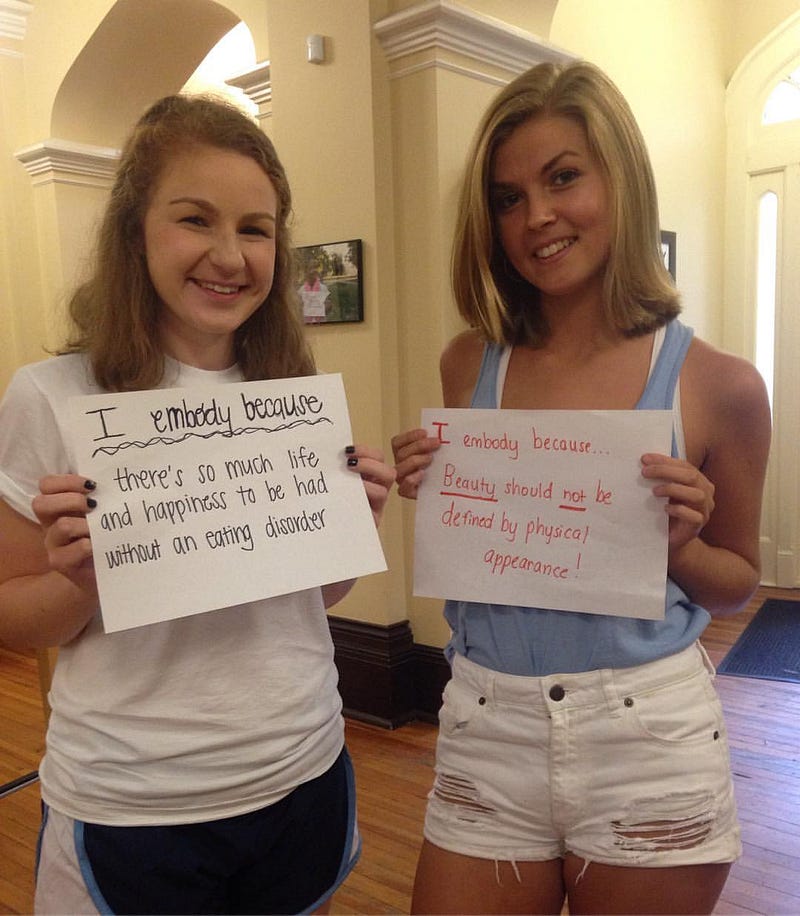
To help me remember these important lessons, I attended Southern Smash every year in college. Southern Smash is a program of The Alliance for Eating Disorders Awareness in which students can smash decorated scales and engage in other self-love activities.

I want to be clear, though: Getting to this point and staying here wasn’t easy or quick. I have struggled many times. I have cried, hopeless. I’ve thought I’d never be able to go to a restaurant and order what I wanted rather than what had the least calories. I’ve thought I’d never recover or feel good about my post-weight gain body.
I had to go to therapy. I had to ask people to hide my scale from me. I held onto diet pills for years as a source of comfort, even though I wasn’t taking them anymore.
But now, I don’t weigh myself and I’ve never been happier. I order what I want at restaurants, even if what I want has the highest amount of calories. I love spontaneous ice cream trips and I love making memories that center on how amazing my friends are. I don’t worry about what my body looks like as often.
I know the fact I’m not struggling as much with body image is because I have thin privilege. No one tells me to diet, doctors don’t misdiagnose me and I can easily find clothes in my size.
But despite the fact that liking my body is easier for me than it is for others, I’m still proud of my success, and I’m still happy with where I am now.
I don’t want to engage in unhealthy eating behaviors anymore. I want to have a full life rather than one in which I’m perpetually stuck in a restricting-binging cycle. I know dieting doesn’t work and that 97 percent of dieters regain the weight and then some within three years. I know my relapses didn’t last long and didn’t “work” because I don’t see them as worthy of my time or emotional space anymore. I know that dieting is the biggest predictor of an eating disorder, something that took away some of the biggest moments in my life.
After struggling with disordered eating and body image for multiple years, I learned I don’t really have anything to show for it. I learned I have better things to do than waste my time chasing a sense of perfection that’s unattainable, and that losing weight doesn’t lead to better body image.
Recovery takes two to 10 years. I say this so you can read this and know that even if you’re not to this point now, you will be someday if you keep working at it.
Recovery is hard work, but my gosh, is it worth it.
You have so many reasons to hold onto hope. You hold a strength inside that you’re not aware of or don’t give enough credit. You have thousands of people ahead of you who have gotten better even though they didn’t think they could and are so thankful they made that choice. No one recovers and says it wasn’t worth it.
If you’re struggling, I encourage you to see a therapist. You can filter through therapists and other mental health professionals through this Psychology Today database. I encourage you to unfollow social media accounts that are triggering or make you feel bad about your body. I encourage you to be honest with your loved ones about what conversations are unhelpful. I encourage you to push yourself when recovery is hard and to hold onto faith tightly. I encourage you to talk back to that dieting or eating disorder voice and realize how it doesn’t serve you. I encourage you to think about what it’s taken away and all that you’ll gain from living a food-positive life.
Take your life back today. Reach out for help. Stay hopeful, and know that you’re fighting the good fight that will lead to true happiness. You can do it, and you won’t regret it.
If you think you may be struggling with disordered eating, you aren’t alone and help is available. You are “sick enough” and deserve support. The National Eating Disorders Association has helplines here and The Alliance for Eating Disorders Awareness lists support groups, referrals, trainings and more here.