
I Gave Up the Scale and I Couldn’t be Happier
I’m not so scared anymore.
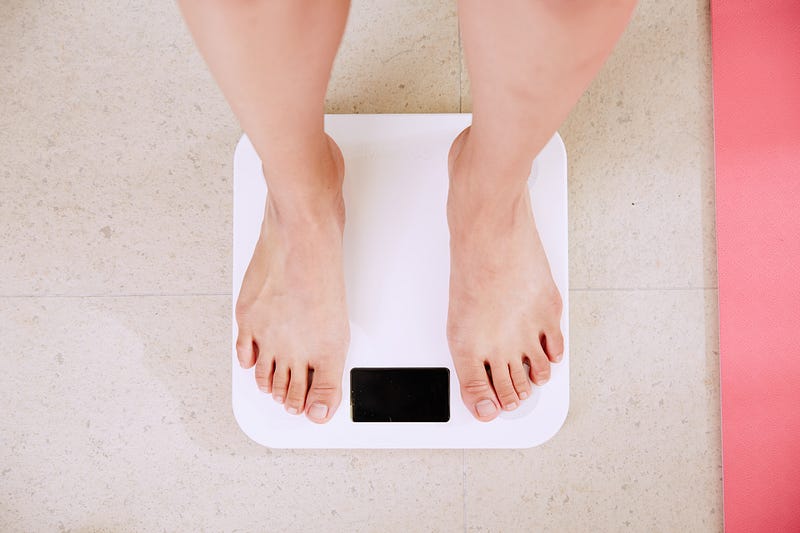
My scale has dust on it now, but it hasn’t always.
I spent years chained to scales in not only my own bathroom, but others’ bathrooms as well. I’ve gone through several scales — a cheap black one, a glass Weight Watchers one and more — as they seemed to lose their accuracy.
I cared a lot about the accuracy because so much depended on that number. My life centered around my weight, but it also centered around how I could control it. For years I engaged in disordered eating behaviors that left me with an unhealthy relationship with food and my body.
In a way, I thought the world would end if I gained too much weight. I needed the number to go down in order for me to stay sane.
The number on the scale meant more to me than I want to admit sometimes.
I found my worth there. I found my mood for the day there. I found my successes and failures there.
I now know that none of those things can be found on a scale. The scale held a number, nothing more.
But my journey getting to that point wasn’t linear, easy or short.
Not all that long ago, I weighed myself. Not multiple times a day, like I used to, but definitely once or twice a day.
I told myself I was just curious. Was that true? Maybe.
But I think my reasoning was deeper than that, more subconscious. Weighing myself felt comfortable. It was something I was used to, something I felt attached to, something I felt I needed after years of making it a habit.
And my habit didn’t even start as early as it does for some people: Research shows that toddlers as young as 3 years old worry about their weight, with 50 percent of preschoolers concerned about their bodies.
Adults also struggle with feeling the need to lose weight regardless of how much they weigh. According to the Centers for Disease Control and Prevention, over 26 percent of adults in the “normal” or “underweight” range have tried to lose weight.
I fit into those statistics.
The number on the scale meant more to me than I want to admit sometimes.
But as I realized how harmful the scale could be, I worked hard to forget about it, to avoid it. I knew the number would never be low enough for me to feel good about myself no matter how much I weighed. I knew the number I saw would ruin my mood and make me feel worse about myself than I deserve to feel.
I knew weighing myself could turn into unhealthy eating behaviors that would worsen both my mental and physical health. I knew it could push me down a rabbit hole, one I’ve worked so hard to climb out of for so long.
My journey getting to that point wasn’t linear, easy or short.
Dietitian Rachael Hartley points out several reasons why the scale isn’t useful.
First, the scale is inaccurate. A mere two cups of water weighs one pound. Add in food weight, hormonal changes, temperature and more, and the weight the scale says is not at all correct.
Further, what we weigh isn’t even a complete indicator of health, Hartley says. Many determinants of health exist, such as socioeconomic level, access to health care and mental health, as well as other social determinants.
Additionally, Hartley says that weighing ourselves can interfere with intuitive eating. If we weigh ourselves and don’t like the number (and we likely won’t), we may be more likely to avoid eating when our body tells us it needs food.
When the scale is sitting in your room though, and no one else is around, avoiding it can be difficult. You tell yourself it’s fine, but it’s not.
Because of this, I asked a loved one of mine to hide it. I don’t see this as a weakness anymore — I see this as strength. Being willing to admit that the scale tempted me and then to go forth and ask someone to take it away from me was hard.
I didn’t want to need someone to take it away; I didn’t want to lose that control. I didn’t want to have to say out loud that I was struggling.
But doing it anyway is what made me strong.
My journey getting to that point wasn’t linear, easy or short.
Now that the scale has been hidden from me for multiple months now, I’m a lot happier. I still miss it sometimes, but I don’t have to look at it anymore. I know that if I had it, I would inevitably step on it at some point, and inevitably feel bad about it. I’d feel bad about the number, even though it means nothing, and I’d feel bad about giving in and stepping on it.
My next goal is to revisit my alma mater, UNC-Chapel Hill, with that scale when Southern Smash happens. Southern Smash is a program of The Alliance for Eating Disorders Awareness in which people can smash scales and engage in other body-positive and esteem-boosting activities.
While I attended Southern Smash all four years in college, I never smashed my own scale — only the ones provided.

But it’s time for that to change, isn’t it?
I’m not so scared anymore.


