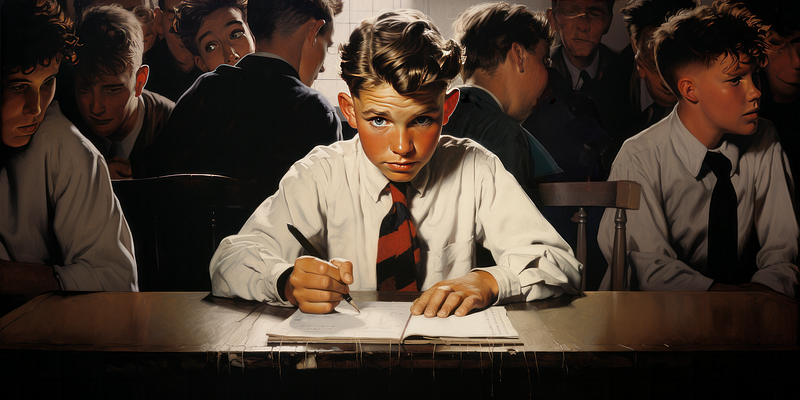
Editorial: Artificial Intelligence, Writing & Creativity
The ethical use of AI in writing: it’s a tool, not a threat
“I use AI to proofread my writing. Is that okay with you?”
The key to ethical use of AI rests in transparency and the empowerment of individual voices, rather than its outright dismissal as a tool for ‘cheating’.
We can all agree that AI has irreversibly changed writing. That genie isn’t going back in the bottle anytime soon. It would take an EMP! But what I’d like to suggest today is that AI isn’t that different from any other writing technology that we’ve adapted to over the years, and that changed our writing systems, language, and cultures. Everything from wax tablets, quills, brushes, printing presses, typewriters and personal computers.
AI generated text isn’t bad. It boils down to how its used. There are ethical and unethical ways to deploy any writing tool: propaganda can be human-made, and you can cheat with a pencil if you look over people’s shoulders!
How can we keep tabs on AI generated content?
On January 27 Medium launched a mostly balanced policy on AI content:
“Medium welcome[s] the responsible use of AI-assistive technology... To promote transparency, and help set reader expectations, we require that any story created with AI assistance be clearly labeled as such”.
In practice, it’s much harder than it appears. Currently there’s no surefire way of detecting AI content. How does one decide what is AI assisted, if it operates on the honor system? And who will be falsely flagged? I write my own blog by myself because I enjoy writing, but I’m regularly mistaken for being AI because I write about artificial intelligence. Previously I enjoyed a high distribution rate, but I haven’t had an article distributed since the new rules. I can only suspect it’s due to being misprofiled. Still, it hasn’t hurt my external views (1.3 million last month), nor my constant readers. But I worry that the AI witch trials will hurt writers who are disadvantaged.
When AI content detectors are wrong, they discriminate
Why? Because AI content detectors rely on identifying statistically low perplexity and burstiness in text, and those are the exact same textual markers that red-flag English Second Language and beginner writers:
Basically, they look for low variation in vocabulary (“perplexity”) and stock phrases and cadences (“buristiness”). I speak languages other than English, but not fluently, and given those parameters, I wouldn’t pass a Turing test!
So effectively, we may be silencing disadvantaged voices when we start pointing fingers. And perhaps people who are less skilled at English for whatever reason should be allowed to use AI! Would you ignore somebody in conversation if they had to pull out a Lonely Planet travel phrasebook?
Whether intentional or not, there’s a definitely privilege at work which says the better you write, the more human you are. You are rated by your words.
AI isn’t what you think it is
As amazing as ChatGPT looks right now, it’s actually closer to spellcheck and Grammarly than it is to “Artificial General Intelligence”. They’re tools that aid in the process, rather than something that can create meaningful, creative content. AI can only generate procedural content. It’s all patterns; language patterns of how words bond together. If we want to get real about labelling AI, then we need to label content where a writer uses Grammarly.
We don’t, because it’s second nature. We’ve absorbed the technology; we accept it as an extension of our own knowledge. Nobody judges you if you write words you can’t spell. But it wasn’t long ago that spellcheck, or even Googling research on the internet instead of rifling through old journals, was perceived as cheating. Yet now spelling basals aren’t in the national Common Core, and we’re happy to use predictive text to say “I love you”.
It seem hypocritical to embrace Large Language Models in everyday life, when it helps us text faster and with fewer mistakes, but turn on writers.
Why we’re wrong to dismiss out of hand writers who use AI
It’s elitism. When you gather the arguments against AI, you start to see gatekeeping creep in to the cultural conversation about who can write:
“Any real writer who is relying heavily on AI should be ashamed of themselves.”
“And I don’t want to read it, it’s cheating. A good writer doesn’t need it.”
“ My brain is the only intelligence I need to assist me.” [ableism]
“Anybody who thinks AI as [sic] ar [sic] replacement for genuine writing is the way to go has nothing worth reading”
I have nothing against these individuals or their opinions, but when you step back and can see the larger perspective, an uglier pattern emerges.
‘Shame’. ‘Cheating’. ‘Not worth reading’.
Because they lack the ‘brains’.
AI disrupts the supremacy of the written word (and that’s good)
We have to decide what writing means. Is it a metric we use to judge? Or is its primary purpose to communicate and connect? I’m not advocating for bulk-produced, meaningless content. But we had spam before AI. And content mills, essay farms, fake news. Humans came up with all that.
AI didn’t cause torrent the flood of bad content. If Artificial Intelligence can help people express themselves better, or streamline it, I’m all for it.
In that spirit, I’d like to reveal one of the ways I use AI — as a person with a language disorder (aphasia). I use AI to help to keep my language on track.
I want you to see how it can be used productively, ethically, and positively.
My personal process: using AI as a resource
I use AI not to write, but to read. Sometime I use it to summarize lengthy articles, especially jargon-heavy ones into plain language when I research.
Recently, You.com released an AI search engine that analyzes and breaks down vast amounts of information, making it more accessible. Instead of getting lost in the maze of hyperlinks, this tool offers a streamlined search experience tailored to my individual needs. For someone like me—battling aphasia—You.com is a game-changer. AI makes my research phase more efficient, while also ensuring that I grasp the essence of the information:
But most of all, I use AI to read my own work after I’ve written it. I ask it questions. I ask where I was clear, and where I missed the mark. I might run different reader avatars through AI: “Will this content be interesting to my audience of X?”. I ask it to look for inconsistencies, gaps, places where I can improve my writing. I ask it to identify boring words and redundant passages. I ask it for objective advice, in a digital safe space. I know the analysis is constructive, and not biased by being read by a friend or rival.
I can turn to a dependable, objective confidant for feedback on my writing:
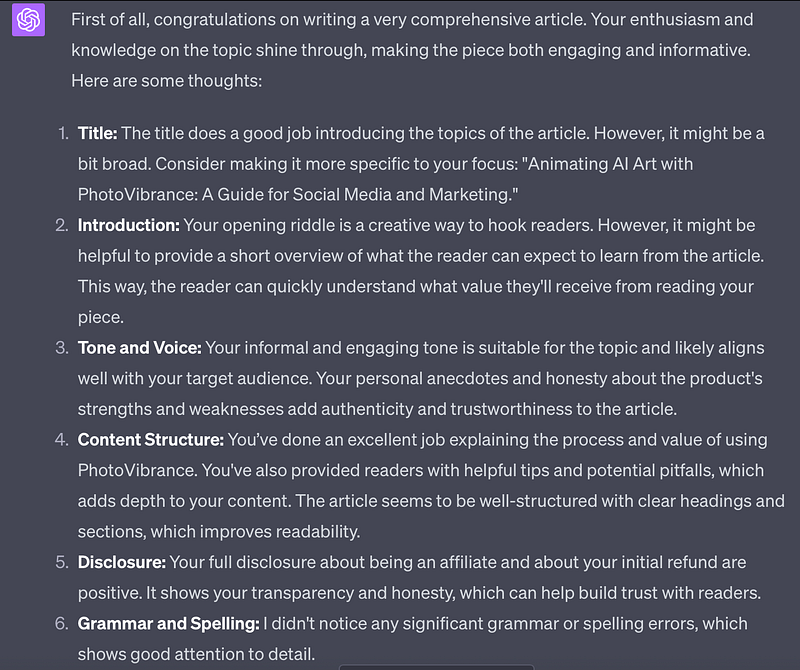
Because that’s what AI is; Commander Data to my Picard. It’s reliable and — at least in terms of language choices — able to make factual observations.
It hurts when someone bashes my profession, because when and if I use AI in an article, you can guarantee it’s to make it better for you, the readers.
My motto is “Go easy”. Reading is hard for many people, so make it nice.
AI can actually put the writer back at the center
We need to overcome this notion that AI makes writing worse. And to stop upholding the written word as sacrosanct, a cultural dog whistle that “only people who write well are worth reading”. Because I’m going to let you in on a little secret that I didn’t learn until I left academia for publishing:
It’s a scam. The sacred authors aren’t: they have feet of clay. They have editors to make them look good, and often agents feeding them ideas.
Many of the prizewinning, literary greats of the twentieth century were prefabricated by editors — often the same editors time after time (look up Robert Gottlieb, and also the terrible tragedy of how he rejected a novel of true idiosyncratic genius, John Kennedy Toole’s, A Confederacy of Dunces).
Of course, the authorial voice still holds considerable importance, even if the finished work is a product of collaboration (and more often than not, capitalism and market forces. Sadly, we read what sells). But the illusion that writing is unadulterated, pure expression, without lots of input and interference is a fallacy. AI isn’t the only pollutant, and may be no more intrusive than an editor. I’ve written articles that were more genuine and human incorporating AI than some I wrote “under duress” from editors.
I personally have great respect for the hardworking self-published novelists out there who don’t have a team, or a deal (and who fervently believe in the art of writing). But the truth is, whether it’s journalism or literature, there is usually no one singular intelligence at work. We need to dismantle this notion of worshiping the author as the “great man of letters”. It’s 2023.
We’ve been trained to read homogenised content, and ironies of ironies, now that the power of the editor has been handed back to the individual, we decry it as harmful. AI is probably the greatest liberator of the written word since the printing pressing (and yes, I’m counting the internet too).
AI gives you the resources of an editorial team. But I’d argue, used correctly, it’s even more your own work, because you’re in control.
What matters is that content is well-crafted. We can embrace AI in a way that upholds transparency, encourages inclusivity, and respects individual voices. It’s not about replacing humans, but the opportunity to use these new resources and tools that can enhance our ability to communicate. By using AI ethically and creatively, we can not only shape our stories better, but widen the narrative space for voices that might otherwise be sidelined.
I’ll be presenting on “Ethical Ways AI Can Assist Disadvantaged Writers”, at 11:30am-12pm ET on August 12 for Medium Day. I hope you’ll join me.
Ethical Ways AI Can Assist Disadvantaged Writers
As a writer with a disability (brain injury, aphasia), I find AI helps me ‘locate’ missing words in my sentences. I’d like to demystify AI, and show how — far from being an unethical content mill flooding the internet — it can be used in positive ways to help bridge language barriers for disadvantaged writers. My presentation would draw on the Tema Okun’s criticism of “Worship of the Written Word” from an anti-ableism perspective, and discuss literacy bias and supremacy culture in tech. I will also propose several examples and scenarios where AI can be used positively to elevate previously ignored writers.
I’m going to give the final word to AI: I asked ChatGPT to review the draft of this article. I took the feedback onboard, and I edited it myself accordingly. I asked the AI to compare the versions. I repeated my process with each revision, until I had what you’re reading now. Here’s what the AI said:

Who is Jim The AI Whisperer?
Jim the AI Whisperer offers private training in how to use AI generators to create stunning visuals, as well as how to write original and compelling content. If you’re interested in discovering more, feel free to contact me.
I’m also available for podcasts, interviews, fine-tuning AI prompts, and creating prompt libraries and professional AI images for companies.
You might enjoy these related articles from Jim the AI Whisperer: