
Overland to the World
I Know Not Which I Am
Short fiction
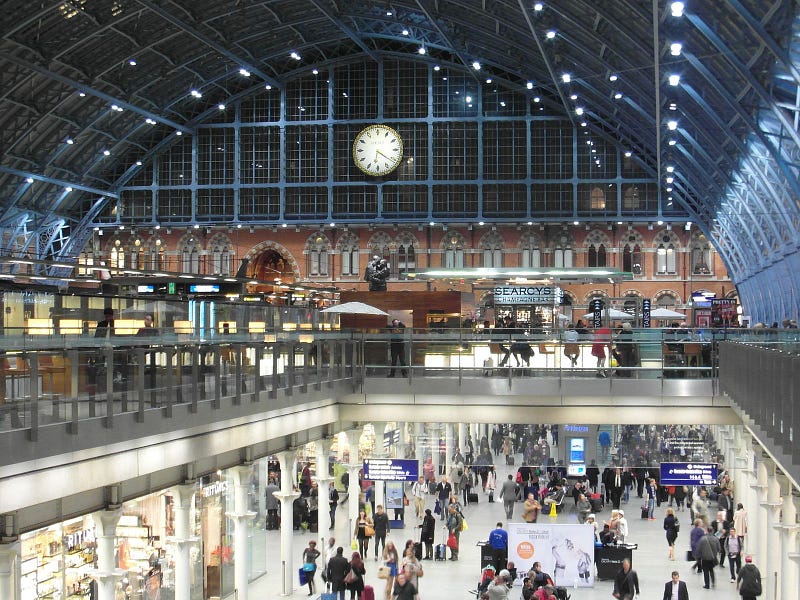
I. “Smoking is Not Allowed in the Station”
Deke Thomas, the American, never wanted to see that eyelid again.
But the eye had spotted him. Deke freaked out, fumbling his cigarettes. He reached down. Those lost seconds were enough. As the man in the Che Guevara shirt yanked out Deke’s earbuds, base beats dissipated into the cathedral of St. Pancras International.
“I don’t have your money!” Deke said.
The man opened the pack. Deke knew those fingernails from last night — an exchange that went to hell. Deke stole the drugs. Just grabbed and ran. Two jolly bells on the man’s belt went ding-a-ling, ding-a-ling.
Deke Thomas was about to board the Eurostar with his mom. Could he get the money? Yep! The hands played with the cigs. His waist moved like a Salvation Army Man.
“I can just go — ”
“Indoor fags— illegal, oye! — For your nic fit — chew — capital tasty, yeah?”
“The money, I can — ”
Che jerked his head. “Way out — there.” The handle of a knife appeared inside his jacket. “Name — have one — must, eh?”
“Deke.”
“Deke? Oye! Ain’t that — Greek — a goddess — no dike — lesbian?— Definitely not lezz — Ooooah! Ah! Dike! Injustice — right — aye!— apropos, yeah, mate?”
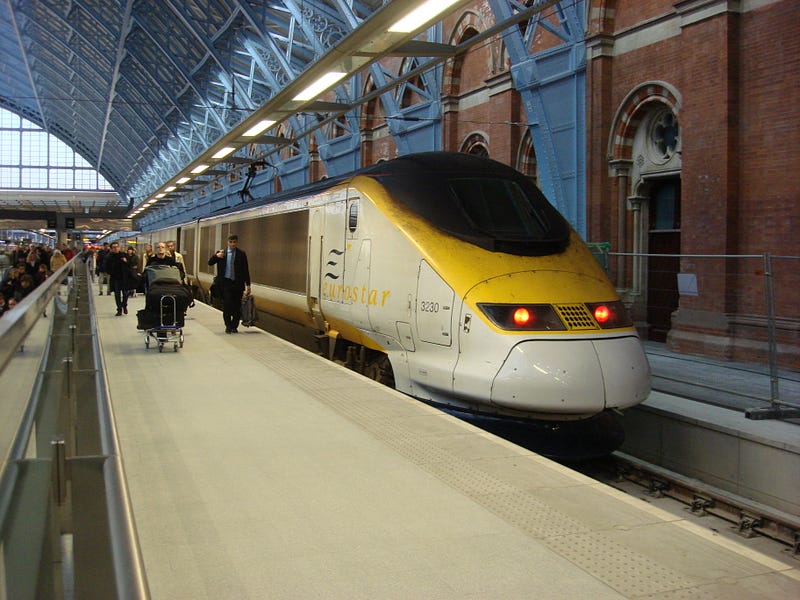
II. “For the safety of all our customers, please remember that smoking is not allowed in the station.”
Deke broke free. He wanted to punch that Cyclops of Fragments. He chuckled — running away from that Odyssean freak.
The Eurostar entrance was so close. Over there — a cop stand like a lighthouse, but what kept him from seeking the light?
Deke slipped through a double door with yellow rubber flaps, wheezing hard. Asthma. Fucking asthma. He hunched over in a dim, industrial hallway. Two locked doors, left and right, and further up, the lights off.
He leaned against the wall. Safe. Fucked, yes. His mom would have her panties in a bunch, but those panties would unknot. After the wash, the same deafening silence — a cycle of resentments unspoken.
“Let’s take a trip, Paul,” his mother said. “It’ll be good for both of us.”
“We are sorry to announce that the 9:31 East Midland Train service to Sheffield has been cancelled. We are sorry for the delay this will cause to your journey.”
Deke didn’t want to miss the train, as long as he nearly missed the train. He had wanted one more hit. How could he cope? Cope with his own mother flirting with Geoffrey Snow — guys in the pubs — dudes in the airport?
One mother was bad, but now there was a whole bus of mothers and fathers and church lady freaks, poppin’ holy spirits from rainbow-colored containers. Was his faith in chemistry and science?
Deke wasn’t his real name — just the name of his father’s fraternity.
Deke slumped until his baggy jeans met the floor. He felt for his phone. Gone. Earbuds. Wallet. Gone. His chest, tight. Oh — God — just a hit that would envelop the pain and the anxiety and the fear and the anger in a gaseous utopia — a one way trip to Wonderland.

III. “Have a successful journey”
His eyes closed to a New Jersey summer afternoon— off-road biking on Blueberry Hill — making ramps — baking around a fire, sitting on old tires, watching the sparks — pissing on the fire — the wet twigs and leaves huffing smoke.
One time he passed out from a mixture of tequila and weed. His buds tied him to a chaise lounge, stripped him to his boxers, and left him in the woods.
His English teacher said pot smoking made kids okay with boredom. It was his only honors class. Did Deke know any of the kids who had big plans for college and careers? These kids were called ‘pixies.’
That class was a colossal mistake. The year before he got an A for doing absolutely nothing except writing a poem about a tape dispenser. They pushed him up.
“If you’re bored, get out and do something, be something,” his English teacher said. Deke failed the class. His friends teased him for being a “try-hard.”
In the woods, Deke awoke to happy birds. He was unable to scratch the bites. His clothes hung from a branch. He felt his phone. Back pocket. Couldn’t reach. He wiggled, straining the belts.
Soon, one of the legs collapsed. He fell backward, his head a halo of pine needles. He gained enough room to free his hand. But the humiliation didn’t end: in black Sharpie read the words: “Son” — on forehead. “Of” — on nose. And “a whore” — chin. On his back a large dick was etched, with a small black dot, like a pimple.
Good buds, right?
With naked knees snuggled tight against his chest, he squeezed himself like a wet rag and cried.
For two days his mom had been frantic. He didn’t know what to say except — “sorry.” Two days he spent trying to erase his face, moving from one basement to another.
It didn’t surprise him when his mother wanted to attend church.
“Doesn’t it seem ironic to believe in magical fairies to help with reality?” he said.
“I’ve made poor decisions,” she said.
She was so caught up in her life that she never considered the trauma of yet another person being ripped from his life, over and over. This one guy got him into camping for a few months, hikes and all, and then: suddenly, he was gone. Another asshole gave him joints — and that’s what got the whole billy-bong going.
He just shut down. He refused to see “someone.” He gave the bald counselor dude at school lip service. Was it out of spite?
The next morning he said, “Yeah, mom. It’s spite.” But that wasn’t the worse. No, that wasn’t the worse. And sitting there on the cold tile in the train terminal, his breathing recovering, those thoughts weighed on him.
“I could’ve passed English,” he said to himself. “Did I fail to spite myself?”
Deke heard the jingle-jangle-jingle of sleigh bells. The sound drew closer. The double door with yellow rubber flaps swung open. It would have smashed his toes, but he wore Timberlands.
Into the dark hallway stepped a short guy in a gray work jacket. Underneath the jacket, a white shirt read “House Music.” His face was a long, pointed nose and a protruding forehead with a receding hairline. Silver stud earrings lined his ear.
“How did — you find me? Deke asked.
“We wos waitin’ wen we scented a wery partiklar odor,” House Music said. “A rayther strong arowmatic flavor. We b’lieve, Deke, sir, it was comin’ from avay down this ways. T’an’t hard to ven you ‘as a nose as big as a porn star as mine be, right?”
“I mean, in the station. How did you find me?” Deke made a weak move through the double doors. There he was — eyelid guy, smiling, playing with the Mayfair pack of cigs — swinging his waist to ring the bells.
“The fags — property proper — Sir Deke of Dike— yours, chum, right?”
House Music laughed.
Che pushed Deke back through the doors and crumbled a cigarette. He shoved the tobacco into Deke’s mouth. “Nicotine — enema — quicker in the bloodstream— ” Che said. “Violation of — privacy — right? A nine-pound note, I an’t — you know, queer, eh?”
House Music laughed again. He mumbled something about this one tart who soaked her tampon in vodka and then went from zero to crazy in thirty seconds. “Kids these days cert’nly do all kinds o’ vond’rous things to twig themselves up.”
Deke chewed nervously. He wanted to vomit. Che’s thick hands massaged his shoulder, hurting the collarbone. Something hard against his butt, the barrel of a gun or a — Did Deke know anything about Pinocchio or Oliver Twist?
House Music laughed. Pinched Deke’s ass. “A conwivial chap such as yourself t’an’t been attentive in school, right?” House Music asked. “Perhaps that vhy you are in this rayther sudden sad state of predicament situwaystation.” Che pulled out of his pocket a folded red and blue ETA luggage tag with the hotel address.
“Calls made — split-lickety, lad — Easy thing,” Che said. “ — Evidence and charm — and good looks — the day won— the lad found — American Group — Departure — Itinerary in hand, right?”
Che said that The Critic was coming. Who was The Critic? Deke had been spotted swaggering through St. Pancras, pulling his pants over his red plaid boxers while silver chains swung across his pants. A white DC baseball cap, worn sideways, had covered his heavy black bangs — a gift from dear old dad.
A maintenance crew was transporting toilet mirrors on a blue trolley. They had stopped for a rest and a coffee. Passing the movable wall of mirrors, Deke had paused. Che laughed. How much time did Deke take repositioning that hat like a Fashion Maestro? “Backstage — Funny show — Clowns — Beep-Beep — Honk-Honk — Jingle-Jangle — Fa la la!”
The Chinese tattoo underneath Deke’s right arm was still pink and raw: the symbols of Ambition, Eternity, and Destiny. Deke rubbed the symbol for Destiny — the tat like a house. Before the trip, he purchased two skull rings with red rubies.
“Ha ha. He don’t understand none o’ our jangle-jingle. Those tats don’t look no good for a sing’ler white fellar, as you, eh?” House Music said.
“I — I — need to get to my train,” Deke mumbled, his teeth stained and dotted with shards of tobacco.
“From — somewhere?” Che asked. “Must be — Right?”
“From — New — Jersey,” Deke said.
House Music starting singing, “‘Holler, Holler, Yanks don’t swalla!”
Deke bit hard on his lip. With his knapsack clutched tightly, he spat tobacco at House Music and sprinted away with sudden energy.
Immediately, Deke struck a passerby. He ran for the exit through the terminus, with its grand, refurbished, and glittering single-span windowed-roof and gray girders. He ran past the ginger-laced Yo! Sushi!, the Excess Baggage Company, and WH SMITH. The anxiety of being raped — seized him — and that time with his mother’s boyfriend — of being pushed down and bent over — his baggy jeans stripped down over his knees, his hair pulled back hard, unable to breathe as his teeth clenched a dirty bandana.
He cut through the barricades of travelers, those huddled around digital timetables, leaped over luggage, and darted around dead trolleys. He spat out tobacco, feeling winded, the wind against his face drying the tears.
He passed a kiosk with the Evening Standard. The headline: “Body found in South Lambeth.” He yelled, “Watch out, lady!” But Deke lost his footing and fell — his chains clinked on the floor — he wiped away the blood from his chin.
A lady in a red skirt was exiting Neal’s Yard Remedies. A sign read: Way Out. On the white letters of “SUCC” from a large, blue sign on the floor, read—
“HAVE A SUCCESSFUL JOURNEY”
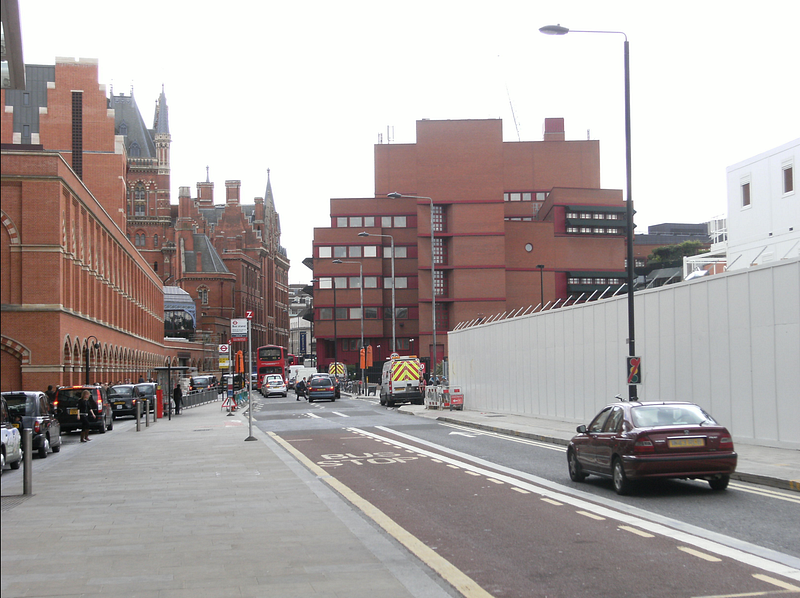
IV. RADIATORS MADE TO ORDER and BOOK CASE’S MADE TO ORDER.
Outside, dry winds on Midland Road channeled through the streets. It was hot and humid, the overcast sky mirrored the London grey of the city. Deke doubled over, panting heavily.
He looked right. Left. Then right. Spinning around, dazed and panicked — his mom speeding away from him under the English Channel. Did she even notice he was missing?
As he walked along Midland Road, Deke read:
RADIATORS MADE TO ORDER and BOOK CASE’S MADE TO ORDER
Did that look right? Cases is a plural noun, right? What idiots! If I was so smart, he thought, why did I just draw cartoon figures on essays?
His English teacher one day asked him for “a walk and chat.” The teacher asked him to recall the Poe story “The Black Cat.” He reminded Deke that the narrator did things knowing it was wrong and evil, but did them anyway — just to vex himself, thinking he wasn’t worth goodness. “Is that you, Paul Deacon Thomas?”
Deke just shrugged, mumbled, “Dunno.” He went back to the class with his head down and hoodie on.
The long, brown brick building was called HOPE in wide, white letters. It was closed. He looked for a safe place: first, keep calm, and then find help: a sign nearby advertised The British Library and the Magna Carta.
A #46 red bus for St. Bartholomew’s Hospital zoomed past him. Multi-colored taxis advertising Ryanair and Vodafone waited by the station. He gazed along the A5202.
Would a girl on a red bike help him? Should he just circle around the station? What was the time, anyway? At the pedestrian crossing, he was almost grazed by a car for gazing the wrong way.
He thought of asking someone for help. A frenzied mind is not a logical. Somehow he needed to call his mother, but he didn’t know her number. He spotted several saviors: a woman in the navy business suit from the Francis Crick Institute, an older man with a bandana coming out from PHS Teacrate truck, the three turbaned guys standing idly outside the entrance for The Royal Veterinary Institute. He continued walking, but that stupid sign made him angry.
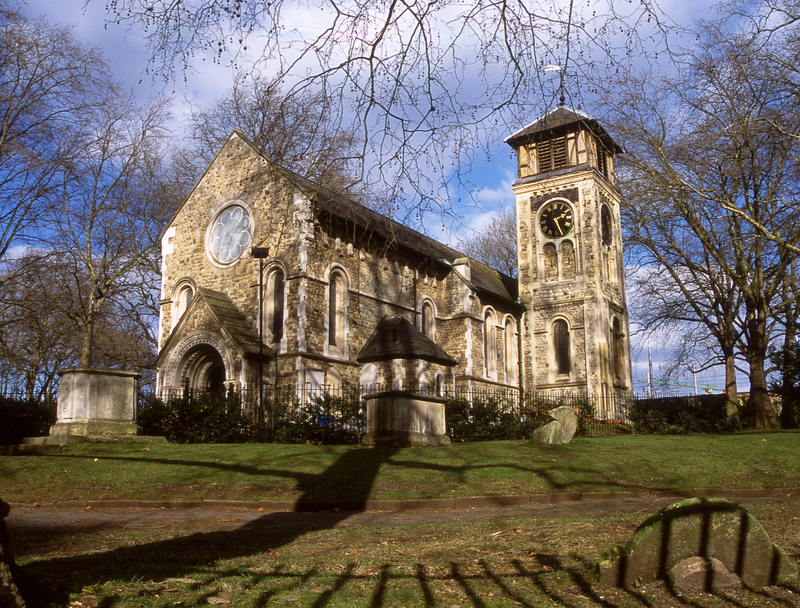
V. The Church is Open
Across the street, Deke spotted two elaborate iron gates. The burial ground was open. As he stepped through the threshold, his anger evaporated. A painted sign read: NO CYCLING.
Up a few steps, he rested on the Burdett-Coutts Memorial Sundial. He traced the sun through the mature trees. The shadow fell on the time. The train had already departed. He slumped against the copper-green, wrought iron fence on the cold cobblestone path. He would wait, return, and ask for help. Geoffrey Snow was the only name he knew from the travel company.
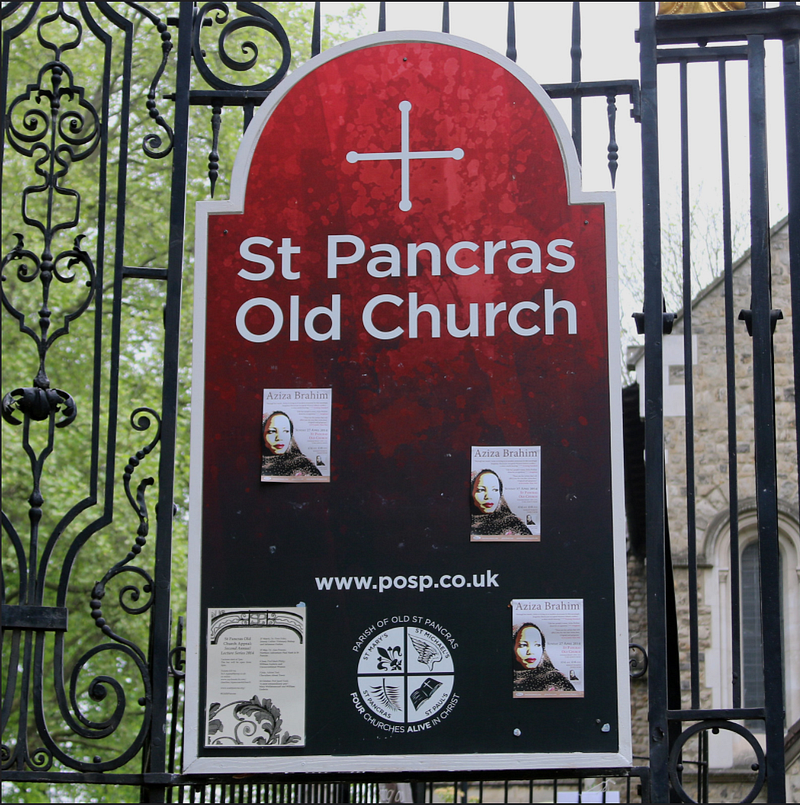
Then he saw House Music and Che. Deke scampered around the fenced sundial and hurried towards St. Pancras Old Church, a church with a small Norman nave and clock tower. The chimes rang out.
A sign read: The Church is Open.
Would there be a caretaker or priest or someone praying, or lighting a candle for some dead one? No. The vestry and nave were empty. So he sat. A few rows of chestnut-brown, spindled chairs, four on each side of the aisle lined with royal blue carpet. He gazed at the SOS signs to save the church from sinking on decaying drains. The plan was to raise £350,000.
Hanging above the altar, there was no martyred Jesus, no three-dimensional Crucified Jesus. Just a medieval portrait of Jesus on the Cross and one dazzling, gilded sun, ablaze with lightning bolts and squiggles and fresh-cut red and white flowers in small, crystal vases along the wall. The quiet was eerie. He liked the peace, the stillness, the damp earth smell of the place — almost like the stillness of death.
Was it ironic that he should find peace in such a place? Deke, after all, considered organized religion a racket to part the stupid from their money. Organized religion is just a larger, older cult with better marketing. He never denied the existence of an Overlord-Sort-of-Being, but he didn’t trust shysters and the hucksters.
In English, he once had to speak before the class on a soapbox about whether the post-modern idea of good and evil were relative. He took a zero for that assignment. On that soapbox, he stepped up and said, “Nuggs and Juggs!” and stopped. But on the church floor, he summoned words in the shadowy shape of prayer about his brother. He never knew this brother. No one knew this brother.
Did the “Overlord” knew his brother? Deke read about the brother in his mother’s diary. When she was out, alone as his own babysitter, at the age of ten, he slipped into her bedroom and read. It was awful. He had no business there, but she was so gone, locked away in her “Eat, Pray, Love’ world, a horror movie he saw by accident, the world she wanted when she asked his dad to leave.
Deke wanted some semblance of fact — solid ground — beyond the quicksand of glamour and gyms and hydrotherapy. A year before she divorced his dad, she had secretly aborted a pregnancy. She wrote it couldn’t have been her husband’s child. He read about what she thought about Deke. Would she have been happier if she had aborted Deke, too? And not been inclined to marry?
Deke wanted to torch the book. A brother would have been preferable to the silence of the house, the boredom, the tedium, and the awkward silences.
Then one night at dinner, Deke told his mom that he knew. The scene was awful. Shouts and screams. Deke running out of the house, walking around for hours — high and flying and angry. Desperately wanting to join his dad, he called his house number in Colorado. Left two messages. But there was no room there, either. By then, his dad had another son, and another soon on the way.
And that’s when Deke told his dad the news. The dad didn’t erupt. He just said, “Well, no surprise, son.”
Deke remained kneeling. The words of the prayer were not formal, of course, just hurt sent skyward. Those silent whispers were soon interrupted by footsteps on the brick — and that awful jingle-jangle-jingle, like one of Santa’s Little Killers.
VI. “I know not which I am”
A man in aviator sunglasses appeared in the doorway, as confident as General MacArthur. Was this The Critic? If so, he looked nothing like Deke expected. More professor on vacation with a clean, blue button-down shirt, a light-weight sports jacket, darker blue, and khaki pants, and brown shoes. Something was hidden inside his jacket pocket. His hair, short and brown. He crossed himself in benediction.
“Your mum must be worried, mate,” he said.
Che and House Music appeared behind him. They kneeled. “I can’t offer you the Body of Jesus, but I have a digestive,” the man in the aviator glasses said. “A cookie, right? Nay, I’m not sure what magical powers I have to transform it, but if you believe, what harm does it do, right?”
“I don’t believe in that shit anyway,” Deke snapped. “Who are you? Are there three of you now?”
“An admirable observation. This is my assembly. I am that scoundrel they call The Critic,” he said. “You heard I was coming, right? And these, well — my students— or angels — or my bagmen.” He laughed. “Has my appearance been foreshadowed? Predicted? Foretold? Prophesied? Prognasticated? The Language of Shakespeare is especially adroit, eh? So many synonyms. Come, shall we step outside? I may catch religion in here. There are some interesting graves out here.”
The Critic was scrolling through Deke’s phone. Where did they find it? Deke backed up and tripped over a protruding root. As Che and House Music followed behind, he told Deke that he had passed by this church many times, but never knew of its “august” history.
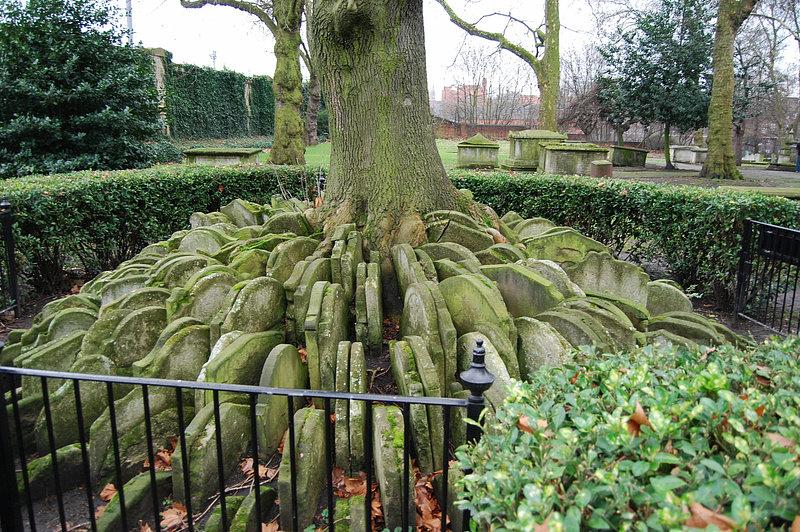
It once contained the remains of Mary Wollstonecraft — the mother of Mary Shelley, the author of Frankenstein. “And William Franklin, the bastard son of your own Ben Franklin,” The Critic said. They marched quietly to The Hardy Tree. Gray tombstones, piled single file like a partially opened fan, surrounded the tree. The Critic said:
‘We late-lamented, resting here, Are mixed to human jam, And each to each exclaims in fear, ‘I know not which I am!’
“Spooky — Stephen King — freakshow here,” Che said.
“I know not which I am,” The Critic repeated slowly. “I know not which I am.”
The Critic said it was from a Thomas Hardy poem. The famous British writer had been a contractor. They had to dig up graves for a train line, and they just stacked the graves single file in a heap. “Trains were more essential than the church or graves. Progress. Upward and onward, right? Wikipedia makes us so smart, so fast, right?”
The Critic, still reading, said Pancras was some fourteen-year-old Roman orphan who was beheaded for failing to renounce Christ in the 3rd Century.
“Dying — For a Ghost — ? Give up Host — Become a Ghost — Spooky!” Che said. “Lop off me head? — Not even — me own mum!” House Music punched Che and said something about his mum giving it up all right.
“At least he stood for something,” Deke said. “His name lives on forever.”
The Critic then spoke. “Like Deke? — His name lives on — Here lies Deke — lies — lies— I like that, right? Double meaning? He knew not what he was — such a shame!”
“That’s my street name,” he replied. “I’m Paul Deacon Thomas.”
The Critic was impressed. “And so shines a ray of light from the darkness!”
The Critic held the phone in front of him, contemplating its existence. The knowledge of the world and of God was contained in this thing. “The whole of the known universe!” he exclaimed. “Every college and book and language, mates, right here. And what do we care about?”
“Porn.”
“Viddies — cats — piano — Father Ted — kebab takeaway online!”
“What do you want?” Deke said, no longer feigning toughness. “Take the phone. Take everything. That’s proper, right? Not cash, no. But payment. Paid in full. You want me to piss the drugs back?”
The Critic waved away Deke’s words. He said the whole of the British educational system is rigged against the poor. “We weep over Oliver Twist. Do we give a cod’s wallop for the poor?” He was poor, his father was poor, and his grandfathers were always poor. Irish. Working stiffs. Good lads, but poor.
“But we all pay a tax to help the rich kids not pay for college,” The Critic said. “I’ve read more books than ten rich wankers together, but because I didn’t get a piece of parchment, some dried lamb’s bladder, I’ve been consigned to the streets. Which may help my literary aspirations, as who wouldn’t want to read what I’ve been through, eh? Talk about ethos!”
“Just let me go!”
“It’s like following the White Rabbit.”
“A and no I. Allusion — no illusion,” Che said. “Right?”
“B’lieve it’s a simm’lee, too.” House Music said.
“Deke, my friend, — or Paul Deacon Thomas — besides upsetting the balance of economics, you also have offended my aesthetic sensibilities,” The Critic said seriously — with a dash of piety. “Just because I’m a highly literate undesirable without the street creed of a diploma doesn’t make me unaware of metaphor. I know who I am. You, me, we both polish our image, right?
In another life, in another time, from another family, I’d be an artist. And not some sperm splattered on a canvas, mind you. A real artist. da Vinci, man. Rembrandt. Perhaps even James fucking Joyce. Eternal stuff, man. Stuff that outlives us all. I call myself The Critic. I pass judgment. I raise my pen, my finger, my voice, and all shudder — as you shudder, right? Art, you see, when extraordinary, is always good for three reasons. Integrity, execution, and vision. But bad art is limitless in its badness. That’s why bad reviews are better to read than good reviews. Villains are richer source material, right?”
“‘Monsieur Softee — and — King o’ insight!” Che said.
Deke didn’t want any more trouble.
“You’re dressed for it, son,” The Critic said. “You advertise trouble.” He held Deke’s hand and examined the skull rings. The Critic never took off the aviator sunglasses. Deke wanted to see his eyes. “We always judge a book by the cover? If you don’t want to appear a racist, don’t wear a white sheet over your head.”
The Critic twisted the rings off Deke’s finger like a screw and pocketed the rings. “What are you selling, mate? ‘I know not which I am.’ That’s the worst thing of all.”
Che Guevara placed his beat-up black leather boots up against Deke’s Timberlands. “Boots — mine — ” Che said. “New Tims — sell big — Portobello Road!”
Deke hesitated, trembling, wanting to scream; House Music reached into his pocket where he had seen something hard. It looked like a cigar case. The word CUBA was in red letters. House Music squirted himself with cologne and then squirted some at Che, who shoved him. Che poised with the end of his lit cigarette as if to press the red-hot end into Deke’s neck, but then Che merely took a drag.
Deke surrendered his Timberlands. House Music opened his Harrod’s bag. Che said he could also take off the hooded shirt and the chains. It was all about the “redistribution of wealth.” Deke was now wearing nothing but jeans, red plaid boxers, and white socks, but soon these “inexpressibles” were placed in the bag. On the green grass, Deke collapsed in humiliation. His bare chest heaved as he tried to catch his breath. He curled up and wept.
“Deke wept.” The Critic shook his head. “All of this because you cribbed from us.”
He pulled out a copy of Karl Marx’s Communist Manifesto from his blue jacket pocket; Che and House Music also took out smaller versions of the book. What Deke thought was the handle of a knife in Che’s jeans was just a large, stiff brown bookmark with a gold tassel. The Critic closed his eyes as if in prayer and held the book to his head.
“Let me ask the book a question: ‘What should our mate learn from this?’ Then he opened it randomly and read — after giving Che and House Music the chapter and verse to follow along:
“The cheap prices of commodities are the heavy artillery with which it forces the barbarians’ intensely obstinate hatred of foreigners to capitulate. It compels all nations, on pain of extinction, to adopt the bourgeois mode of production; it compels them to introduce what it calls civil-i-sation into their midst.”
“If I were a professor, I’d ask you to interpret this passage to your current situation,” The Critic said. “But our time is short. Cheers, mate.”
Deke’s mom had warned when he was just a boy going into the NJ Turnpike rest stop. Sex traders would kidnap him. After all, there was no dad to guide him to urinate. He was too old for the women’s room. Now he imagined these boy brokers would sell his patsy white ass to ass-bandits who would stuff coke down his ass and snort it out with a rolled-up fiver. Deke stood shaking, pleading, “No, please, no, please don’t.”
The Critic asked him to please settle down.
“It’s just my mom. I don’t see my dad much. I don’t have anyone!”
“Like Lucifer, so goes the fate of all the world,” The Critic said, peering at the ground. He kicked a stone. He kicked a few more stones. “Kicked out of heaven! Kicked out of Eden, we spite heaven. But what can poor sinners like us do? We are not financially prepared to receive counseling. We’re the flotsam and jetsam of modern society. We are cut from the same nappy.”
The Critic was talking while leafing through Deke’s phone. His mum — Morgan — was quite an attractive. Young. These other people here — he was saying — look the “wrong sort of people.”
“Feathers — together — fly — high, right?” Che asked.
“You see, Paul Deacon Thomas, I’ve learned that every experience can lead to a greater awareness of Self. Capital S there. Self. Selfhood. Maybe you can learn something. Good from the bad, you see. I saw you acting thug, and you just seemed so — pathetic. No, you’re not really one of us.”
The Critic flipped the phone to Che who started taking pictures of Deke. He Should he send pics to all Deke’s contacts. Why?
“Honor — Code — and thieves, all, right?” Che asked. He laughed. “Code break? — Ass-rapped — London — a good time — holiday! Lucky Deke — Middle Man — Front door — back door!”
Would Deke mind if they walked over “there” with him for a little “confab, chit-chat, tongue-wagging, tête-à-tête, chitter-chatter, tittle-tattle, and a little heart-to-heart.”
Deke walked away with the Critic to behind the bushes.
Che and House Music tossed Deke’s phone back and forth. The Critic and Deke must have been gone for ten minutes.
The Critic reappeared — snap snap snap — as if summoning himself to the scene — and asked for Deke’s phone. From behind the bush, Deke crawled out and hollered, a deep roar, lasting for several seconds, a roar that burned his throat.
“Yanks do holler!” House Music said.
Both raised their eyebrows. The Critic wasn’t worried. “We had a pleasant dialogue,” he said. “Socrates would be quite impressed. Deke said his English teacher believed in him. That’s a capital start. And then I see him crying — and that’s a right good cleansing.”
House Music said — “Ha ha. To ha’ a catheterized experience?”
The Critic smiled — and corrected: “Cathartic.” Deke hollered again — a deep, hurtful yawp.
Che and House Music ran off while The Critic remained still and calm, typing like a fiend on Deke’s phone. An old caretaker with a shock of white hair soon shouted from the church. He was old. Didn’t move quickly. Another siren wailed down Midland. The caretaker moved toward them, and The Critic threw the red ruby rings like craps-dice towards Deke — and then handed Deke his phone.
“My work here is done,” he said.
Deke stammered words staccato-like, intending, simply, to mean, “Why?’
“Who knows?” The Critic yelled back. “Bored, suppose. Summoned — some Higher Power. Perhaps I’ll come back and pray for our eternal souls, right?” Then, in what seemed like an afterthought. “I was never a huge supporter of Apple products. Proprietary garbage, that.”
VII. “Holler! Holler! Yanks Don’t Swalla”
Deke kissed the tattoo that reminded him of home. He spotted the red rubies in the dirt as if he had just rolled snake eyes. What had once been so powerful now seemed so pathetic. In his hands, in so short of time, The Critic had transformed the rings — now, just cheap costume jewelry. A theater prop. He buried the rings deep in the dirt.
The three hooligans vanished among the mature trees, the graves, and the rolling green fields and flowers. The sound of the bells evaporated. Deke collapsed, his will spent, and the caretaker gave him a sip of water from his plastic bottle of Evian.
Was he all right. What happened? Did he need clothes? Should we call the Metropolitan police? “Wut’s yer name, son?”
“Paul Thomas,” he said.
Then he provided a slow, measured account. The caretaker listened. He would call the authorities. “Ya jus’ can’t trust no one these days ye can’t,” he said, “But I guess — ya gotta hope — right — or why else I be ‘ere for — takin’ care o’ this ol’ place.” There was a bathroom if he wanted privacy. And freshen up. It had been an ordeal. He would brew a needed fix: chamomile tea.
“It will ‘elp soothe the nerves, lad.”
He would find him clothes from the donations. Did the style matter? “They just need to cover me up, I guess.”
Deke — Paul Thomas — felt new life with his phone returned. He expected the phone to have died, but for some reason, it was fully charged. That’s strange, he thought. God knows what they must have done to it — or messages sent. He was stupid not to have password protection. Deke scanned through the photos, seeing himself anew, the lanky figure, the scraggly hairs, the knobby knees, the tousled hair. He thought of that stupid English class and the stool and the rants they needed to do every week, and boy would he like to have another chance to prove himself with those honors kids.
What a story this would make!
He got two messages — in responses to messages he never sent. One was from his mother and one was from — Long Lost Father Joseph. He hadn’t said shit to his dad for so long — and now he gets a freakin’ message?
The same message was sent to both parents. It was sent — God knows — but when — how? Why?
It read: “This is Paul. I’ve done so much stupid stuff. How could anyone love me, right? A poor wretch, like me? I’m sorry — I’ve held on to so much hate — and I guess I’ve needed someone to blame — and I’m done blamin’ and complainin’ and I want to be good. I fucked up today — again — and did something stupid — and I could have lost it all. But I’m okay now. I’m safe. It’s hard being a human being in this fucked up world. This bloke The Critic taught me a lesson. Just wanted you to know — I love you — and whatever you did or did not do to me — I forgive you — and I want to make things right before I leave this world for good, you know because right now I’m actually in a cemetery. And I don’t feel too much like dying yet. LOL. Love, your Paul.”
Paul Thomas read over the text message three times. The caretaker came out with tea and clothes. “Is everything all right, Paul — I means, in light of — curled up there takin’ kiver — ya looks like you be just born — ”
The two messages from mom and dad filled Paul’s eyes with tears. He sobbed uncontrollably, luxuriantly, and heaved — as if grasping for even more oxygen. Was there enough oxygen to restore him to health? To make up for all those years in a vacuum — floating in a void? The caretaker allowed for time and silence to pass before placing the tea beside him. Paul rubbed his blue eyes, said thank you, and chuckled.
“Yes,” he said, “You know, I think — hope — everything — I think things may be all right.”
Thank you for reading! For more stories from Overland to the World on Lit Up, check out:


.jpg)


