
I Just Finished a 30-Day Passive Income Sprint (Results)
The power of focus.

For the last 30 days, I have been singularly focused on growing my KDP business.
I’ll share the results in a moment.
I’ve been dabbling with this for a few years now, and so far, I’ve seen promising results with minimal-to-moderate effort.
I consider my publishing business to be a source of “passive income” because I do most of the heavy lifting upfront and receive royalty payments into perpetuity with little additional effort.
For some time now, I’ve wanted to do a 30-day sprint where I focus ALL of my energy and efforts on this ONE thing.
But as someone who has been self-employed for over a decade, I’ve learned that relying too much on one income source can be dangerous.
Mental Dilema
We all know that focusing on ONE thing leads to the fastest growth, but if putting all your eggs in one basket is too risky, then you need multiple income streams, right?
Because of this mindset, I’ve always maintained some sort of active income stream — audiobook editing, writing, legal services, etc. — where I get paid quickly based on my time.
If I had an unexpected expense or needed extra money beyond my budget, I’d just “work more hours” to make what I needed.
The problem is that I ended up spending about 70% of my time on these “active” income sources, but they accounted for just 15% of my total monthly revenue.
It wasn’t adding up.
Over the last decade, I’ve slowly built passive income streams by dedicating a few hours each month to making faceless YouTube videos and educational tutorials around my favorite software products.
I’ve watched those small investments add up to substantial monthly payouts over time.
So, I finally had to ask myself,
Why do I keep running in this “active income” hamster wheel?
My long-term goal is to fully detach my time from my income.
But to do that, I had to overcome “the gap.”
The Passive Income Gap
The education system and culture in the US have normalized exchanging time for money.
Most people make an hourly wage or an annual salary doing work for someone else.
For some people, this is the only way they know how to make an income.
While there’s nothing inherently wrong with this, it is a choice with both positive and negative consequences.
If you show up to work and give up your most valuable resource (time), you’ll get a predictable paycheck on a predictable schedule.
We humans like things that are predictable.
Predictable feels safe.
The downside is that predictable income is addictive, and eventually, you will hit a ceiling.
Yes, you can get a raise or change jobs, but there will always be another ceiling.
Bump. Tink. Thump.
Ugh.
The solution is to go where there is NO ceiling.
But to do that, you have to let go of predictable paychecks (at least at first.)
This feels…uncomfy.
I’ve been saving and living on a budget for years, preparing to leap “the gap” from active to passive income with as little risk as possible.
I knew in advance that my income would decrease this month because any gains made during my 30-day sprint wouldn’t be paid out for at least two months.
But the thought of seeing my income drop this month still caused mental anguish.
The recurring thought I had was,
What if I fail and lose an entire month of (active) earnings?
This is a limiting belief — a mental holdover from a time when losing any amount of money could have had serious consequences on my livelihood.
In reality, “failure” today would result in the mild discomfort of tightening my budget for a few months.
The potential upside was that I could finally close the gap and earn back some of my time.
Was that a risk I was willing to take?
100% yes.
Results
As expected, my income for March decreased by about 15% because I didn’t earn any active income during the month.
However, the gains I made in my KDP business during the 30-day sprint were more than 2x what I would have made with “active” income during this time.
Focusing all of my energy and effort on this ONE thing during the sprint resulted in a significant increase in sales starting around the middle of the month.
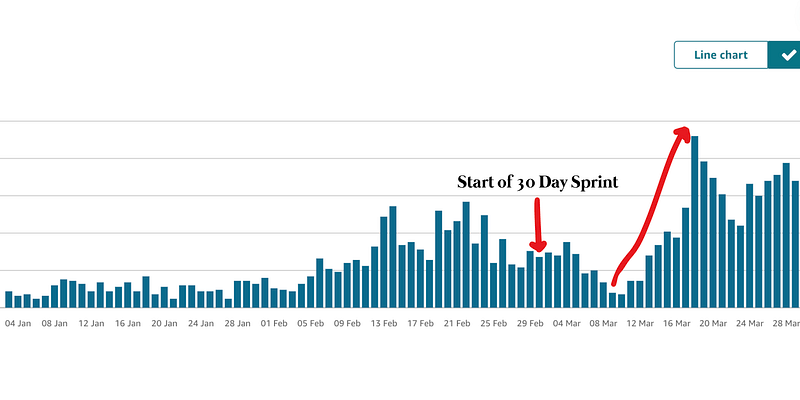
So, while I had to endure seeing an immediate drop in my bank account, I made significantly more in the same amount of time by focusing on this long-term income opportunity.
Not only that, but the “assets” I created last month will continue to generate income for years to come.
Takeaways
The biggest lesson I learned was —
Crossing the gap was far more difficult in my mind than in reality.
Throughout the month of April, I plan to document what I did during my 30-day sprint in my KDP Project Publication here:


