The Masterpiece Interview
“I Have Written About 200 Romance Novels” ~ Josephine Crispin
I am a writer, will always be.
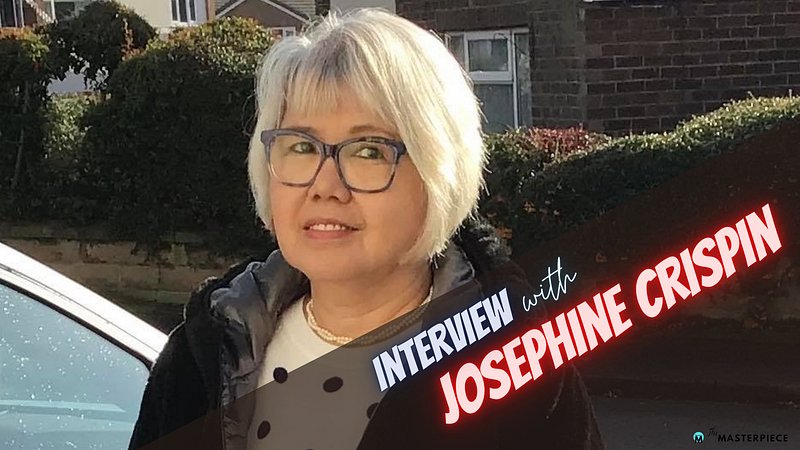
Welcome everyone to our second episode of The Masterpiece Interview.
Today we have a very special guest Josephine Crispin, a prolific writer, and editor with an incredible amount of experiences. We will talk to her about her eventful life and writings. She has so much to offer. I hope you all will have an amazing experience.
So, let’s talk to our guest right away.
Hello, Josephine. How are you doing? We are very happy to have you here.
Josephine Crispin: I’m good, thank you. Happy to be a contributor to The Masterpiece as well.
We are curious. Where are you living right now and how is the pandemic situation there?
Josephine Crispin: I’m now permanently residing in England. The pandemic is being successfully controlled with much of the population (over 50s, the vulnerable, etc) having had our vaccinations. Been over a year in lockdown, but hopefully, we can soon meet with friends and family, even hug indoors.
That’s a ray of hope. As we know, the world is going through a real tough time and many people have started to rethink their actions, works, and life. How this pandemic changed your life?
Josephine Crispin: For me personally and in relation to lockdown measures and working from home — it wasn’t really that tough for me. I worked from home for 10 years — 2011 to July 2020 — in my corporate job. That is to say, I worked wherever I was at the moment.
So, no, it didn’t have that much impact on me, except the lockdowns did not allow me to have my daughter and grandson visit me and my husband as frequently as possible.
We see that you are quite used to the home-office concept. That’s great for you. Many people find it hard to be in a home-office situation for long. It impacted their family life and to be honest, ruined the peace. Anyway, now the obvious question. How will you describe Josephine Crispin? Who is she and what does she do for a living?
Josephine Crispin: I am a writer, will always be. It’s one of the two reasons why I packed up my job — to work on my book projects that I set aside in late 2010.
For a living, none at the moment. Still enjoying R&R after all those years of work and work-related stresses.
Why not tell us something about your early days — your hometown, parents, and childhood?
Josephine Crispin: I was born in Malabon, Metro Manila. I grew up with my maternal grandparents as my mother gave birth to me when she was 15. My father — not a happy story, he was a womanizer through and through. Aside from not growing up with my mother and father, I had an ordinary life. Nothing unique.
I wanted to be a lawyer but only because I wanted to write with knowledge of the law. Didn’t get to Law proper, just majored in Political Science also in a university in Manila.
I had to work, earn for the family, so was unable to continue studying.
At what age you started to earn for your family. Can you share a bit of that experience with us?
Josephine Crispin: I was in my early 20s, started writing scripts for the comics (in local language, Tagalog).
Are you always a comic fan? Or, you just started it anyway to earn money? And you learned writing through the process?
Josephine Crispin: Not initially a fan of comics. I wanted to start writing for magazines (I did that, too, but not immediately). Barely out of my teens, I got a part-time job (while still studying) as “supposedly” member of the secretariat of an organization of comics publishers and editors.
It was martial law in the Philippines. The organization (KPPKP was the acronym) was created to self-censor the content of the comics magazines. While my designation was secretariat, what I did was monitor all the comics (50 issues a week; different publications) and report the violations.
I learned how to write scripts, what stories to write, because I had to read and monitor at least 50 comics magazine every week for one year. Yes, I wrote because I love to write and for the money, too.
Then I got pregnant so stopped that part-time job. After a few years, I started seriously making a living writing comics scripts. But previous to that, I have already written human interest articles, on various topics like drug addiction, food and nutrition, women’s issues.
After a year of writing freelance, I was offered an editorship by Atlas Publishing (the biggest publishing firm at that time). During those days, editors do not apply for jobs, they are offered positions.
So, at that time you were married and having a family of your own?
Josephine Crispin: I wasn’t married to the father of my kids. Another sad story of being attached to a womanizer.
We see that you had quite a life. Anyway, when did you leave your hometown?
Josephine Crispin: I migrated to New Zealand because I met my first husband, an Englishman who had also migrated to NZ. I met him while I was doing research for my second romance novel which was about mail-order brides.
From Manila to New Zealand. How many years did you live there? And tell us about the first romance novel of yours? What’s the name?
Josephine Crispin: I lived in NZ for about five years. My first romance novel was about love between a Catholic priest and a religious lady. My second romance novel was about mail-order brides.
The titles are in Tagalog, but loosely translated: (1) Flame of Forbidden Love (Sa Ningas ng Bawal na Pag-ibig), and (2) Is It Wrong to Love A Sinner? (Mali Bang Mahalin ang Makasalanan).
Why you were particularly interested in writing romance novels?
Josephine Crispin: I wasn’t! Romance novels do not interest me. Most of the stories I wrote before writing romance focused on women and family in a social context.
Really? That’s interesting.
Josephine Crispin: The manager of Atlas Publishing asked me to write romance because they would start publishing books. I said yes. Couldn’t say no to the big boss, right?
So on the way home, I went to a bookstore and bought three-four Mills & Boon books to see how romance novels are written.
Hahaha. That’s understandable. But you have written around 200 romance novels? That’s huge work!
Josephine Crispin: Yes, I did — but not for Atlas Publishing. I was inundated with projects at the time. I had two weekly columns at the time, plus a few comics serials. I did not have time to write 35,000 words for a novella. I was an exclusive author of Books for Pleasure for 10 years, contracted to write one book a month. Between those contracts, I wrote for several other romance book publishing firms using pen names.
You worked extremely hard that time!
Josephine Crispin: I did; no life except writing, book signing, meeting with romance readers, did a few interviews on radio, magazine, TV.
Unimaginable! But wasn’t that really exhausting? What kept you doing all this hard work? In other words, what was the motivation?
Josephine Crispin: My kids were all studying and I was the head of the family. My Kiwi husband — another unhappy relationship, but such added to my strength and experience.
That’s unfortunate. And when you left NZ? Did you come back to Manila?
Josephine Crispin: We returned to Manila because my then-husband took the redundancy package from the airline he worked for at the time. Not a good move on hindsight but I believe in Fate. I do not regret any of the decisions I made in my life.
When we returned to Manila for good, that’s when I signed up for an exclusive writing contract. My first husband, meanwhile, went into business with an Australian partner. It did not do well. My marriage actually went downhill as soon as we returned to the Philippines.
So many ups and downs. Anyway, how many kids did you have that time?
Josephine Crispin: I have five children.
And all of them were solely dependent on you?
Josephine Crispin: Yes, I supported them all and supported my first husband as well.
We see that you are an incredibly strong woman.
Josephine Crispin: Looking back, yes, I didn’t know how I managed. But I’m incredibly lucky with my second husband.
That’s great to know.
Josephine Crispin: I was separated from my first husband for 19 years; got divorced, he passed away three years ago. I remarried in 2019.
That’s a long time of separation.
Josephine Crispin: The separation was that long because he was in NZ all those years while I was in Manila, in Singapore, in the UK. He did not want to file the divorce papers, insisting that I do it myself because I was the one who wanted it.
And how you met your second husband?
Josephine Crispin: I met my second husband, Jeff, in England.
We met online. My daughter who lives here in the UK urged me to find a good man. I resisted the idea at first, but well, why should I not?
I have so many personal stories to tell and write about — hopefully, the lessons I learned will be picked up by other women who stayed in marriage even if incredibly unhappy.
Yeah, sure. A good partner is indeed a blessing. So, when did you permanently shift to the UK?
Josephine Crispin: I permanently made England my home in 2018. I have a daughter and grandson who are British citizens so that was also a consideration for my move, plus my son and his family live in mainland Europe so possible visits would not be a problem.
Well, you said that you packed your corporate job to concentrate on writing? Give us a brief history of that part of your life?
Josephine Crispin: I was encouraged to apply as editor for Singapore-based Brandtology. I was hired, got trained in Singapore. The job is mainly home-based. It was a total reinvention of myself in this sunrise industry, that of media intelligence. In 2012, Brandtology was merged with Media Monitors, an Australian company. Soon after, it was named Isentia.
For 10 years, I worked so many hours — like perhaps averaging 10–12 hours a day.
I moved up the rank from editor to team lead to associate research manager to manager. One of the things I did earlier was to train and supervise analysts in writing analytical reports based on big data. I had about 100 analysts in my team.
Incredible! We think you are a human robot. Hahaha. How did you manage all that? That’s a huge team.
Josephine Crispin: It is a huge team, yes, but I have three associate research managers under me, and there were team leads under them.
And when did you leave the corporate world?
Josephine Crispin: Mid-July 2020. Took me a year for the company to let me go.
That’s just a few months ago!
Josephine Crispin: It is.
So far we understand, you are an exceptionally hard-working woman with extraordinary stories. Lots of ups and downs but you were always there to support your family.
Josephine Crispin: Family will always be important.
With all the work and life experiences you have, if you are asked to give just one piece of advice to other people, what message will you convey?
Josephine Crispin: Work to live, not live to work. But I guess my advice to millennials and those with growing up children is to spend quality time with them, make memories with the kids that they will remember fondly, for always.
That makes sense. Excellent advice. Most people lack this realization when they work hard to set up their careers.
Josephine Crispin: I have little of those memories, and that makes me pensive, regretful.
Okay, now let’s talk about your writing and Medium journey. How difficult it is to become a professional writer for a woman, even in this modern time?
Josephine Crispin: The way I look at it, there is no difference in opportunities between a man and a woman. Any editor will be delighted to discover great talent, whether male or female.
But yes, it may not be easy for a woman who also looks after the children. But if there’s a will, however, a way would be found.
Tell us about your writing process. How ideas come to you and you start to make them into the form of an article or story?
Josephine Crispin: For articles, I do take notes of whatever idea came to mind, also nuggets I get from reading. I was, still am, a news junkie. Even a phrase, or possible headline that comes to mind as possible topic, while reading anything, I would write. I have notes all over the house, aside from my home office.
Writing novels — that’s different. I’m very organized. I must have a beginning and an ending. What happens in the middle is the hard work.
I do a lot of research, do character sketches as well; describe the characters, do background stories that may not necessarily be mentioned in the book. I spent a lot of time naming my characters. It should fit their character, most of all. Consistency in characters’ attitudes is very important to me.
For novels, some writers cannot start writing until they see the whole story in their minds. Others just start working on an idea and figure out the rest through the process of writing.
Josephine Crispin: This is very true. I’ve heard of writers writing their novels as they wrote along, making their characters move on their own. Like impromptu, which I think is crazy. That’s not my style although the endings to my novels could change somewhat from how I envisioned it.
As a writer, do you think solitude has a profound impact on writings?
Josephine Crispin: Yes, I do. Concentration, for me, requires solitude. It is very important to me to be able to focus. Writers have to be in the story itself; in the role of the protagonist, the antagonist, and the minor characters. When I was writing novels, I could not be disturbed; no one was allowed to speak to me. “I am here but not here” was my warning.
After a session of writing a chapter or two, I had to wind down for maybe 15–20 minutes because I was still “in my novel”.
Tell us about your favorites writers. Who are they?
Josephine Crispin: I am a big fan of Agatha Christie, Arthur Conan Doyle, JRR Tolkien, Maeve Binchy, Mary Higgins Clark, John Grisham, Frederick Forsyth, Ruth Rendell.
Detective stories, suspense novels, thrillers — I could read a book non-stop in 48 hours if the book is very interesting to me.
But not anymore — no, I don’t do that anymore, read without rest. Too “old” for that. Hahaha.
Hahahhaha. We all get distracted many a time while reading a book. Actually, this world of notifications makes it hard to concentrate on reading. Well, why not tell us about some of your favorite books?
Josephine Crispin: I have lots of favorites including the Tolkien’s trilogy, the Hobbit, but the last books I’ve read are The Confession by John Grisham; The Lighthouse, and The Private Patient by PD James.
If you haven’t read PD James, you may like her writing. She takes you into a real-world, not made-up world. My recent reads were also Fox by Frederick Forsyth and The Fallen by David Baldacci.
I do not have much time to read anyway, unlike before. I used to read about eight books a month. I was a regular customer at Book Sale — cheaper books there.
Thank you for the book recommendation. Anyway, do you procrastinate while writing?
Josephine Crispin: If I were working on a deadline, no time to procrastinate, especially if the printing press is on hold waiting for the manuscript. At this time, I’m taking it easy so I do not set a deadline. I’m still, I suppose, trying to get over the stresses I had at work.
How about your Medium Journey, when you started writing on Medium? Do you regularly write on other platforms too?
Josephine Crispin: I write for Vocal but not much. At this point, I’m at an impasse. I have two-three book projects but I’m interested in continuing to write for Medium.
I am also considering creating my own publication, but I’m unsure whether I could commit to it. Would be good to derive some income, though, from Medium, but I’m still considering if I should commit to this.
That would be wonderful. We think the blogging interaction we get on Medium is just great. It’s like instant feedback on your writing. Though constructive feedback is a rarity, it’s good to know other’s thoughts on your story.
Josephine Crispin: Same here; the interaction I had during my romance-novel days was centered on intrigue from the less-popular writers from other publications. It’s quite the opposite with my fellow writers on Medium. I enjoy interacting with them.
What do you think about this generation? Do they really passionate about books and writing in general? Or, they want fame in the quickest possible time? What are your thoughts on this?
Josephine Crispin: On Medium, I’ve observed many writers who are passionate about reading and writing. They are the ones who take the time to read the works of others. I think they’re mostly late 20s and above.
The younger ones, hmm, I think they need to be patient to hone their writing skills. They should write not for the money (in the beginning) but write out of passion — in the beginning.
I’ve observed the new ones, a few only, whose work seemed to be translated into English by Google, or whatever application they use. But I’ve read a few whose English may not be great but they have good ideas.
So true. Well, what is your relationship with the natural world? Are you a nature lover as we know that you love to spend time in the park? Do you feel connected to the surroundings of yours on a deeper level?
Josephine Crispin: Yes, very much into nature. My husband and I do regular walks in parks, woods, canal paths, by the river. I take a lot of pictures, too; observe and listen to the birds. It’s one way to energize, feel connected with Mother Earth.
I’m very conscious of doing my bit to save the planet, much as it gives us — nature — so much in life.
That’s great. Now a different question. Do you really visit graveyards? Why do you do that?
Josephine Crispin: I do, honestly. It probably sounds weird. I have a portfolio of graveyard photos. Wherever my husband and I go on weekends anywhere, I’d always want to visit the old church. All churches in the UK have graveyards. Out of curiosity in the beginning, I visited graveyards, too. But me being me, I always entertain story plots in my head. The gravestones/inscriptions provided tips for possible plots.
It’s like imagining and recreating the probable life events of the deceased. And what death means to you? Are you afraid of it?
Josephine Crispin: Not afraid of death. I think you can attribute it to Faith. I’m not afraid of the after-life. I’ve had a long and eventful life. But I want to write first all my experiences, especially in relation to writing, that even my children and family do not know.
Now it’s time for some quick questions.
How many books have you written so far? How many of them are under your own name? Josephine Crispin: I only started using Josephine Crispin in my ebooks on Amazon, just two. As for the books in print under my maiden name and previous married name — 200 perhaps on romance genre; the others, I honestly did not keep a record. But I see a lot of my book titles when I do Google search. My hard copies of my books are not complete, sad.
What inspires you to continue this writing journey? Josephine Crispin: Let me see — when the CEO of Isentia announced that I was “retiring” — I was peeved. I wasn’t retiring, I resigned. I wanted to get back to writing. Writing and being a writer is my lifetime journey. It’s my calling, then and now. I’d like to also one day have my books still to be written published by “proper” publishers, not just self-published. Big dream, but I’ll keep at it.
Tell us something about Midnyte? Josephine Crispin: Midnyte is as I described it in my Midnyte Is My Madness article. That is not fiction.
What is your favorite tourist destination? Josephine Crispin: I’d say New Zealand. Even when I spend years there, I was only able to have a couple of weekends on holiday. I’d like to go visit the location where they filmed The Hobbit.
What is the biggest regret of your life? Josephine Crispin: My biggest regret was not being able to spend more time with my children when they were growing up.
What qualities do you want to see in a man/woman? Josephine Crispin: Kindness, being grateful, being practical but also positive.
Share your definition of a good life. Josephine Crispin: Good life, for me, does not mean having a lot of money or material possessions. For as long as one lives in harmony with family, has a comfortable life — that is a life full of blessings.
Recall one moment when you felt so happy and blessed? Josephine Crispin: When I married Jeff; he was the opposite of the men in my previous relationships.
Have you ever experienced an identity crisis in your life? Josephine Crispin: Never
What is your biggest fear? Josephine Crispin: Maybe, death in the family.
Your favorite food? Josephine Crispin: Pasta mostly, but I miss Philippine food of course.
Who is your role model? Have you any? Josephine Crispin: I don’t have a role model, but if you ask me who is the person I admire most, then that will be Margaret Thatcher.
Who named you ‘Josephine’.? It’s a wonderful name. Josephine Crispin: My grandmother on my mother’s side.
Okay. That’s all. We cannot thank you enough for your time. You are an extraordinary woman and we think we can talk to you for hours after hours.
Josephine Crispin: It is I who should thank you. The interviews I did before, they all asked “where did you get your ideas” type questions. Thank you so much.
Dear readers, We hope you enjoyed the conversation with Josephine Crispin. You may read her amazing stories from the following links and know more about her and her writings.
If you want to read amazing conversations like this one, you may check out other interviews by clicking the below image.
You can also share your outstanding stories and inspire others. Just click the below image and be a writer for The Masterpiece.