I Have a Dream…
Every year I get together with Dr. King to celebrate his commitment to peace, justice and hope
One of my favorite units during the AP English Language and Composition season was always the one in which we tackled political speeches. Lincoln’s Second Inaugural Address; JFK’s “ask not what your country can do for you” oration — delivered during his inaugural; Reagan’s “Challenger” speech, honoring the astronauts and the New Hampshire teacher who perished that day; Obama’s Sandy Hook speech, in the wake of the murder of 20 six- and seven-year-olds and their six adult teachers and administrators. The unit culminated with Dr. Martin Luther King’s “I Have a Dream” speech, delivered on the steps of the Lincoln Memorial in August 1963, when he called for civil and economic rights for all people.
That’s the point of AP Lang, as we call it in the high school English department where I taught for 23 years — to “learn about the elements of argument and composition”, according to the College Board. But one more thing as well. My students studied both the text and the video/audio of these remarks — with the exception of Lincoln. Do you think, had he known something like the Tee Vee was coming in the 20th Century that he would have been happy to have missed its advent? The point of my lessons wasn’t just to commemorate the words of great American leaders during the month in which we honor Dr. King — because that’s when this particular analysis always took place — but to analyze ways to discern the emotion that drives one to summon an audience to action. Metaphorically, at least.
Our AP Lang studies each January culminated with analysis of Dr. King’s remarks because that speech is the one both most familiar and familiarly distant from the 16- and 17-year-olds whom I taught. They’ve grown up listening to this wonderful tapestry of words, but have become so attuned to hearing MLK’s sonorous intonations during class each year — some of my kids told me they listened to the speech as early as kindergarten, understanding it was important, but not really understanding the importance — that they routinely listened by rote. In other words, they heard Dr. King’s words, acknowledged Dr. King’s tone, and then put it back on the shelf for another year without thinking about it or understanding much of it at all.
My goal was for my Lang students to look at MLK’s words; listen to his cadence, and decide for themselves what his call to arms was all about.
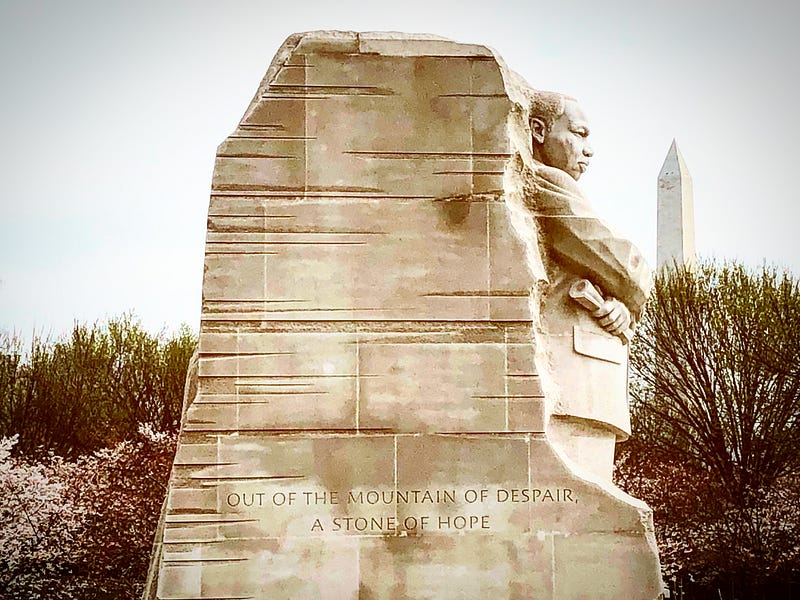
That’s why I love visiting the Martin Luther King Jr. Memorial in D.C. Not to look at his slight scowl, nor his authoritatively crossed arms — both of which clash with my knowledge of his passion for achieving equal rights through non-violence — but at his words, with one quote etched on the statute and more than a dozen on walls surrounding the work.
The design and construction of the memorial was filled with controversy, from the selection of Chinese sculptor Lei Yixin, to the almost Soviet-era stance of MLK in the 30-foot rendering. In fact, at least one change was engineered before the site opened to the public in 2011. Dr. King stands between the memorial honoring FDR and across the Tidal Basin from the likeness of Thomas Jefferson, who sits in a Rotunda-like structure among D.C.’s famous cherry trees. MLK also stands near the Lincoln Memorial.
Dr. King has a place in a cherry tree grove as well. I believe it’s a simple and striking location to honor both the man and his mission. And if you think about it, maybe Dr. King is scowling in this giant granite depiction because he needed to move mountains to accomplish his agenda.
Only one quote engraved on or near the memorial is from Dr. King’s “I Have a Dream” speech, but I believe it’s the most important:
“Out of a mountain of despair, a stone of hope.” The complete quote from the speech reads, “With this faith, we will be able to hew out of the mountain of despair a stone of hope,” and captures victory in the face of despair, and perhaps the fight for equality and justice.
Yes, I could spend several class periods discussing the importance of this analogy, expressed in Dr. King’s words and also in the way the MLK Memorial is divided into three pieces: The towering statue of Dr. King, flanked by what are known as the Mountain of Despair and the Stone of Hope. All of this is surrounded by a wall bearing more of Dr. King’s prophetic words.
And of course, I never lectured my kiddos. The purpose of my quasi-Socratic Method in the classroom was to have them think; debate; express their thoughts after carefully listening to one another. Because “There is always strength in numbers,” according to the Bible. American journalist Mark Shields later amended this passage from Ecclesiastes to more modern parlance: “The more individuals or organizations that you can rally to your cause, the better.”
I think Dr. King would agree with that. And I certainly used this power as a tool to get my cherubs thinking.
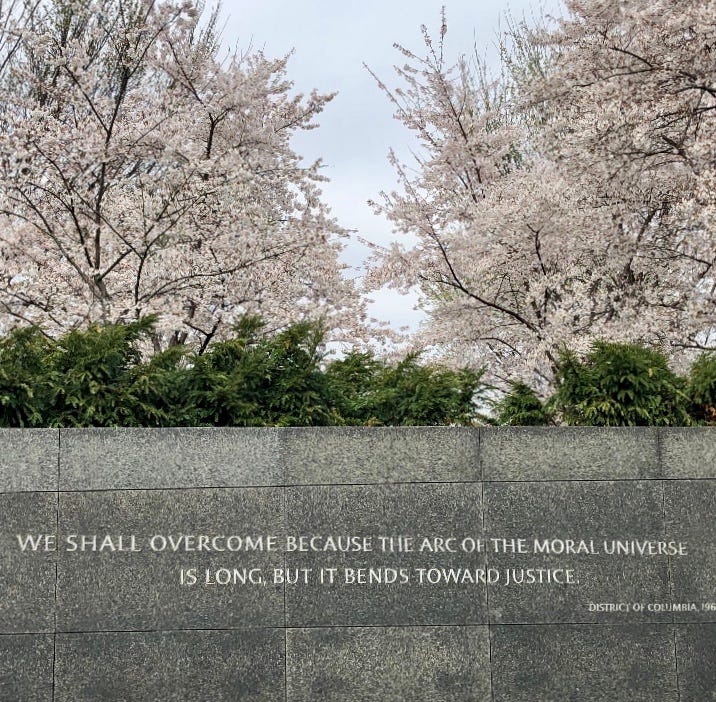
While there is only one “I Have a Dream” speech quote engraved on the MLK Memorial in D.C., there are more to sink one’s teeth into. I favor his remarks from a speech at D.C.’s National Cathedral in 1968, four days before Dr. King was assassinated in Memphis: “We shall overcome because the arc of the moral universe is long, but it bends toward justice.” And also, “Injustice anywhere is a threat to justice everywhere.” He said those words in his famous “Letter from Birmingham, Alabama jail,” which my students also analyzed, in April 16, 1963.
When I lived in D.C., I made a habit of visiting MLK down by the Tidal Basin a few times a year. Sometimes I’d miss that mark, but I always showed up to see him during Cherry Blossom season, which falls either in March or April each year. It’s thrilling to see Mother Nature putting on such a glorious show, honoring the man celebrated worldwide for his commitment to peaceful approaches to solve our most militant obstacles.
It’s true that my cherubs and I didn’t study any speeches by famous women. I’m hoping that will change soon. Although I’m now retired from the teaching trenches, I know that soon-to-be-inaugurated Vice President Kamala D. Harris has a lot to say. And it would be fun to analyze her vision for our shared future.