
I Generate 30% Profit Per Year In The Stock Market — Here’s My System
As an investor, you’re playing against yourself.
75% of day traders quit within the first two years. I wish someone had told me this when I started investing in stocks ten years ago.
Most investing advice is way too complex and even irrelevant, which scares and confuses many beginners. What you actually need to make profit is far simpler than what you might think. Through my successes and failures, I learned how to generate 30% per year from the stock market as a private investor.
To make significant profits in the stock market, you need to master:
- Investing psychology
- The virtue of patience
- Unwavering focus
- Discipline
- A well-put-together investing strategy and routine
How The Journey Began
During my first experience attending a stock market course, I was surrounded by a sea of 300 people in a large hotel space.
The experience was overwhelming.
I found myself inundated with unnecessary information presented through endless PowerPoint slides that, in retrospect, served no purpose whatsoever.
I was day trading and swing trading at the start of my investing journey, but that did not last long, as only 1% of day traders are profitable.
I realised that fast, but I was drawn to these methods of trading because of the appeal and promise of making a set amount of money every day. The seminar I first attended fully endorsed these methods.
The truth is that achieving consistent profit, if any at all, can be quite challenging. Spending hours glued to a computer screen, searching for investment opportunities, can take a huge toll on your psychology.
Just staring at the market going up and down is a mental rollercoaster I would not recommend to anyone. Day and swing trading requires you to do just that. You hold your investments from a few minutes to a few days, which is not long enough to allow a stock time to grow.
Upon further reflection, I learned you need to give your investments more time to grow. This is the reason I pursued another investing approach. I constantly lost money and began to fear investing my hard-earned money in the stock market. During this phase, I overlooked crucial investing opportunities that would have proved profitable.
A Hard Lesson Learned
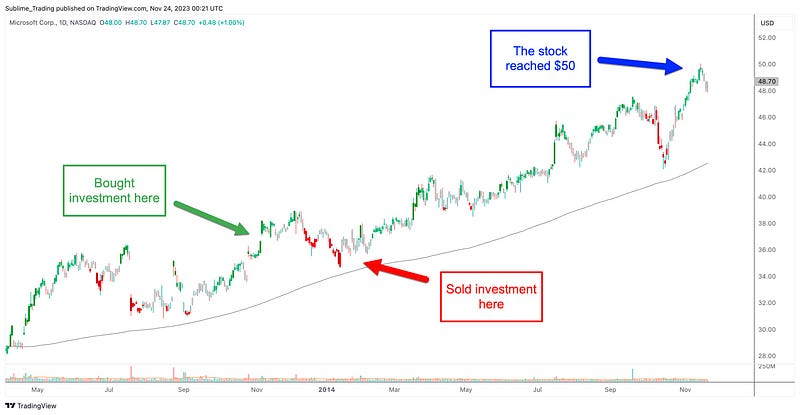
In November 2013, I bought some shares in Microsoft, which started well. I bought it when the share price was around $36, and once it hit $38, the stock reversed and fell in price by 10% to $34. I quickly jumped out of that investment with my ego bruised and a loss to my account.
When I jumped into that investment, it looked like it was going to be a surefire win. So when it didn’t go as planned, I didn’t take the loss lightly and couldn’t accept that I was wrong about it. Now that I was out of the investment, something unexpected was happening. The stock was beginning to rise again. I couldn’t consider getting back into this investment because I was not mentally ready to be hit by another loss.
The stock continued to rise and went from $35 to a high of $50, and this happened over a span of 10 months from January to November 2014. Fear caused me to miss out on the easy profit, and that experience taught me a big lesson.
It showed me that:
- I needed to get over losses quickly. Otherwise, I'd miss out on great opportunities to profit and offset my losses.
- I would not be able to make money day or swing trading without losing my mind in the process. I needed to invest in a stock for months to see a good profit and keep my sanity.
Longer-term investing made more sense because, over a period of months to over a year, a stock usually moves up in a trending market.
Trend-following
I came across a method of investing known as trend-following, which would have allowed me to seize the opportunity I missed with Microsoft.
This approach enables investors to capture a trend in a stock and profit from it, while also providing an exit strategy if the stock starts to fall. It simplifies the process of making money and managing risk.
Knowing this, I put all my focus into studying this method, buying books, and watching videos about it.
I became more enthusiastic when I learned about an experiment where people without any experience in the markets were taught this method and generated over $100 million in five years.
It started off as a bet between two multimillionaire investors, Richard Dennis and Bill Eckhardt, to see whether traders were born with the skill to make money or whether they could be nurtured to be successful.
The experiment was called The Turtle Traders and the name came about when the pair visited a turtle-breeding farm in Singapore.
The individuals in the Turtle Trading experiment were selected from an ad in the newspaper. It was aimed at anyone with no trading or investing experience. The outcome of it and the amount of profit generated in a short period of time confirmed that anyone could be nurtured into being a successful investor. They just needed to have the right mindset and be able to follow a simple trend-following system.
The strategy used was kept a tight secret for many years, but it is now accessible for anyone on the internet to view. You would think this strategy would make investors fortunes, but there is a mistaken belief that the system alone is sufficient. They fail to realise the significant role psychology plays in making a system a success.
From learning about the Turtle Traders, I knew I would become a profitable investor. I was willing to do everything it took, especially developing a winning mindset.
If these regular people could generate huge profits, then so could I.
I just needed a winning strategy.
The strategy I use now incorporates some elements of the Turtle Trading system by using breakouts to identify trends in a stock. This ultimately allows me to identify a strong stock in just three seconds.
Build A Winning Routine
With newfound confidence in place, all that remained was to establish a well-defined trading plan, a winning system, and a consistent routine to keep me on track.
Step 1
The first step in the process involves having a way to find all the stocks with the greatest likelihood of forming profitable trends. As a trend-follower, our objective is to find stocks that are breaking through levels of resistance akin to breaking through a ceiling set by a previous high point.
Finding such opportunities is driven by the fact that exceeding these levels often results in a consistent upward movement for a stock. This is called a breakout, and good software can effectively scan and detect breakouts as they happen.
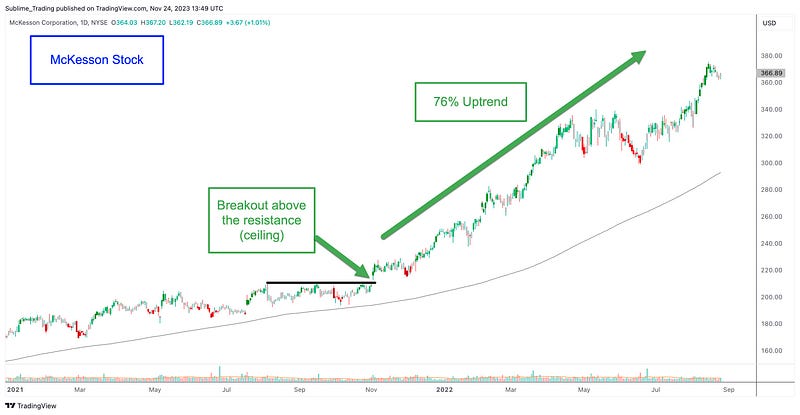
There are thousands of stocks to choose from, but only a handful will present opportunities that go on to become profitable. It can be tempting to jump into any stock that has a slight hint of rising, but you need the discipline to wait for the best setups.
I scan thousands of stocks daily, and my scan setting finds all the stocks that have formed breakouts similar to the chart of McKesson above. The scan whittles the list down to between 50–300 stocks, depending on how volatile the market is. More volatility equates to more breakouts.
Step 2
Now that thousands of stocks have been filtered down to a reasonable amount that can be analysed, each stock is looked at individually using charting software. I can then easily see if the stock is moving up and creating new all-time highs.
Contrary to what people think, stocks at their highest levels are likely to continue moving higher. What most think is that you should buy low and sell high. This is not the wrong thing to do, but if you buy low, you run the risk of your stock falling a lot lower or taking years to begin rising. A stock creating new all-time highs is clearly rising, and the momentum will likely carry it higher.
I use a 3-screen setup to glance at the stocks that have been identified by the scanner. The screens contain the monthly, weekly, and daily timeframes, where each bar on the respective timeframe represents the time intervals.
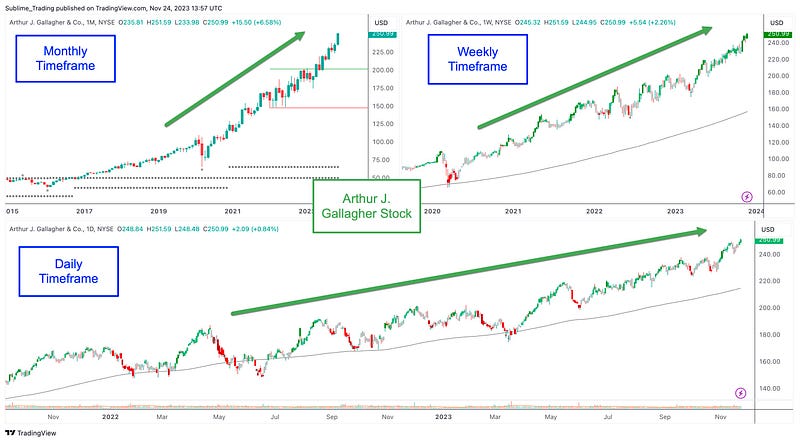
I go through each stock and because of the simple setup, it takes me just three seconds to look at each stock to know if it is worth investing in.
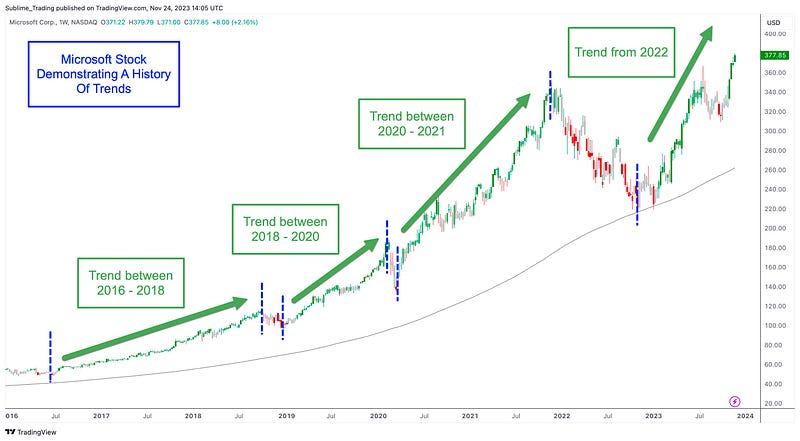
I love to look at the history of a stock as well. If it has a track record of strong trends in the past, it increases the likelihood of it forming strong trends in the future.
Step 3
The stocks need to be reduced again to the best ten or less. These stocks have a strong history, are moving up on all three timeframes and don’t display signs of volatility where the movement is unpredictable, moving up and down at random points. The ideal investments are the ones that navigate smoothly, free from turbulence.
There are times when hundreds of stocks make it through the scans but none of them make the cut to be included in the portfolio. Remember, we only want to invest in high-probability stocks. If such opportunities are not available, we are willing to be patient until suitable options become available.
Step 4
You have to know your entry and exit points. I usually enter a stock just above the bar that breaks out above a resistance level. This means my entry points are objective and require no thinking at all.
My exit points are also objective and the simplest way to exit would be using a Donchian channel on the daily timeframe. A Donchian channel marks out the highest and lowest points over x number of days.
A common Donchian setting is 20, which shows us the highest and lowest points over 20 trading days, which is four weeks.
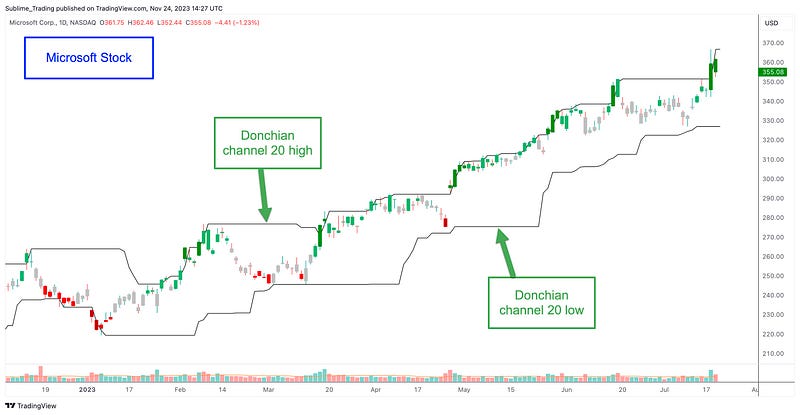
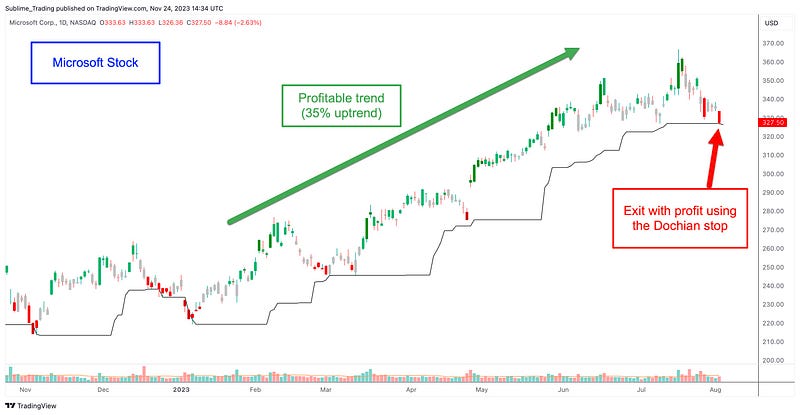
A Donchian channel stop loss in an uptrend focuses on the bottom Donchian 20 line.
Setting a stop loss here would exit us from a stock investment if the 4-week low is broken. A break of this level would indicate there is something wrong with the trend. This is where we would want to exit to look for setups in other stocks.
My Routine
I thoroughly scan the stock market every weekend to have my stocks ready on my watchlist for the week ahead. I go through these stocks during the week to see if they have produced a signal for me to buy them.
I also conduct scans during the week to take advantage of new opportunities as they happen.
I spend one hour daily reviewing the scans and then adding the best setups to my portfolio.
At the end of the trading day, I manage my portfolio by adjusting the stop losses and buying more shares of the stocks that are performing well in my portfolio. This process takes around ten minutes a day.
You’re Ready To Go
Having a step-by-step structure is critical to building a profitable portfolio. The mistake I see many make is treating investing like a side hustle and not putting in the required effort. What you put in is exactly what you get out.
You must treat investing like a business. A structure is crucial to ensuring essential things are done correctly.
- From seeking the best stocks amongst a sea of terrible ones.
- Knowing how and when to execute the investments.
- Getting out at the right time, either with a small loss or a huge profit.
Without structure, it becomes freestyling. The markets are not the ideal ground for experimentation. They can swiftly deplete your capital, distributing it among others who naively believe they can simply try their luck in the market.
Just because one might excel in another field of expertise does not mean they can apply those skills in investing. The mindset demanded in this field is fundamentally distinct from that required in other professions, such as law, medicine, or accounting.
These occupations and others require you to do a lot of studying and reading to achieve excellence. Investing requires studying your mind and the ones who possess this insight have the ability to effortlessly extract wealth from the financial markets.
Equipped with this newfound understanding of the markets, you can make a conscious decision whether you want to enter the lowest probability route by trying to be the 1% of day traders that succeed or the effortless route of trend-following. The latter offers less stress and consistent returns. It’s a decision that balances ambition and peace of mind.
Get my Stock Market Blueprint & Stocks Newsletter here to simplify your process.
Subscribe to DDIntel Here.
Have a unique story to share? Submit to DDIntel here.
Join our creator ecosystem here.
DDIntel captures the more notable pieces from our main site and our popular DDI Medium publication. Check us out for more insightful work from our community.
DDI Official Telegram Channel: https://t.me/+tafUp6ecEys4YjQ1


