
I Embrace the 49-Hour Rule to Keep Things Simple at Work
Because it works

I know, I know.
Not another darn productivity rule someone else swears by, right?
I get your sentiment. It’s overpitched.
And quite probably, we are sick of hearing them repeatedly.
But very few of us talk about them. Why they flop on us is a great reflection point.
This is my perspective.
- We fail to understand the underlying nature of productivity systems.
- We also fail to understand our psychology and demands in life.
Taking a productivity system that worked well for one or many and injecting it into our unique circumstance is like squaring a circle.
The edges of the square get abrased.
The circle?
Deformed.
The 49-Hour Rule
First, this rule works for me.
Feel free to test it, use it, and adapt it.
But I would like to emphasize the last part. Adapt it. Tweak it to the point where it becomes natural to you and your daily life.
That is my advice.
And this is the principle.
The components of the 49 hours are broken down into the following.
- 40-hour work weeks — Our usual 9–5.
- 1 additional after-hour on weekdays.
- 4 hours on Saturdays.
That adds up to 40 + 5 (5 days * 1 hour per weekday) + 4 = 49 hours.
It is quantitative, subject to flexibility and the work needs of the week. Above all else, it does not tell you what to do or how to allocate work across time.
Sorry.
I hate rigid structures.
So, how does the 49-Hour Rule work?
First, it acknowledges our commitment to our 9–5. Many of us have one. Let’s not kid ourselves.
Our day job requires a time commitment.
Proposal drafting, product pitches, client site visits, virtual conferences — You name them, I work on them.
Dutifully.
Accountability to self, results, and my company matters.
And then, I started thinking if the standard 40-hour window is possible for me to excel. Not just in my day job.
I mean all things combined.
They include,
- Polishing my sales skills for my day job.
- Online writing (takes time, too).
- Running my 1-person business.
These are necessary must-dos for my desired long-term success.
Procrastinating them to tomorrow means I live tomorrow like today. It is a bad idea.
And now, my psychological dilemma makes a grand entrance.
- The contribution to redline burnout.
The word in bold matters more than the one in italics. Let me explain.
Burnouts are tangible. We see it. We feel it. When it happens, of course, it is too late. I have been there. I have no plans for a revisit.
The trick is to avoid contributing to it.
This is the difficult part.
It is psychological. How will we know that we are on the road to hell?
I don’t know. No one knows.
And so, I put guardrails.
I will work an additional 1 hour a day.
If I’m feeling good, I push for 1.5. Or 2.
When I’m tired, I use that additional 1 hour to clear my emails and list the things to work on for the next day. I keep things simple for myself.
And then I walk away.
I force myself to. Because I can get too caught up at work.
Those are the weekdays.
For Saturdays — I seek quiet and non-emotionally volatile moments.
I never meet clients, prospects, and suppliers when I work on Saturdays. That is too noisy for my liking.
I focus on me.
I spend 4 hours every Saturday morning working on the following.
- Administrative work from my day job — Filing expenses and clearing invoices from suppliers.
- Online article drafts — Headlines, skeleton structure, polishing the key messages.
- Peppering my calendar — Sending meeting invitations to clients and prospects.
- Professional Development courses — I recently attended one on negotiation.
- Reading — The Economist, Bloomberg Businessweek, etc.
I typically cover 3 of them every Saturday. Again, this is a weekend. I have no wish to kill myself when I should be stepping down by a gear or two.
It works very well for me because I paid for a co-working space. I own a mobile hot desk. And the co-sharing space is typically empty on a Saturday morning.
This is what it looks like.

Quiet environment + a good cup of coffee + simple snacks = Quality time and deep work
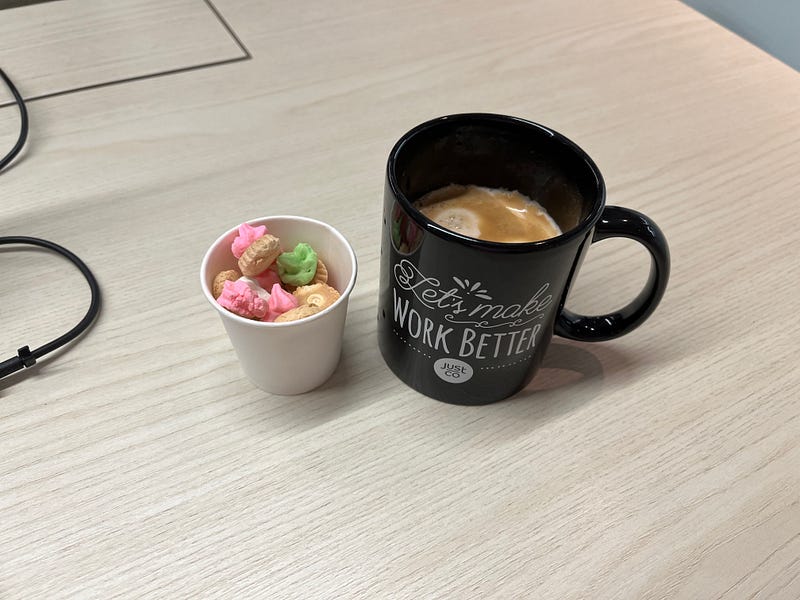
I feel better ending the week after my 4-hour block on Saturdays.
It facilitates a good start for the upcoming week.
Nothing beats that feeling of preparation.
And that I’m ready to go when Monday comes.
The Close
Will the 49-hour rule work for you?
I have no idea.
I hope so.
It has worked for me. And I say this as…
- A working professional trying to excel in my day job,
- An online writer trying to figure out success on the internet,
- An after-hours millionaire-entrepreneur-wannabe running 1-person business,
… without killing myself.
Of course.
It raises eyebrows.
“How can you work on these many things without committing late nights?”
Great question.
I quote Jamie Dimon, whose simple ideas inspire me daily.
“Life is long, and we can pretty much get what we want. Yes, we can. We just need to have a dose of humility. We can get what we want, just not all at once. Don’t burn the candle at both ends.”
I read this quote in my mind daily.
Jamie is right.
We have 40 working years or longer. Life is a long race. We can achieve what we aspire to.
We can achieve it all, given time.
And the 49-Hour Rule falls very neatly into that approach to life.
Enjoy my writing? Consider subscribing here.