
I Don’t Want To Be On Your Pedestal
Idolizing is just another form of objectification
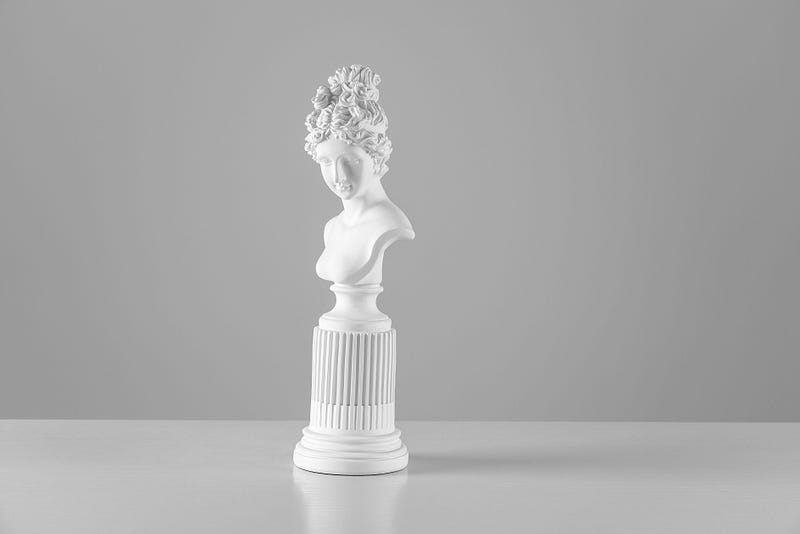
Several months ago I met a man on Medium who would become my friend. We chatted in the comments section of someone else’s article, and eventually began to email in order to continue our conversation. Within a few days we were emailing almost daily. He’s an American living in another country, and I enjoyed hearing about his life there. He’d had some interesting experiences and he was genuinely curious about my life and experiences as well. We didn’t see eye to eye on every little thing, but that isn’t necessary for me to be friends with someone. I have all kinds of friends, both in person, and on-line, whom I don’t completely agree with. It’s a part of what keeps life rich and interesting.
It became apparent pretty quickly that this guy had a bit of a crush on me. But he wasn’t asking for anything other than to talk to me, and his admiration was frankly, flattering. The only part that made me a bit uncomfortable is that I could see him putting me up on a pedestal. In hindsight, I should have paid more attention to that discomfort. He waxed poetical about how he imagined I must look and published what was essentially a platonic love letter about me and our relationship. I should have put the breaks on it at the time, but it didn’t really seem like that big of a deal. My husband didn’t think it was out of line, so I wasn’t that concerned. I liked him; I liked our discussions and sharing our worlds. So, he was a bit smitten — I liked him too and we were both handling it like mature adults, right?
What I should have realized is that to put someone up on a pedestal of admiration is to disengage from who they actually are as a person. It’s another form of objectification. He was less interested in me, the real individual, then he was in me, the imagined embodiment of desirable qualities. He could project on to me whatever personification of beauty, desirability, fascination, intelligence, wisdom and grace that he wanted. But in doing so, I became a fantasy woman and not the actual person that I am.
The problems began to arise when who he imagined me to be began to clearly no longer mesh with who I actually am. I’m a what-you-see-is-what-you-get kind of woman, and I never pretended to be anyone other than who I am. But humans have a great capacity to see what they want in other people and to ignore what they don’t want. He admired my intelligence and insightfulness, until it produced insights that challenged some of his dearly held, and wound-informed beliefs. We all have positions based in our prior experiences and ones that arise out of places we’ve been hurt can be particularly tricky. Because I’m well aware of this, I tried to have compassion for those spots where he was deeply entrenched and beyond the reach of reason due to old pain. And, it’s not like I have the only handle on Truth, although I am at least always open to expanding my perspective. And I also take a look at and deal with my personal BS on a daily basis. Everyone has shadow spots and sore spots, but there’s also a limit to how much latitude I’m willing to give someone who is lashing out at me because of them. Particularly so, when they won’t even acknowledge that this is what they are doing.
Somewhere along the way I went from the admirable woman living in an expanded and larger than life way to a tawdry harpy living in a bubble of delusion. Meanwhile, nothing about the way that I live, talk about my life, express my point of view, or anything else about me changed in any way. What changed is that I’d fallen off of the pedestal that he’d hoisted me up on. His dream woman wouldn’t be someone who challenged his deeply held beliefs or who encouraged him to deal with his wounding. She would be someone who would see how worthy he was and admire and accommodate him. I did like and admire a lot about him, but enough was enough. I am a person; not a doll.
After one particularly vicious and unhinged rant, I told him to stop emailing or I’d block him. His final message was one of regret, but then weeks later he commented on an old story of mine and was at it again — lashing out like a child throwing a tantrum. Who knows, if I hadn’t finally blocked him, he might yet turn around and be filled with regret again. But, it’s too late for that. I’ve kicked that pedestal to one side, a place that I never sought to be in the first place, and I have no more tolerance for such an abusive adore/despise dynamic.
Quite interestingly, at least some part of himself understands this inclination to objectify and project. Here’s an excerpt from that platonic love letter:
It leads one to the conclusion that the lover adores the object of his attention only as long as ‘it’ remains an extension of himself. When this object breaks off the dance and stands alone as a truly separate being, the lover is aghast.
He feels cheated. It never occurs to him what a monster he is. Yet, he is not a ghoul and neither am I, who also have been guilty of projecting my make-believe worlds onto others who have no obligation to respond. A mild monster, let’s leave it at that.
So, in other words, he told me pretty close to the beginning how he is and what he tends to do. And, I should have paid attention to that and taken Maya Angelou’s advice.
When someone shows you who they are, you should believe them the first time.
People are complicated; relationships of all types are complicated. I’ve worked hard these past couple of years to learn to take people as they are, but sometimes that just isn’t going to work out — sometimes it’s just not a viable dynamic. And now I really understand, one of the things that will make a relationship not viable is if one person has the other on a pedestal. There is just nowhere to go from there but down.
It was an interesting friendship and most definitely a learning and growth opportunity for me. But now I truly see that the love relationships and friendships that really nourish me are ones where neither person is idolized, but we both simply adored each other for all that we are, as well as all that we aren’t. That’s where real love, friendship, and admiration can thrive, in the millieu of what’s real. So from now on, I’m staying right here on the ground.


