
I Don’t Want To Be Called ‘Girl’
For the same reasons that a black man doesn’t want to be called ‘Boy’
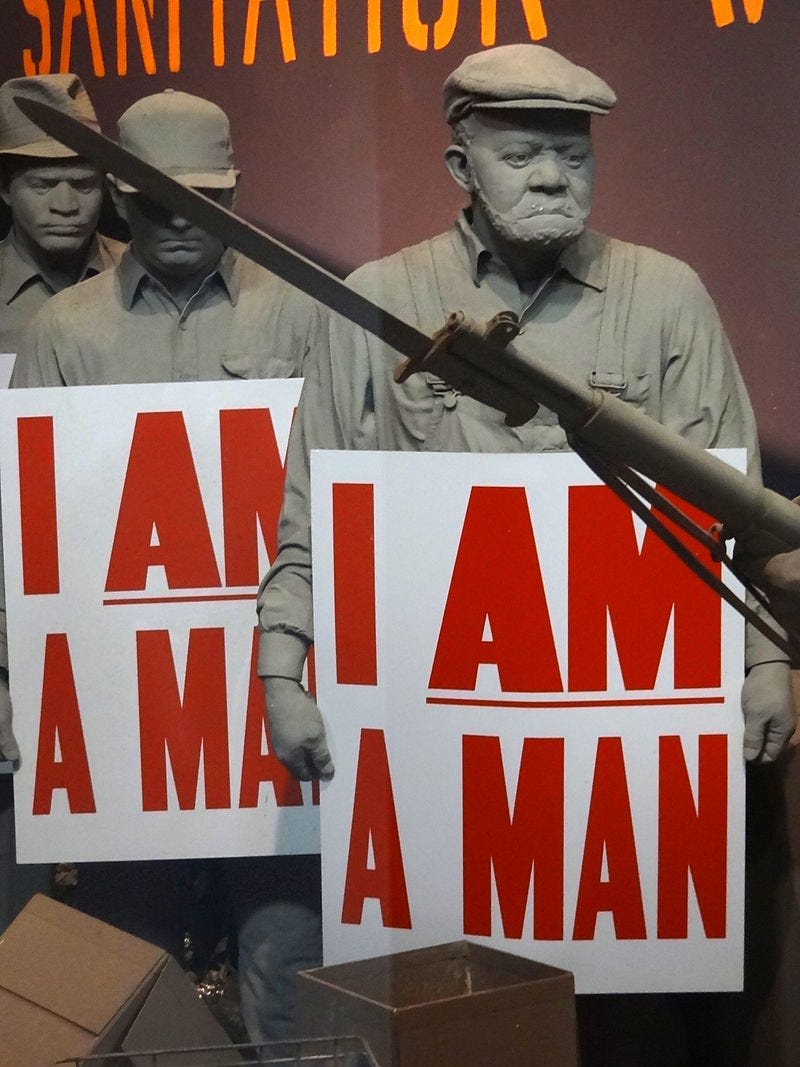
On February 28th, 1968 black sanitation workers went on strike, asking for better pay and working conditions in the wake of the accidental death of two of their own. They wore placards declaring “I AM A MAN” — protesting the historic marginalization of black males by referring to them as “boy.” Black men had long been treated as not socially on par with white men, and calling them boy was one way to remind them of it. It’s an overt signal of the inherent difference in status.
Although there may be instances today where it’s considered playful or informal to speak of an adult male as a boy, and many guys would feel just fine about it, it’s pretty unlikely that a black man would feel comfortable with that if it came from a white person, even today, because it has such a long-standing and pervasive racial charge. This is how I feel about adult women being referred to as girls — particularly by men.
Until the 1970s, women could not get a home loan or a credit card in their own name. They were presumed to be incapable of having the income or the maturity to handle a substantial financial obligation by themselves. They needed a man, who was a real adult, to supervise and manage them. That’s why their dad handed them off to their husband at the altar — from one mature adult to another.
My mom told me the other day about when she went to select new carpet for our home around that same time and the salesman informed her that she needed to bring her husband in to get his approval and to pay for it. In other words, she was a social child — someone who needed to be supervised by a man. She read him the riot act and got her carpet, but that was how many people used to think. It’s still a pervasive undercurrent, which is why the language we use matters.
Referring to an adult woman as a girl harkens back to that social dynamic, even if the person saying it isn’t intending to be disrespectful. But just like calling a black man boy, it doesn’t really matter what your current intentions are. Those terms have too much disparaging baggage attached to them to be able to be used cleanly, very often, or at all. And unless diminution is part of your intention, as a consensual part of a D/s relationship, there really is no non-offensive way for men (or anyone) to refer to women as girls.
Sometimes women refer to themselves or to each other in that manner and don’t mean anything by it. To some, it may even feel collegial. It’s mostly just habitual, but those habits help to maintain a society in which women are not authority figures or serious, or don’t really know what they are talking about. Only about 2% of our thought is conscious, so mindlessly maintaining old, outdated notions about women as being in need of adult supervision does make an impact, no matter what your conscious intention is.
Nearly all of your brain’s work is conducted in different lobes and regions at the unconscious level, completely without your knowledge. When the processing is done and there is a decision to make or a physical act to perform, that very small job is served up to the conscious mind, which executes the work and then flatters itself that it was in charge all the time.
The conscious you, in effect, is like a not terribly bright CEO, whose subordinates do all of the research, draft all of the documents, then lay them out and say, “Sign here, sir.” The CEO does — and takes the credit.
We create our culture with the words we say, whether or not we consciously mean anything by them, because our intentions matter a whole lot less than the impact of our words and actions. I grew up saying the word gypped when I felt that I’d been shortchanged somehow, with no ill intention. But as I got older, I learned that this was a slur referring to gypsies/the Romani people and I stopped using it. It has negative connotations referring to that ethnic group as untrustworthy and as swindlers. The fact that I used it in the past with no malice is irrelevant. It’s reinforcing a negative stereotype, and I want no part of that.
The way we label things changes how we frame them in our minds — this is brain science. Even if most people don’t intend to imply that adult females are inferior to adult males, continuing to speak of them as girls does subconsciously reinforce that dichotomy. We never speak of men in positions of authority as boys, because it’s demeaning and emasculating. However, sometimes women in positions of authority do still get referred to as girls because 50 years after women weren’t seen as competent enough to have their own home loans or credit cards, the subconscious dregs of this lives on.
As Mayim Bialik, a neuroscientist, says, “Maybe if we start using language that elevates women and doesn’t equate them with sweet, small, cuddly, tender, things, we’ll start treating them as more than that as well. Language sets expectations. Let’s set ourselves up to have women behave like mature, responsible women. In this way, we encourage women to keep being the complicated, wonderful, unique, gifted beings that they are.”
Another aspect of this issue is that adult women are culturally not seen to be as valuable as young, nubile, fresh young girls. We don’t have to take them seriously, but damn… they look good! Some women want to remain as girls for this reason. There really is no term for females other than girl that conveys vibrancy, beauty, sex appeal, and desirability. Some women resist being labeled as such because it sounds old and dried up to them. Broads, chicks, dames…. there really is no other good word for women that conveys beauty and power other than girl (such as her power is — simply to be hot and sexy).
Mature women are hot and sexy too, in ways that mere girls can’t begin to fathom, but that’s another way that our society needs to begin to shift in order to be more healthy as well. Youth and the kind of beauty that comes with it aren’t the only important things, even if they are kind of the current coin of the realm. Every age and stage has its blessings and gifts. None is better or less good than another, but one thing I do know — I am not a girl at this point in my life, and I will not be spoken to as if I am, because intentionally or not, that is disempowering, and that is not OK.
© Copyright Elle Beau 2020 Elle Beau writes on Medium about sex, life, relationships, society, anthropology, spirituality, and love. If this story is appearing anywhere other than Medium.com, it appears without my consent and has been stolen.


