
I Could Not Help But Love Them
a story about my father’s cruelty
My childhood was long ago but parts of it are only now making sense to me. We moved around a lot because my father could not keep a job. In his later years he was diagnosed with a plethora of disabilities. But as a young man he knew nothing of bipolar disorder, rheumatoid arthritis or that he would develop Parkinson’s Disorder. It was tough on him, my mom, and my brother and me.
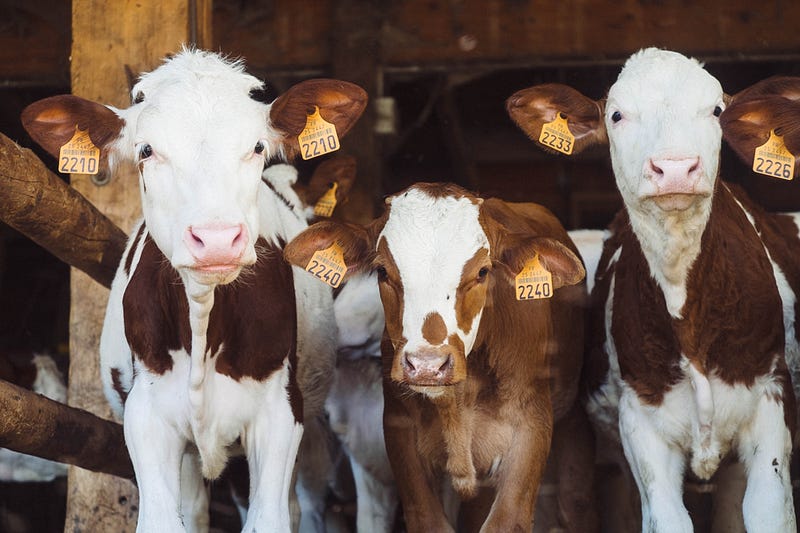
For many years when I was a child we lived on or near farms. We rode horses, milked cows, gathered eggs, gardened and preserved. My dad hunted, fished and slaughtered farm animals. The slaughtering of farm animals is a fact of life on the farm. It is also a fact of life for everyone who eats meat but many people are far removed emotionally from that fact. Most people are not emotionally aware that a steak was once a living, breathing, feeling cow or that their crispy, tasty bacon was once a cute little piglet as smart as their dog. They know these things factually but they’ve never felt them in their hearts. Most people have never looked an animal in the eye and then seen the same animal on a plate. (This is not an essay to say that all meat eating is wrong, I am not saying that, this is only my experience.)
On the farms it was grilled into our heads to “not get attached” to the animals. Don’t give them names. Don’t think of them as pets. Don’t even think of them as living. They are food, a commodity, money. I didn’t do this very well. As a matter of fact I could not do this at all. I always saw the animals as living, sentient creatures. (I didn’t know the word sentient when I was a child, of course.) My father just got madder and madder; yelled more and more. “Don’t get attached! They aren’t pets!” I felt like a failure, I was doing this farming stuff all wrong even though I loved being in the open fields, with the animals, in the fresh air. But I was disappointing my dad over and over again.
Once, a calf was born: it was taken from its mom to be slaughtered for veal and so that we could milk the mom. We fed it formula by bottle. “Don’t give it a name, it won’t be here long.” Ok, I’ll call it Milk Face. “That’s still a name…” I just could not get the idea of not liking the animals.
My dad took us to a barn full of rabbits. It was an open floor plan and the rabbits ran around all over the barn. There were dozens, maybe hundreds of them in all colors and patterns. It would probably be raided as a hoarding situation today. I was in little girl heaven. My dad actually let me and my brother pick out baby rabbits. I got a gray one and called it…oh, you can guess…Bugs. My brother got a black and white one…can’t remember its name. My brother and I played with them, fed them all their favorite greens, watched them grow. Bugs turned out to be a doe, the other one a buck. Bugs started getting fat with babies.
My brother and I came in from playing one day and my dad had slaughtered, skinned and fried the black and white rabbit. Yes, he did! And he expected us to eat it. My brother and I sat there crying. My mom sat there trying to not cry. My dad was mad. Mad! MAD!
I still don’t think I’ve processed the shock, 40+ years later. To me, he might as well have killed and eaten my dog or cat. To my dad, it was no different than slaughtering a cow. That’s what he’d gotten them for — food — to feed us, to reproduce and feed his family. We weren’t supposed to get attached. We weren’t supposed to play with them. We weren’t supposed to think of them as pets. But we did.
Very shortly afterwards, before Bugs even had her litter of kits, we moved away from farming country. We moved to a more city like area. I no longer had to deal with the slaughtering of animals on a daily basis.
As I have connected with more and more people on the internet, especially vegetarians and vegans, I have come to understand that I was not wrong as a child. I was a caring, loving child. Seeing animals in pain and about to be slaughtered was traumatic for me. My dad tried to take my love of all living beings and break it until it was gone. I was born a loving, empathic soul. I can not help but care. I look into the eyes of an animal and I see it as a life, not as food.
This isn’t me preaching about veganism, I am not a vegan but I may be working my way there. I have, however, stopped eating pork and beef. I do still eat poultry and fish for now. This is about how parents can warp a child, how parents’ brutality can leave a person doubting themselves for decades later. We believe whatever our parents tell us: we have to for survival.
My father made me feel insecure, as though I could do nothing correctly. Because I kept loving animals who were destined to be killed, he made me feel like I was less-then, incapable of doing anything worthwhile. I was “too soft” to survive. But I was being who I was made to be. I was being a loving person. I was caring, empathic and a beautiful little soul.
In my childhood I could not help but love those going to slaughter, going to their deaths. I cannot help but love them now. I am glad my dad did not succeed in killing my love and empathy.