
I Constantly Use MrBeast’s Strategies to Grow My Business — Here’s How
3 psychological biases you won’t be able to unsee anymore
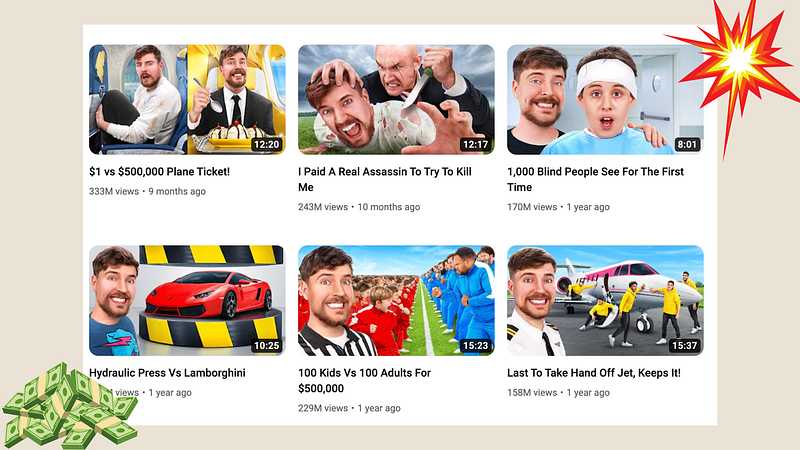
In 2012, Jimmy Donaldson was a regular 14-year-old guy.
Today, he’s running the world’s second most followed YouTube channel known as MrBeast.
While some assume he was lucky to produce viral content early on, Phill Agnew, host of The Nudge podcast, figured that Jimmy made smart moves early on.
Even in some of his earliest videos, he leveraged powerful psychological biases that helped him gain popularity and attract millions of viewers.
If you want to learn how to capture and keep attention, you can spend an enormous amount of time dissecting his work and strategies.
Luckily, you don’t have to spend dozens of hours watching him cut a table in half, put thousands of rubber bands on a safe, or read the longest existing English word.
Here are the most popular biases MrBeast is using and how you can leverage them:
The more you invest, the more valuable it feels.
According to the Input Bias, we value things more when we know they cost a lot of time, energy, or money.
“The tendency to use signs of effort to judge outcomes, when actually the two may have little to do with each other.”
— John Beshears & Francesca Gino
When you pay a lot for a product or service, you value it more. Just think of designer clothes or an expensive bottle of wine.
As the saying goes, what costs nothing is worth nothing. But that’s not just true for financial costs. It also applies to effort.
When you know something takes a long time to prepare, you typically find it more valuable and pay more attention.
When you spend hours preparing a meal, you’re emotionally attached to it and hope others value it as much as you do.
When you spend dozens of hours on a painting, you hope others will like it.
When you pour your heart and soul into writing your first book, you’ll hope others will see how much time and effort you’ve put into it.
Input Bias in action:
MrBeast used the Input Bias in his early days on YouTube by recording himself doing insanely boring things that took hours, days, sometimes even weeks to complete.
He spent two hours reading the longest English word, 17 hours saying Logan Paul 100,000 times, and 24 hours counting to 100,000.
Who would want to watch that?!, you ask? Well, apparently, millions of people.
Granted, those are extreme examples, but they prove a point: People pay attention when you spend lots of time or effort on something.
While the most common (and overused) piece of advice for creators is to provide value, I dare to say that there isn’t much value in watching someone cut a table in half with plastic knives.
Yet, millions of viewers were curious to take a look because cutting a table with plastic knives means you made an effort.
And that’s what many of MrBeast's early videos were all about: He started as a regular teenager without fancy gear, millions of dollars to give away, or exceptional video editing skills. But he had time and dedication. And he was smart (or lucky) enough to use the Input Bias to his advantage.
Here are real-life examples of how you can use the Input Bias in your own marketing:
Jay Clouse and Phill Agnew used the Input Bias when recording an interview to talk about the psychological biases MrBeast is using in his work:

When you read the title, you automatically believe the video is valuable because so much time has gone into the research.
If someone spent 50 hours watching MrBeast’s content, he must have some valuable takeaways, right?
During the interview, Agnew also mentions running a Reddit ad for his Nudge podcast:
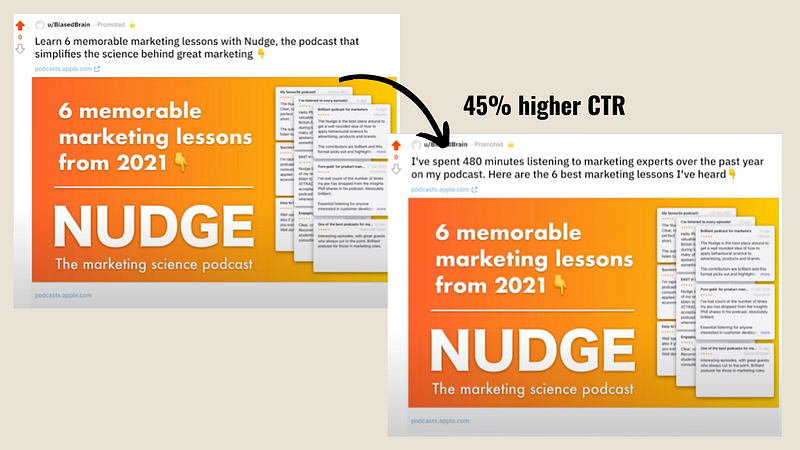
He saw a 45% higher click-through rate on the ad when he mentioned he had spent 480 minutes listening to marketing experts — the power of the Input Bias.
He’s telling you he spent lots of time on something, so you inevitably value it more and are more excited to click.
I always use the Input Bias to tell my audience I’ve been working on new content, promotions, or events for a long time.
Here’s an example from a newsletter a few weeks before announcing a new live challenge:
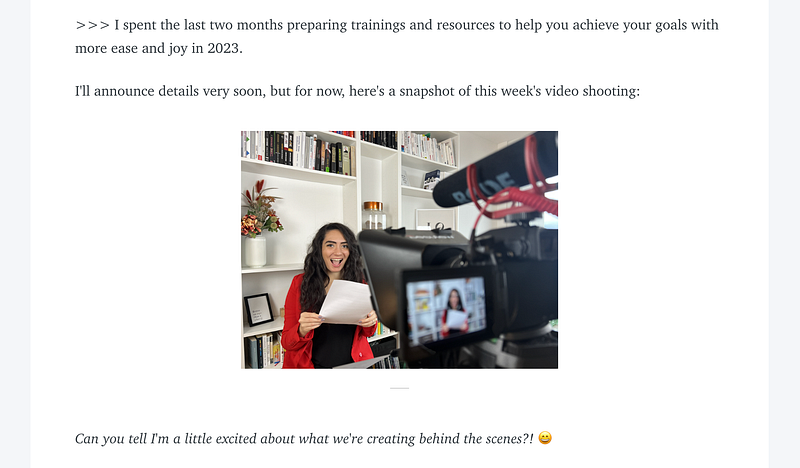
I used the same bias to announce what I’ve been working on:
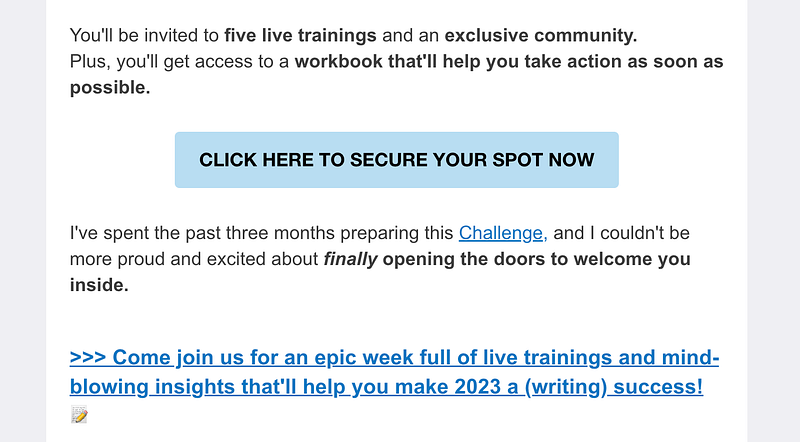
By telling you that I’ve been working on this thing for months, I’m implying that lots of effort went into it, hoping that’ll make you want to sign up and see if it was worth it.
Another example is this title I wrote, implying that I might know a thing or two about writing:
If you’re a new writer wanting to grow your audience, you’ll be tempted to click because you’ll think you might learn a few things that can save you a lot of time and effort.
When you know someone has spent much time working on something, you‘re usually afraid of missing out on the value.
Long story short, the Input Bias works because we value effort.
While nobody can check if you really spent x hours doing or learning something, MrBeast actually showed that he’s cutting a table in half or reading every number until 100,000.
He recorded himself doing these insane things over and over again, and people ended up believing him anything.
He never disappointed his audience. The more he grew, the crazier his challenges and videos became — still using the Input Bias to his advantage.
High costs signal high relevance.
While the input bias usually refers to how much effort went into something, Costly Signaling often implies the financial cost.
“Costly signalling states that the more money or resources someone spends to market their products or services, the more trust someone will have in the brand. “
— Phill Agnew
By strategically showcasing your investment, you’re signaling quality and creating urgency by hoping your (potential) audience doesn’t want to miss out on what you created.
In content creation and marketing, Costly Signaling is often about demonstrating commitment, quality, or investment in your content, brand, or offer.
MrBeast’s videos are a textbook example of Costly Signaling: He’s using extravagant giveaways, massive charity campaigns, or meticulously crafted challenges that involve significant financial investment.
He’s showing how he’s:
- Spending a million dollars within 24 hours
- Giving someone $100,000 to spend in an hour
- Or giving away $500,000 to the person leaving a giant circle last
These aren’t just acts of generosity or creativity; they’re signals to his audience about the lengths he’s willing to go to create unique and high-value content.
It’s also clear he’s making a massive (financial) investment when shooting videos that compare a $1 plane ticket to one that costs $500,000.
Or when he recreates entire sets of popular series or games for his challenges.
Even though MrBeast is going the extra mile through his massive financial investments, Costly Signaling isn’t always just about money. Similar to the input bias, it can also imply commitment and effort.
Costly Signaling in action:
Granted, MrBeast has mastered Costly Signaling because he’s able and willing to spend more than anyone else on his videos. But even as marketers and creators without million-dollar budgets, we can use Costly Signaling to our advantage.
For us, Costly Signaling often means showing our audience and community that we’re deeply invested in our content and work — whether through time, effort, or other resources.
You can, for instance, show your investment by sharing behind-the-scenes footage of your work.
Show the making-of process of your products or content.
Share the research process involved and the challenges you had to overcome. Be transparent about the process and take your audience and customers on the journey.
You’re also using Costly Signaling by ensuring quality and keeping a high standard for the marketing and products you create — whether that’s the actual quality of your offers or through high-quality marketing materials like visuals, videos, or sound.
Quality is always a sign of investment.
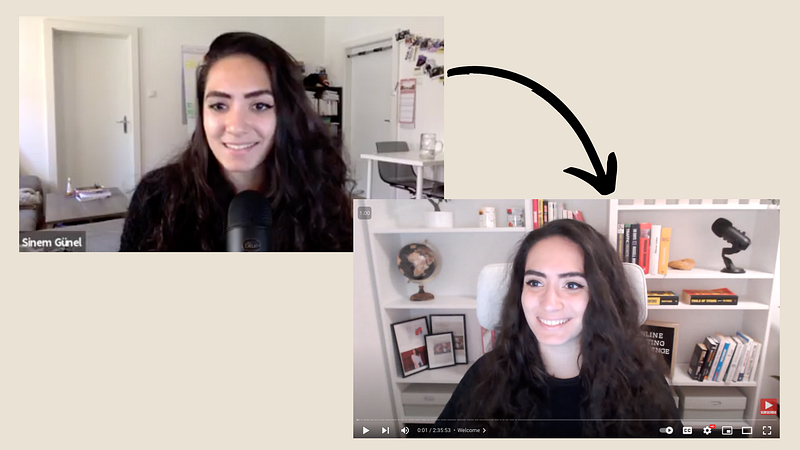
When I started my coaching business, I recorded videos in my 2-room apartment.
You could see my couch, dining table, and other distractions like my boyfriend’s beer jug in the background. The sound quality was poor because I lived on the ground floor and had a tram passing by right next to my window.
Today, I have a proper setup in my office with decent lighting and sound. My videos look more professional, and it’s clear I made an investment to produce higher-quality visuals:
Phill Agnew ran a simple test to see if he could make use of Costly Signaling without actually making a substantial financial investment:
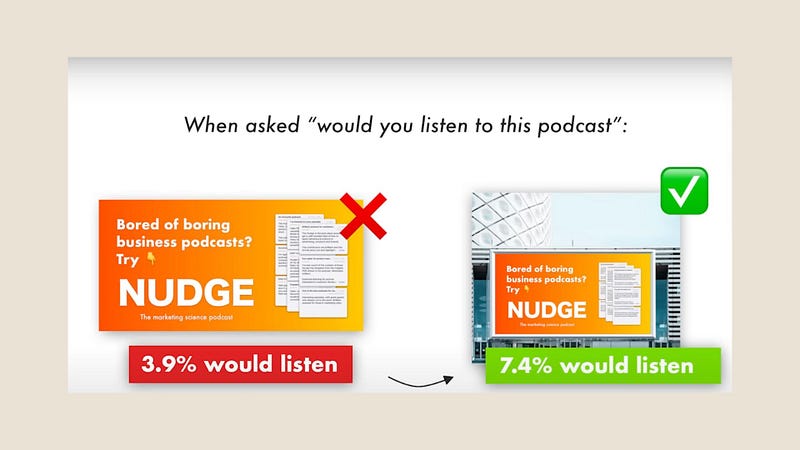
While the first banner looks decent, it’s boring. It’s what you see all the time.
The banner on the right, however, looks different because it’s placed on a fancy billboard. The background seems more expensive, and it implies a higher associated cost. Even though it’s not actually more costly to create the second image, more people clicked on it — the magic of Costly Signaling.
In short, Costly Signaling is about showing your audience that you’re not just another creator in the crowd; you genuinely care about your audience and invest in the content you produce. It’s about building a brand that resonates through quality, effort, and authenticity.
Tease without revealing the entire thing.
Last but certainly not least, MrBeast is exploiting the Curiosity Gap in almost all his videos — it’s the strategy marketers and creators can copy most easily.
As a creator or marketer, you use the Curiosity Gap to capture and retain attention.
The gap refers to what you know vs. what you want to know.
Think of it as a teaser: The title gives you an idea, a hint, or a promise, and your mind desperately wants to fill the gap.
Your curiosity is piqued.
You’re looking for an answer. You not only click, but you actually stick around until you’re satisfied.
When MrBeast says he rented a $1 hotel room and another for $1,000,000, you want to find out what he’s talking about.
Your mind runs in circles, trying to find answers to questions like:
- How do you find a hotel room for a dollar a night? Where is it? What does it look like? Did he really sleep there?
- What does a hotel room that costs a million dollars a night look like?! How is it possibly worth spending so much money on a single night?
You don’t know, so you watch the video to find out.
That’s the Curiosity Gap in action.
Most of MrBeast's recent videos leverage a combination of Input Bias, Costly Signaling, and the Curiosity Gap in the title and thumbnail.
Oh, and if something works, he’s doing it over and over again:
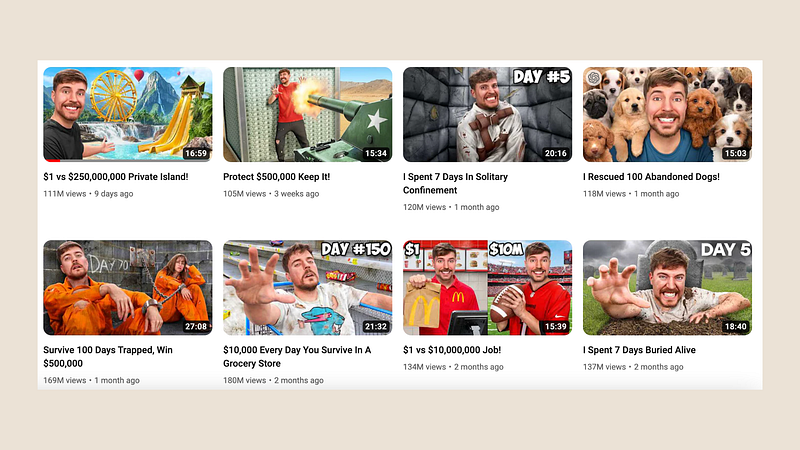
MrBeast’s titles spark questions:
- How did he manage to do that? (Buy an island for $1, spend seven days in solitary confinement, spend a week being buried alive,..)
- What happened during the challenge? (Did someone manage to protect $500,000 and actually keep the money? What did he do with the dogs he rescued?!)
This curiosity compels viewers to click and watch the video to find the answers, driving his videos’ high view counts and engagement rates.
Moreover, MrBeast often structures his videos to maintain this curiosity until the last second.
He introduces multiple hooks and teases upcoming challenges or rewards early in the video, ensuring viewers stay tuned to discover what happens.
Curiosity Gap in action:
The curiosity gap starts with your headlines. Each piece of content you produce should spark curiosity so your audience thinks, I have to learn more.
Whether it’s an educational piece of content or a promo for your upcoming launch — you need a curiosity gap to imply urgency and drive clicks.
Use questions, provocative statements, or subtle hints to compel your audience to seek answers by engaging with your content — or at least by clicking on it.
By using a curiosity gap, you tease what’s coming and give a sneak peek while still leaving enough unsaid to keep them guessing. You get them curious, but they can’t figure out the whole message without clicking on your content — and, ideally, watching or reading through to the end.
You want to ensure you keep your audience’s attention even after getting the click. MrBeast is using several brilliant strategies to keep attention:
- Many of his videos start by telling the viewer that they’ll get way more than they clicked for.
- He doesn’t bore the viewer through lengthy intros — he gets straight to the point.
- He makes bold promises that keep you sticking around until the last second.
Even though Mrbeast’s videos start with one big promise, he uses several teasers and new curiosity gaps during his videos.
You can also leverage curiosity gaps by using “coming soon” posts on social media, preview snippets of your upcoming content, or blurred images of a new product — all designed to build anticipation.
An example I love is how Chenell Basilio is teasing her upcoming newsletter on X:
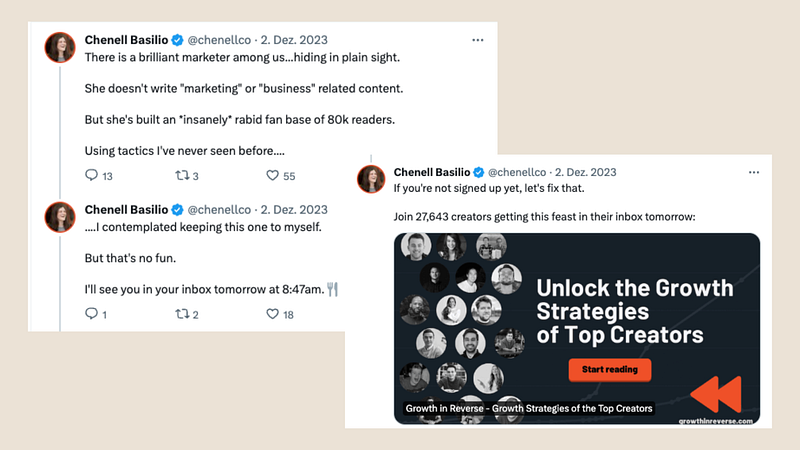
Through teasers like these, you make your audience feel like they’re in on a secret or part of an exclusive group. This creates interest and enhances the perceived value of what you’re offering.
Final thoughts
The bad news about all of MrBeast’s biases is that you can’t fake them.
To use the Input Bias, you’ll have to put extra work into your content because that’s what makes the bias work.
Costly Signaling won’t work if you don’t actually make investments that signal quality and relevance.
And the Curiosity Gap won’t work if there’s nothing to be curious about.
In a world dominated by shallow, repetitive, boring, and uninspiring content, you’ll only stand out if you’re willing to go the extra mile.
💻 I teach you how to share your story with the world, build an audience, and make money online. Click here to learn more.


