
I Ate At A Michelin Star Restaurant For The First Time And It Gave Me Hope For Hospitality
It’s cool to care!
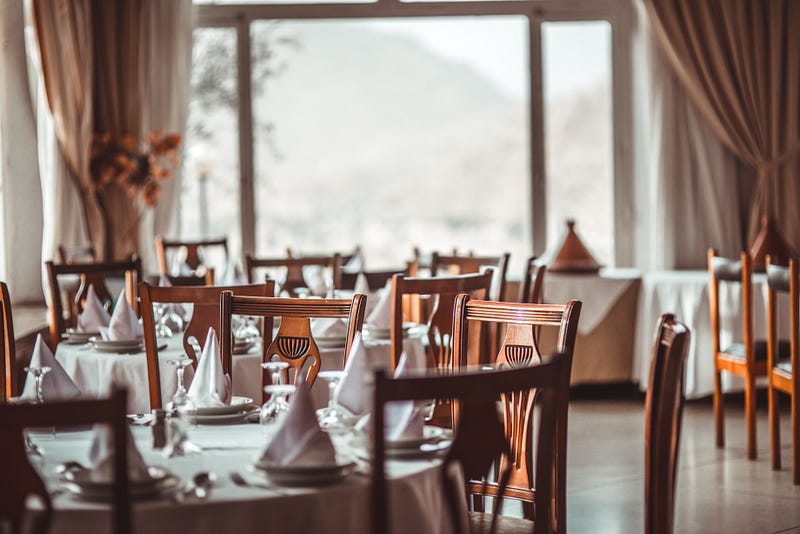
I don’t spend a ton of time eating in Michelin star restaurants.
In fact, I can’t recall if I’ve ever been to one other than the one my partner and I ate at the other night — Osteria Mozza in Los Angeles.
I don’t eat in them, particularly because they tend to be super expensive and, generally, they’re not my thing. Often, they’re stuffy and pretentious.
From what I hear.
However, I have a huge interest in hospitality, stemming from my time working in the bar and restaurant industry in LA. Part of that time for Make It Nice Hospitality, which still owns the world’s former #1 restaurant, Eleven Madison Park, and used to own The NoMad Bar and restaurants in New York City and Los Angeles. Plus, I most recently worked for a couple of guys who execute fining dining-level hospitality in a fun, almost raucous way.
That’s really the thing — how do you deliver high-level hospitality that’s not stuffy and pretentious? How do you include elements you find in a Michelin star restaurant in a casual, loose and maybe even fun environment?
I can’t answer these questions. At least not the “how” part as it relates to how do you get an entire team of other people to do what it takes function at such a high level?
If I could I’d hold the key to turning just good establishments into great ones.
I feel like I know what to do. Because I did it.
In fact, almost everything I learned working at NoMad resonated with me. It just made sense to treat people like guests, not customers. One of the many mantras they rightfully drilled into our heads.
Rightfully because when you work in bars and restaurants — particularly ones with relatively high prices — you never know who you’re dealing with.
Ultimately, it doesn’t matter. Because you should treat every guest the same way.
However, the thing that always worried me wasn’t keeping the regulars or big spenders happy. That’s actually the easy part.
Instead, it was keeping that couple you can tell is out on a date night happy. Maybe a once-a-month, once-a-quarter or even less frequent date night. That couple who got the baby sitter, maybe even saved a couple bucks extra for the splurge and looked forward to visiting your place for weeks, possibly months.
This is a representative sketch of the type of people I wanted to provide an extra special experience for.
That can be a fun, entertaining and personality-filled experience like I describe here. But that’s not always possible or something every guest wants. You have to read the room.
However, I’ve never met somebody who dines or drinks out who doesn’t want to feel taken care of — looked after and appreciated — when they visit.
That’s really the difference between service and hospitality. Bringing someone what they ordered versus making them feel like you give a shit when you bring them what they ordered.
For the first time in a long time, I saw how it’s done the other night at Mozza.
The whats to providing Michelin star-level hospitality in a setting that doesn’t feel stuffy, pretentious or even like fine dining. As it should be.
And you don’t have to have a Michelin star to do this.
We didn’t have one at NoMad in LA. But the things we learned — some of which I pull from the Make It Nice handbook that I still often refer to — were easy to execute and allowed us to perform at a level that made us consistently great.
The whats we saw the other night at Mozza are part of why they have a Michelin star.
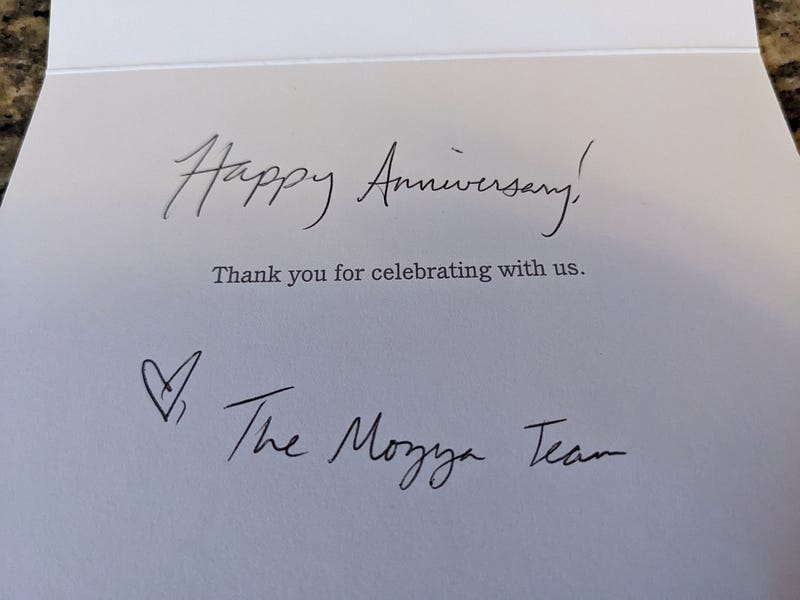
- We noted it was an anniversary (three years of being together) with our reservation. So there was a card on the table for us.
- Two glasses of bubbles to start, on the house.
- You remove the little collar from your napkin and set it on the table. Within seconds, a server passing by grabs it and takes it away.
- My girlfriend is away from the table when her entree arrives. Immediately, the plate gets covered with one of those fancy lids.
- She returns and, within seconds, a server appears to remove the lid and offer some Parmesan cheese.
Specific, small things that add up.
These small things happen as part of a systematic awareness.
Nobody is assigned to any one duty. However, everybody on the dining room floor is constantly scanning the landscape for these little things that need to be done. And — seamlessly — they get them done.
The other thing good dining room teams do is earn their guest’s informality. That’s from Make It Nice.
They hated when bartenders greeted guests approaching the bar using “you guys.” Instead, from the handbook, “We err on the side of professionalism until we’re invited in.” When a guest shows that it’s okay to “call me Jim,” you go ahead and call him Jim.
Words matter.
When your plate looks empty, the server usually asks, “Are you still working on that?” But not at Make It Nice. And not the other night at Mozza.
Are you still enjoying that?
Because working on food sounds like a fucking chore. The way my Dad attacks his food like he’s digging a trench.
On paper, I realize this might actually sound like stuffy and pretentious shit. But the key comes down to the people who execute these and a million other little details in a way that becomes second nature so it’s near flawless and super casual at the same time as being professional.
It’s tough to put your finger on this dynamic. You know it when you see it. As a guest, you can feel it. At least I can. When there isn’t that uneasy hierarchical sense between the workers doing the serving and the guests being served. It takes a good hospitality professional to break down this barrier and level the playing field.
It’s actually a great art. Few people have mastered it. And, of the ones who have, quite a few make a good living in the craft.
This excerpt from the actual Make It Nice handbook goes a long way to summing things up. To explaining the attitude of the server, host or bartender who gets it and makes it nice —
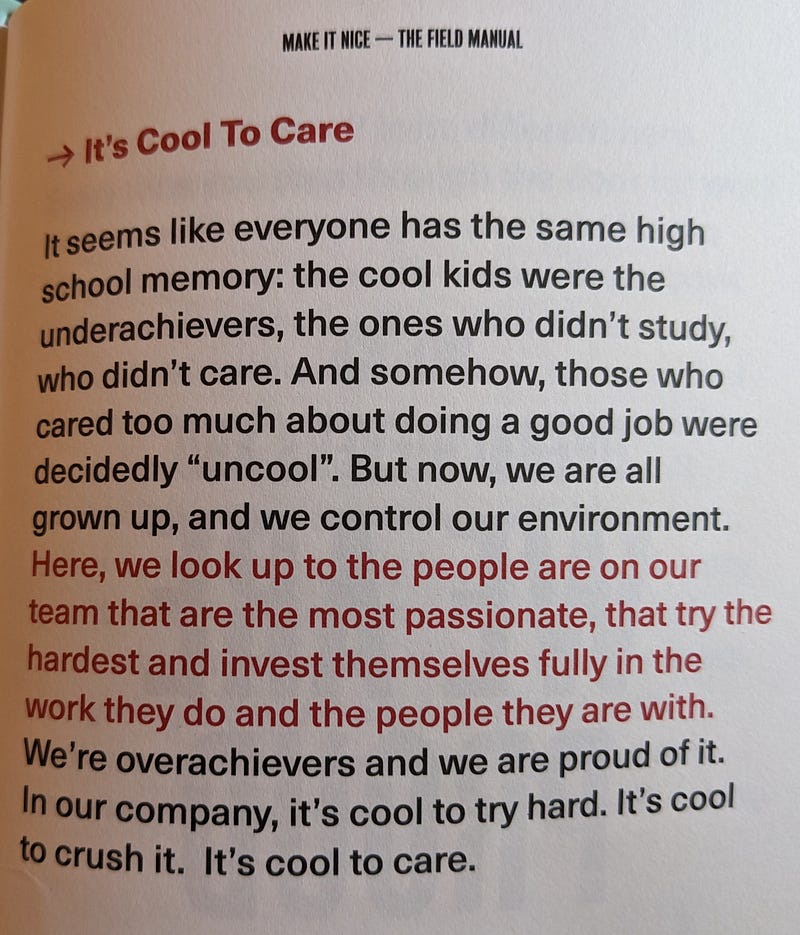
This resonates with me more than anything I learned when I worked in bars and restaurants.
We have all been there. Not wanting to give a shit because it makes you look uncool.
Or being around people trying to appear cool by not caring.
It doesn’t make any sense. Yet, an endless number of grown adults still function this way.
Ultimately, it’s about putting yourself in the guest’s shoes.
If they’re acting like douchebags, disarm them and give them the leeway to not act like douchebags for a second.
If they’re the couple out on a date night, don’t ruin their date night by being a douchebag yourself. Understand your role in helping dictate their experience. Act as if you’re working in a Michelin star restaurant.
Like anything else, this stuff must be taught. Given the high cost of eating out these days, there needs to be a renewed emphasis placed on providing this level of hospitality. More people — in ownership and on the ground — who take their work, but not themselves, seriously.
Receive a notification each time I publish a Medium article by going here.
You can also subscribe to my Living The Semi-Retired Life newsletter where I chronicle my big decisions on lifestyle, housing and cost of living, which includes moving to Spain in roughly one year. A move prompted, in part, by the contents of this article.


