
I Analyzed 389 “How to Be Successful” Tips — Here is What I Learned
Condensing 18+ “How To Be Successful” articles into 6 Powerful Tips.
Curiosity got the best of me. After reading hundreds of self-help articles over my lifetime, I wanted answers. Halfway asleep, I had a light bulb moment for what I thought was a good idea for an article. There are so many articles that provide lists of tips on how you can be successful. If you Google ‘How to Be Successful’, like I did you will find dozens of articles listing the exact steps on how you can be successful.
I thought amongst these hundreds of ‘tips’ there had to be at least some cross over. I wanted to know which of these keys to success was the most common. Ideally, I would be able to break down the many tips into a smaller subset of usable action items.
All of this theory sparked a small version of what I’ll call a meta-analysis. (This isn’t actually a meta-analysis by the academic definition).
Methodology
The methodology I employed was rather simple. It was created in this way so I could have fun with it, while also learning something new. Here is the process:
- Phase One: Gather Data
- Phase Two: Categorize
- Phase Three: Review Results
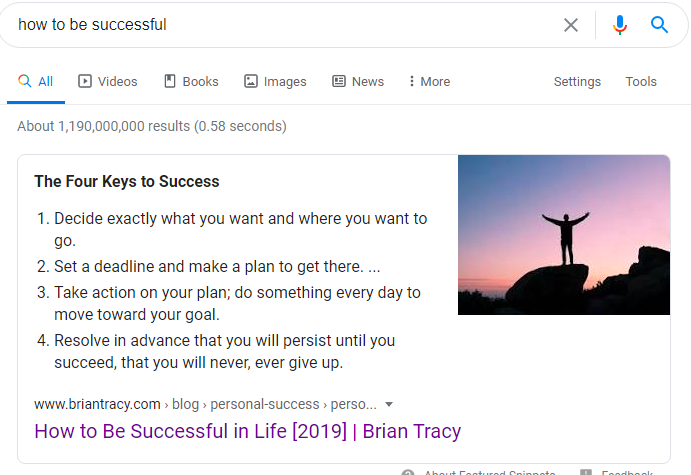
Gathering Data- In this stage, I started with the Google Search “How to be Successful”. I opened the first search result and created a document, combining all the tips.
Categorize- The next step was to categorize and ultimately condense the many tips into a smaller subset. This involved lumping certain phrases together.
Review Results- After many iterations of categorizing I had a workable subset of categories. From there, I did some analysis and found the top values.
Phase 1: Gathering Data
I opened up a spreadsheet and began my search. Step one was to Google “how to be successful” and let the results populate. My first task was to see if this experiment was feasible. After my search query, I was happy to see that the most common results were in listicles. In fact, almost the first 4–5 pages of articles contained listicles. For this analysis to work, I needed scannable documents that I could quickly add to a spreadsheet. My goal was to scan the first 10 pages of google, but I was losing interest and effectiveness after page number four. After 30–40 minutes of work, I looked at my list and saw that I had 300 unique success tips.
I decided to get as close to 400 tips as I could before starting on phase 2. I made it to about page 5 of Google search, ending up with a list of 388 unique words.
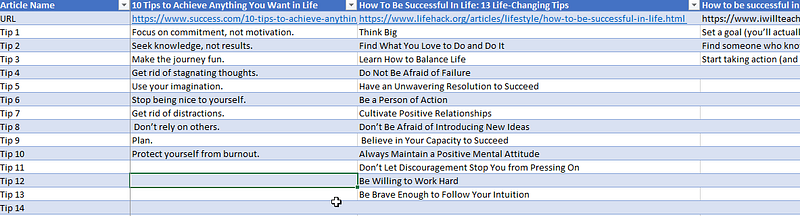
The 388 tips used in this analysis came from the top 18 ranking articles.

A couple of notes about my process:
- I skipped any essay like documents — I only used articles that contained scannable success tips.
- I did not include results that were sponsored — No Ads.
- I am not a data analyst — The results are prone to subjectivity and analysis errors.
- Results include two excessively long lists — A list of 50 & 101 success tips were used in part of the analysis.
Phase 2 — Categorize
I now had a sizable list, perfect for the amount of work I wanted to put in. My next step was to attempt to condense the list by re-categorizing terms. This required a test of limited linguistic skills as well as memory. When you are looking at a list of 400 items it can be hard to remember what you’ve reviewed. The human brain can only remember a couple of items at once. I was challenged to make this analysis accurate and effective.
What I started to do was to take the 400 items and sort them into alphabetical order. First, looking for any connections. Then seeing where the similarities existed. I evaluated and saw some common themes emerging. I again tried to reduce the total size of the list by finding commonality. Starting from the top of the list alphabetically I changed each phrase into a shorter categorization. Aiming for consistency throughout the document.
For example, when I saw a phrase like “Start Doing” I converted it to a common theme of “Take Action”. There were some cases where the phrase was truly unique and I was not able to rewrite without destroying the meeting. More so I was challenged with converting it in a way that didn’t lose the point.

Due to the tedious nature of this task and an occasional lack of focus, this first conversion took at least 50 minutes. I would often have to go back up the list to see what category I was using. During this process, I found that I would often have a dilemma of how to convert a phrase. Here were some of the questions I had to ask. Should this phrase be converted to positive action? Does this conversion change the meaning of the original phrase? Should I create new verbs? Am I oversimplifying?

There were also moments where I may have over-generalized a category. Words have subtle meanings. For example, those that wrote about setting goals were specific. They use words like ‘ambitious’ and ‘concrete’. Those are two opposite adjectives, yet, I initially put them in the same category.

I would often be far down on the list working through a phrase conversion then have to scroll back up to see what words I was using. The idea was to condense the first list of 388 unique values to a smaller list. A smaller list would be easier to work with and eventually summarize.

Phase 2: Categorizing was a step that I repeated multiple times. I kept revising my list and checking the categories. The repetitive analysis was my way of making sure that I was accurate. My theory is that if you spend enough time on a project, you start to make connections. These connections can only happen after your brain has had a chance to spend time certain data sets. After several repeats through the converted list. I created a simple pivot table. The pivot table allowed me to look at the dataset and start to see where the commonality existed.
Phase 3: Reviewing Results
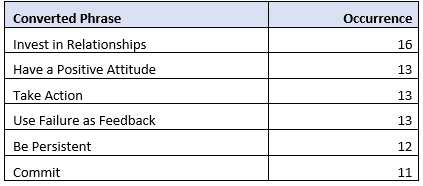
After creating the table, I was able to see the counts. These counts are based on my categories. Again, I am pointing out the subjectivity here. I enjoyed the exercise and challenge of trying to work through these text strings. However, the real reason I went through this was because of genuine curiosity. I really wanted to know what the collective knowledge of the internet said about being successful. Are there certain mindsets, habits, and/or actions that are more heavily cited toward success? I found that there were several categories that repeated themselves more often than the rest. Out of the original 388 Unique ‘how to be successful’ tips, these converted phrases accounted for 20% of all tips.
Breaking down the top 6
1) Invest in Relationships — I personally love that this phrase came up the most often. It can be easy to get trapped in an unwavering commitment to the grind. Although the hustle mentality is starting to face just criticism, there are still advocates of the work until your successful attitude.
I don’t think components of these ideas consider sacrifice. Specifically, does your version of success mean sacrificing moments of happiness?
I can speak for myself. When I set an ambitious goal for myself, I often find that I can neglect my relationships. On the path to achieve something, I forget to remember what it’s all for. I believe that the frequency advice of investing in relationships shows the importance of having something to work for. 2) Have a Positive Attitude — Common sense, right? If our paths to success feel miserable then what’s the point. Not shown in the top five, but prevalent further down the list is to “enjoy the process”. I am a strong advocate of making happiness the mission. There is a false belief that first comes success then happiness. It doesn’t work like that. If you don’t believe me check out all of the TedTalks, Youtube videos, and blog posts about people who talk about how success did not make them happy. Positivity has to come first. Dr. Martin Seligman uncovered this insight in the classic positive phycology book, Learned Optimism. Positivity, optimism, and enjoyment are all essential elements on the path to success. Most of all these good feelings make any version of success worth it.
3)Take Action — The order is important here. Take action is third. Before action comes relationships and positivity. In theory, we find ourselves in a good state which allows us to then take meaningful action. I still believe that finding happiness is most important. Happiness should absolutely be the first metric to success. However, to do anything great we have to do something. That is where this take action advice comes from. This insight is the precursor to almost anything else on the list. Clarity comes from action. Insight comes from action. Failure comes from action. So much starts to happen once you start to move. Tiny steps are much better than no steps because it creates a path for us. 4) Use Failure as Feedback — Undoubtedly, the results of repeated action is an eventual failure. Failure is a vital tool to learn and grow. We know this. We know that we have to fail in order to succeed. It is cliché’d advise that is so often toted that it can easily be ignored. Perhaps the more important element to this advice is to have the courage to fail. It’s scary putting yourself out there. Criticism sucks at times, especially if you feel you’ve put your best stuff out there. Its easier to stay safe in the comfort of perfecting. We get trapped making our little projects so perfect before showing the world. Only its never good enough. We end up keeping what we do to ourselves forever. Quiet and fearful. Never giving ourselves an opportunity to learn and grow. The widely cited “ceramics quantity over quality” study proves this. To summarize, a college art professor split students into two groups. One group was to be graded on the quality of one project. While the other was graded on the number of projects completed. Can you take a guess which group showed the best work? That’s right the quantity students were the ones that ended up improving this most. They were more likely to experiment and find out what works. Constantly failing and learning in the process. It would be easy to say that you should fail often and end this point, but I think there is more subtly to it. Fail at your pace. Don’t rush things simply because ‘failure’ is the key to success. You still have to figure out what works for you, but you also have to share. There is no other way to get feedback. 5) Be Persistent — How else could we say this…
- Have grit
- Don’t give up
- Keep going
- Stay with it
I believe persistence is related to consistency and tip number 6 which is to ‘commit’. Being persistent is another way of saying stick with it. For any goals to succeed there must be continuous action. Even if that action is small. The smallest course of action in the face of adversity shows persistence. The real test and true mark of whether someone is going to be successful are if they can stick with something even when it gets hard. Staying consistent allows growth in the good and in the bad times. 6) Commit- Finish. Finish projects. Don’t be a squirrel. I’m 31 at the time of writing this and I’ve probably squirreled around to hundreds of shiny objects since my mid 20’s. See the list: Publishing books on Kindle Selling meditation pillows Meditation blog Amazon fulfillment ideas Writing books Half-baked product ideas Learning X number of songs on guitar. Lingering house projects. Life is exciting when novelty is introduced. Here’s the reality — to do something great, you need to deal with the challenges of boredom. The more you spend time committed to one thing, the more likely you will experience burnout. These moments of boredom are when a new project can quickly take over your attention. The problem with this is that there is no way to master anything if you constantly jump. Time and dedication create new insights. The only way to connect new dots is through an investment of time. That investment might feel painful at times, but know that the commit pays off. Learn to trust yourself
After I had spent some time writing this piece and looking at the data, I got to a point where I was no longer interested. I saw some flaws in the methodology I employed. There are errors due to subjectivity that exist throughout my document. That is all to say that it doesn’t really matter what the world says about being successful. One of the parts of this analysis that I didn’t dive into was where these words came from. Sure, I mentioned that the tips were extracted from 18 of the top Google articles for a “how to be successful” search, but that doesn’t really mean anything. We all have stories to tell. These stories in this data set happened to be the ones that correspond to an algorithm created by people most of us have never met. The definitions of success vary from person to person. Even those that have reached success as agreed on by society can only tell us so much. They can only tell us about their experience. They can tell us what worked for them. For us to find our own success, we need to figure out what works for us. The words on this screen are me pursuing a curiosity and seeing a little experiment through.
Does that make me successful? I would say yes. I had an idea. I saw it through and I wrote content that I am proud to share. This is how I define success. If you’ve read this far, I thank you for allowing me to talk at you for 10 minutes. I’d love to know how you, the individual, defines his/her success.