
Dear Diary: I Am Trash
Surviving trans conversion therapy
CW: transphobia, disordered eating, SA, hospitalization
In a mental institution for boys, a young trans girl isn’t trash. She’s a prize.
Note: this article is also available as a video
Anorexia was the word my doctors used
In the Fall of 1996, my dad drove me, his thirteen-year-old transgender daughter, to the mental institution I’d call home for the next two years (offsite to Oak Circle Center).
No way out. But then again, no desire to leave.
Our God is a cruel god
The car’s speakers played the song that defined my dad’s identity: “Our God is an Awesome God!” (YouTube)
The lyrics, like the man who repeated them, were simple.
Our God is an awesome God He reigns from heaven above With wisdom, power, and love Our God is an awesome God
The volume couldn’t have been very loud. It didn’t need to be. My body, already deathly thin, shook from the power of those words.
Anorexia was the word my doctors used. My dad refused to call it anything.
I don’t remember what I weighed. I didn’t want to know. My weight didn’t matter when I could never be skinny enough. I needed to be thinner, thinner, thinner, until I was invisible. Safe. Untouchable.
Honestly, every minute up until my dad loaded me into the car was one scheme or another to avoid another bite.
Most days, I eventually submitted to eating something — and a surge of euphoria rushes through me at the memory of melted cheese on bagels. Even an anorexic teenager knows what she likes to eat.
The day Dad brought me in, I didn’t bother eating anything. Why bother? It was my decision now. My dad didn’t yell for me to put the food in my mouth that morning. He’d given up, too.
Or not really given up. He’d finally won. He’d just gotten rid of his oldest daughter. Now he was getting rid of me. There could be only one woman in the house: our new step-mom. Finally, someone willing to satisfy his endless need for love and sex.
Finally, a wife who would fulfill what God had promised him.
I didn’t understand until recently why his new wife saw his daughters as competition — not until I remembered that to a predator, a person is only a prize until they refuse to obey.
My only shield was a piece of paper
I am trash. The one that ruins everything. The one that makes problems. The one that’s easy to point at and say look, it’s her fault. If she went away, so would this awful feeling.
I know this now. If I look deep enough, I knew it then.
I knew I was trash when I was twelve and my brother disappeared into the boys club he learned to dominate with power and seduction. But me, his little girl sister, ironically two minutes older but a lifetime younger, always held him back.
My brother had limited resources, a life of his own, but I needed him. His charm. His guile. His protection. My needs were distractions from his ambition to be the same kind of would-be cult leader my father has withered away still trying to become.
My brother showed early signs of promise. The sort our dad could only dream of. He could charm anyone. Intimidate anyone. Seduce anyone. The only person holding him back was me.
I wouldn’t hold him back any more.
I knew I was trash when my sister disappeared at sixteen into the den of a married man ten years her senior. He seemed kind. Confident. Protective. They always do.
I knew it when her friends stayed over and reached out at night in hopes I was too lonely to resist.
I don’t want to hate her for the people she brought into our lives. The people she called friends. They promised to call me friend, too. But they abused me — you’ve heard the term grooming and all the places that leads — and the thought that haunts me as I heal is that it’s never just one victim. Whatever happened to me probably happened to her.
But my god was I happy to go into a place where her friends couldn’t groom me, where my father couldn’t hurt me, where my mom couldn’t scream until I had no safe place except the world I call the Void.
The void
I’m not going to explain it, but most writers will relate by thinking of this as where they live when each element of their story and their soul converges into a unified experience. Every detail, every scent, every texture feels real — perhaps more real — than what’s in front of you. The only limit is your imagination and the will to make it manifest.
The creativity is its own thing, but the need for that degree of disassociation is a trauma response. Existence itself has always felt painful for me. My body and my mind can’t process all of…this. I know I can’t stay in the Void all the time, but everyone needs a place that feels like home.
Especially when the one they were raised in refuses to be safe.
A place to call home
Much as I don’t want to remember, Mom sometimes came to my room, too. Not the way she went to my brother’s to teach him how to be a proper man — and not the way my dad came to each daughter’s to teach them how to be proper women.
Each moment of divine euphoria mixed with the promise that whatever felt unclean about it would eventually be redeemed in Heaven.
That was our home. The place my dad warned me “they” would ensure I never saw again. The mental institution, he said, would be the worst place of my life. He’d been wrong about everything else. Maybe this place would actually be okay.
Then they brought me to my room.
The danger of broken things
The room was big enough for two people. One bed on the left, one bed on the right, and a desk against the far wall for our most productive hours.
Could I write after dark, like I had at home?
I didn’t yet know that the dark was when this place became the most dangerous.
Maybe you’ve heard the famous line from Watchmen by the anti-hero Rorschach. He’s more brutal than Batman. He gets caught, sent to prison, and though the prisoners at first can’t believe how lucky they are to have him in their territory, Rorschach reveals a horrifying secret.
He’s not trapped in there with them. They’re trapped in there with him.
A padded cell
When I feel desperate, I wish it had been like that for me. But then I look at my brother. A wounded predator, like Rorschach, ready to hurt anyone he blames for any unwanted feeling in himself.
But he and his mentor didn’t teach me to strike to kill (in defense). They taught me to submit.
The rule was simple:
Give a predator what they want — or else.
A predator always has more power. And only a predator has the will to do what must be done. The only question is if they’re on your side.
The people around me didn’t call themselves predators, of course. They called themselves friends. Brothers. Sisters. Parents. Family. The names some of them still cling to when confronted with the harm they’ve done.
The first day
On the first day at the mental institution, a staff member pulled me into a private medical room. He told me to undress. He checked for marks, bruises, and instead found what my father had tried to hide.
I saw in his eyes how dangerous this place would be for a girl. For me.
But this was Mississippi in the mid-90s. He had a job. Orders. He sent me to what he knew waited.
Rules are meant to be ruled
My first roommate at the mental institution was named Brent. He seemed nice. He spoke of his girlfriend in the girl’s wing, sweet times for his sweetheart.
I told him a secret I still don’t share with most people. That man who mentored my brother? He used to take me into the woods. He taught me how to track, how to fight, how to survive. Of course, he’d occasionally ask me to take him on. Just to remind me who really had the power.
I didn’t mind if Brent had the power. I just wanted to show off for a minute.
My foot left the ground, my hip twisted, I rose onto the front of my other foot and spun — a side kick that Brent then perfectly replicated. He wasn’t making this up. He knew stuff, too.
Some people want trash
The next day, my therapist asked if I was making any friends. I mentioned Brent. Her face flashed with concern. I didn’t think anything of it. Everyone’s face flashed with concern when they looked at me.
Brent was almost immediately transferred into a different room. Brent, I learned, had been committed for abusing little girls. His new roommate — me — would have been his next prize.
I was supposed to be trash. And maybe I was — but it seemed some people wanted trash.
The power of broken things
Why, if the staff knew what Brent intended, did they wait until I said he was my friend before they saved me?
Because in a prison for predators, the only thing the staff could control was what they did if their prey indicated she might be willing. Predators require a prize to obey. The ones who call themselves protectors watch out for the same thing.
If I’d thought there was no privacy at home, there would be even less at the institution.
I couldn’t lock the door. Not to the room, not to my mind, not to my heart. I curled up on the bed and gave myself what little safety I could. My only shield was a piece of paper nestled into the door’s window for a modicum of privacy.
Then a staff member took that away, too.
My only shield
The mental institution turned out to be as dangerous as my dad had warned. In some ways better than home, but in some ways worse. Both taught me new ways to submit.
The only safe place was the one that piece of paper represented. The one contained in my imagination: the Void.
As a teenage trans girl raised in an offshoot of a cult, the tools I used to go to that place depended on who I was with. Whether I was alone…or required to satisfy the person in front of me.
Building power
The tools were always simple. My body and mouth, a pencil and paper. You can use almost anything to tell a story.
My father had snapped me in two and then some. God, he promised, would repair me into the child who deserved his pride. Until then, I was the broken one.
But there is power in broken things. Enough to wonder what else that power can achieve.
I survived however I could — wherever I could. Including the places inside me. A person goes wherever they can find safety.
I didn’t escape the mental institution for another two years, but I didn’t escape my family for nearly another thirty. It took time to build that power — and to find the courage to use it.
Escape
The shattered pieces will never be put back together again. Broken things don’t work that way. But then again, a thing is only broken if it tries to be what it once was. A broken thing isn’t broken if it simply accepts what it is.
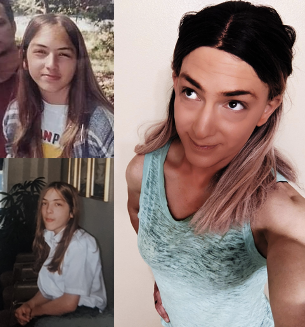
The first is a picture of me at thirteen. Just out of view — because to show their faces is a risk I won’t take today — is my brother and the man who took us to the woods.
The second is me again at thirteen on a small boat at my dad’s wedding. We’re in New Orleans during that precious time before Katrina. I can’t forget my dad’s wicked smile when his newest wife promises to give what so many women had tried to refuse him.
And then there’s me on the right, twenty years removed from the girl hiding on the left. I used to blame that girl for her family treating her like trash. Now I know she didn’t deserve it.
A thing is only trash, after all, if you treat it like trash. The same goes for a person — and I am not trash.
It takes time to sift through the mess of so much harm and chaos. But ruins are only ruins if you leave them that way. Because ruins are trash, too. And they can be the seeds for what comes next.
And you won’t believe what happened next.
UPDATE: Go here for the video essay version of “I Am Trash”
If you like my work and want to support it, buy me a cup of coffee or become a paid subscriber for Translating Everything


