
Board Games
I Am Obsessed with the Most Soulless Game on Earth
‘Blackbox’ is technocratic nirvana
“A blackbox is a device, system, or object which can be viewed in terms of its inputs and outputs, or transfer characteristics, without any knowledge of its internal workings. Its implementation is ‘opaque’ — or black.”
— from Blackbox designer Heiko Günther
Blackbox is a technically theme-less print-and-play game. Different scenarios introduce themes, but those themes aren’t represented in the artwork at all. Besides a single Theme Card with a few lines telling you the setting and backstory, it’s completely abstract.
Blackbox is not “fun” in the traditional sense of the word. Not by a mile. But the idea behind Blackbox is addictive. It has not, and will not, let me be.
It’s the apex of abstraction
“JASE” is short for “just another soulless euro”. The term is used a lot by both lovers and haters of eurogames. Up until the current board game Golden Age, almost all eurogames were fairly soulless. Theme was grounded in the real world, with few robots or wizards.
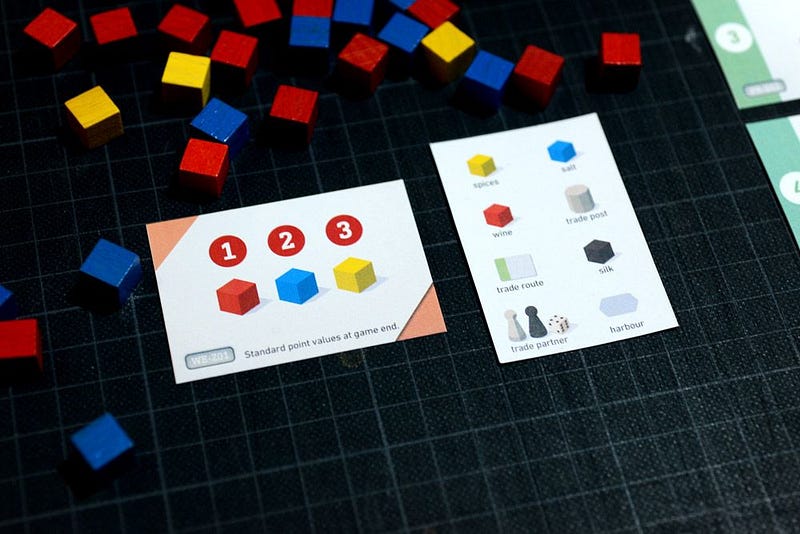
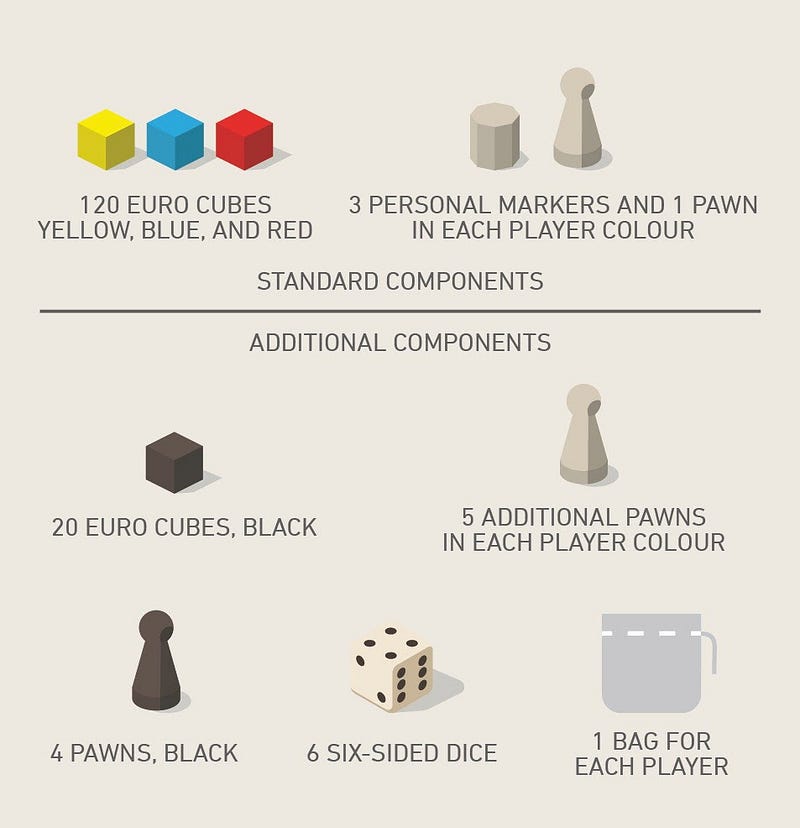
But Blackbox is zen-like in its abstraction. There is no “art”. There are icons of cubes and pawns and dice, accented with arrows and other indicators of action. “Soulless” doesn’t begin to describe it. The designer stripped away the veneer of real-world parallels, leaving only processes.
Blackbox is made up of the Proto Pack, 8 Scenario Packs, and the Bonus Pack. Each scenario includes a Theme Card that spells out the backstory, along with a legend of what the cubes and pawns and such represent in that scenario. It’s a scifi research game! Now it’s about shopping in ancient Greece! Now it’s a race to make the best stained glass windows for a cathedral! The atmosphere isn’t painted on the walls. It’s written on the menu.
The Proto Pack introduces the basic rules, core cards, and a starter scenario. Other Packs introduce more Modules. These are sets of cards that center around a particular mechanic. Rondels, dice pools, bag building, etc. The designer insists that you play the Merchants of Venetia scenario first. After that you can hop around however you want, but leave the Bonus Pack for last. That’s where the weird shit lives.
It’s easy to grok (once you’ve played it)
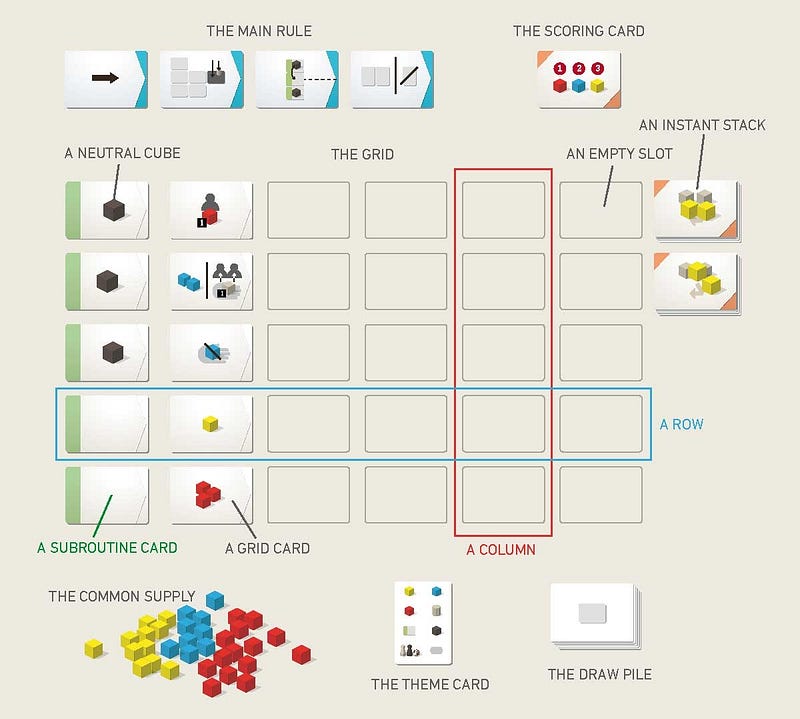
A turn is dictated by a line of blue Rule cards that make up The Main Rule. So the Main Rule in Merchants of Venetia (above) means…
- On your turn…
- …place a Grid Card onto the Grid…
- …then move a black cube onto an empty Subroutine and run that Subroutine…
- … then draw 2 cards from the draw pile into your hand and put one card from your hand at the bottom of the draw pile…
The printed cards have text explaining what they mean, but the iconography is kinda obvious after you’ve played a few times.
Players place Grid cards on a (normally) 6x6 Grid. Cards are placed so that there are no gaps, but you can displace cards. Displaced cards all move to the right. If a card is pushed off the row, they get moved down until they slot into a row with room. Cards displaced from the bottom row “fall” to the top row. If the Grid is ever filled up, the game ends.
Running a Subroutine means a player performs all the actions on every card in that row, from left to right. If they can’t fulfill an action, they move down until they can, then continue to the right. They perform all those action until they reach the side or bottom of the grid.
It’s modular
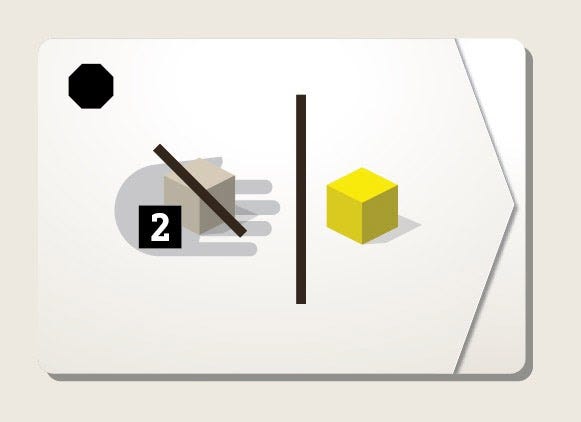
The Proto Pack includes the basic cards, along with Rondell and Scoring Card modules. Antimatter adds Dice Actions, Upgrades, and Sudden Death rules. The Cathedral adds Bag Building mechanics. And so on. In the end, there are about 20 modules that ape every eurogame mechanic ever conceived.
In the game’s current form, this is all a bit confusing. Only the first scenario compiles the various module rules. That means for scenarios 2 through 8 you have to read the rules for the modules you’re using before reading the scenario rules. It’s not a huge burden, but this shouldn’t be someone’s first modern tabletop game.
When you’re done with all the scenarios, you’re free to “kitbash and assemble Modules in new and stupid ways”. Which I most definitely will.
It’s (technically) free
Blackbox can be downloaded and printed out RIGHT NOW. You just have to shell out for printer food. And you have to supply your own cubes, pawns, dice, and whatnot. But if you don’t have those things you can make do with whatever.
Blackbox isn’t a totally new idea. Like Stonehenge, it’s meant to represent whatever you want it to. Like 504, it’s the same game played different ways.
One downside is that the instructions are over-written. It’s very possible that the designer doesn’t trust the player to understand that they’re not missing something. Each scenario really is that simple to play.
All that said, I am in love with the brutal minimalism of it all. Few colors. Clear iconography. There’s no art to clutter the sheer beauty of systems, processes, and events. It may not model the real world, but it does emulate life itself. Because life is not a story. It’s all just stuff that happens. We invent the story later.
Blackbox is the be-all and end-all of eurogames. It marks the end of eurogame history and there is no reason to play any more euros ever again. I don’t know if the designer intends to publish Blackbox properly, but I’d buy it in a heartbeat if he did.


