
I am not afraid they are going to break my spirit.
Ted Kaczynski on forgetting. (The Commonplace Book Project)
You can find all the posts in The Commonplace Book Project here:
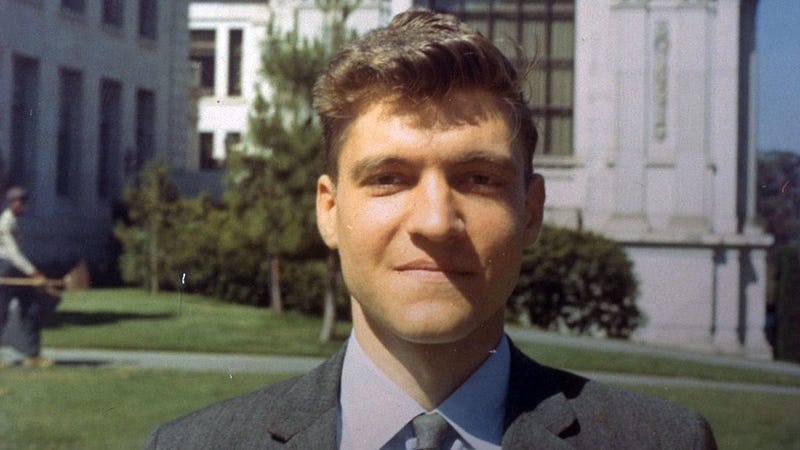
“No, what worries me is that I might in a sense adapt to this environment and come to be comfortable here and not resent it anymore. And I am afraid that as the years go by that I may forget, I may begin to lose my memories of the mountains and the woods and that’s what really worries me, that I might lose those memories, and lose that sense of contact with wild nature in general. But I am not afraid they are going to break my spirit.” — Ted Kaczynski, in an interview from prison.
I was thinking about villains today.
And how important it is to understand that a villain is the hero of their own story. Even if they’re bad. Even if they’re really bad.
Even Darth Vader was the hero of his own story.
I watched Good Will Hunting the other night and was struck by a scene near the end where Robin Williams, who plays a therapist treating a math prodigy (Matt Damon), tries to explain to the prodigy’s mentor why the kid’s mental health matters.
The mentor lists names some crazy-smart math guy and asks the bartender if he’s heard of him and the bartender hasn’t. Then the therapist rattles off something about crazy-smart kid who did brilliant math, was an assistant professor at Berkeley, then moved to Montana and “blew the competition away.”
Ted Kaczynski. The mentor hadn’t heard of him, but the bartender knew he was the Unabomber.
It’s a fantastic scene. And it’s essentially about the origin of a villain. Is there a point where a person shifts from potential to villainy?
Your writing will be stronger if you fully develop your villains.
I wonder if Matt Damon and Ben Affleck researched Kaczynski when they were writing Good Will Hunting.
The villain in that story is the mentor. He’s kind of a wanker, resting on some old laurels that came from winning an award a long time ago. He’s icky — flirting with girls who are both his students and half his age. He’s maybe envious of this kid who is clearly so much smarter than him. But he’s the hero of his own story.
And he’s on a mission to help Will Damon’s character embrace his Einstein-level potential, no matter what. Maybe, if this movie came at the story from a different angle or from ten years in the future, it would be about how the mentor turned the brilliant student into a sociopathic murderer.
The scene leaves you thinking. Would Kaczynski have turned out differently, if he’d had a therapist like Robin Williams? That’s it’s purpose.
Real life’s not a movie, but it’s still a gripping question.
So if Damon and Affleck researched Kaczynski, what would they have found?
That he was a prodigy, at Harvard studying mathematics when he was only sixteen. And that while he was there, he was subjected to an intense social experiment that would be considered unethical today. And that he was later sort of diagnosed with schizophrenia (but not really,) which often starts to show symptoms in late adolescence, and is exasperated by stress like the kind Kaczynski must have experienced as a teenager at Harvard.
This isn’t about making excuses. Twenty-one other people participated in the social experiment that Kaczynski did and none of them became the Unabomber. Many, many people have schizophrenia and don’t commit violent crimes. Most teenagers put into stressful situations don’t turn into killers.
But if you’re writing a villain, following their origin to its roots is a good idea. Understanding why they do what they do will make you a better writer.
Every human being is the hero of their own story. And in a novel, the villain’s story is inverse to the hero’s. The hero’s win at the mid-point is the villain’s crushing loss. When the hero has his dark night of the soul three-quarters of the way through your book, your villain is having his big win.
Kaczynski did terrible things. He killed people. He hurt lots of people. He was a domestic terrorist. But he also worries about having his spirit broken. For a fiction writer, you have to figure out how to get that in, too. Otherwise, you’re just writing a flat character and your writing will suffer.
I found this article about Kaczynski in The Atlantic that does a good job of exploring his origin story.
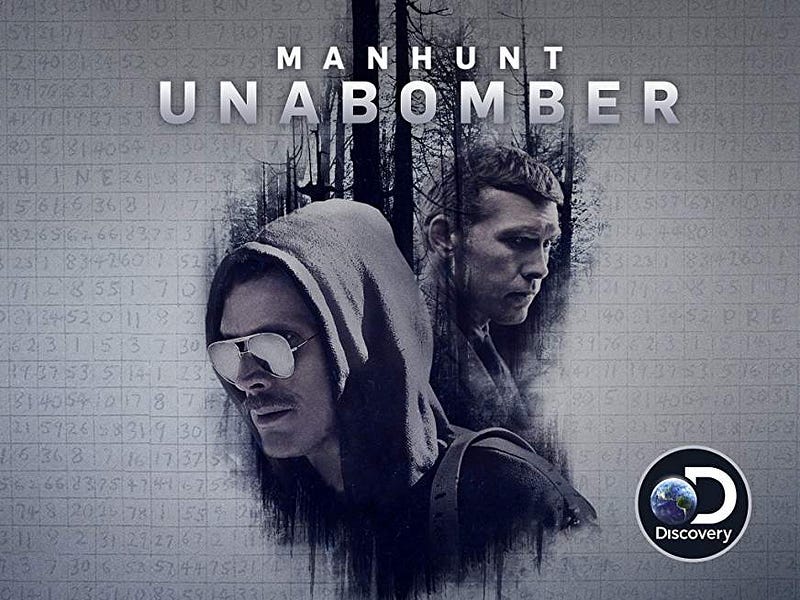
I watched a couple of episodes of Manhunt: Unabomber as I wrote this post. It’s got an interesting angle — a genius killer hunted by a genius profiler. It’s a fictionalized account, with the Jim Fitzgerald character (Jim Fitzgerald is a real person) a composite of the team that caught Kaczynski.
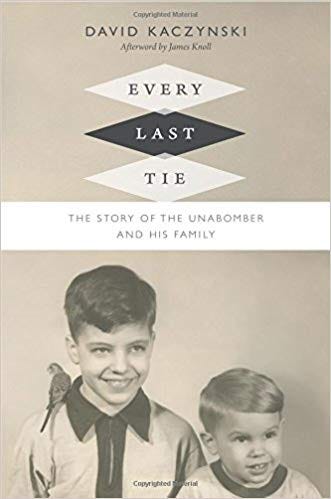
Kaczynski’s brother, David, wrote a memoir about his family that I think might be interesting. David read his brother’s manifesto in the newspaper, recognized his brother’s writing, and turned him into the FBI. It’s particularly interesting to me, on a personal letter, that he writes about reconciliation and forgiveness as well. I’ve added this book to my reading list.
Today’s Poem:
Evil Seekers by Anne Sexton
We are born with luck which is to say with gold in our mouth. As new and smooth as a grape, as pure as a pond in Alaska, as good as the stem of a green bean- we are born and that ought to be enough, we ought to be able to carry on from that but one must learn about evil, learn what is subhuman, learn how the blood pops out like a scream, one must see the night before one can realize the day, one must listen hard to the animal within, one must walk like a sleepwalker on the edge of a roof, one must throw some part of her body into the devil’s mouth. Odd stuff, you’d say. But I’d say you must die a little, have a book of matches go off in your hand, see your best friend copying your exam, visit an Indian reservation and see their plastic feathers, the dead dream. One must be a prisoner just once to hear the lock twist into his gut. After all that one is free to grasp at the trees, the stones, the sky, the birds that make sense out of air. But even in a telephone booth evil can seep out of the receiver and we must cover it with a mattress, and then tear it from its roots and bury it, bury it.
Thanks for reading and clapping (to let me know you enjoyed it!) If you’d like to get these daily doses of inspiration in your inbox, fill out the form below.
Shaunta Grimes is a writer and teacher. She is an out-of-place Nevadan living in Northwestern PA with her husband, three superstar kids, two dementia patients, a good friend, Alfred the cat, and a yellow rescue dog named Maybelline Scout. She’s on Twitter @shauntagrimes and is the author of Viral Nation and Rebel Nation and the upcoming novel The Astonishing Maybe. She is the original Ninja Writer.


