Hunka Hunka Burnin’ Death: How Sad Irons Got So Sad
My antiques tell a grim story of women’s past
My family knows I collect “old stuff”, so when my dad was cleaning out the crap left behind in a foreclosure he was turning into a rental property and came across an antique iron, he gave it to me. And I’ll be honest, my first reaction was, “What am I going to do with this thing?”
So, being a nerd, I started researching. The “thing” was a sad iron (also spelled sadiron). The funny name made me even more curious. Except, guess what? It’s not a funny story. At. All.
In fact, learning about sad irons made me realize that, if it was so incredibly dangerous to get wrinkles out of fabric back in the day, women must have been even more disposable than I ever thought. I guess when your woman got too burned/disfigured/dead from ironing, you could just go to the woman market and buy yourself another. Because obviously, those wrinkles weren’t getting themselves out.
What is a sad iron?
By definition, a sad iron is an antique household iron, made of a solid piece of cast iron. In practice, sad irons were how old-timey women died, or at least severely injured themselves. Let’s dig further, shall we?
They’re called “sad” because in Middle English, “sad” meant “solid”. I suspect this is somehow related to the great vowel shift. But that’s another topic. Anyway, they were also sometimes called flat irons, since you can never have too many pet names for the thing that might just be your demise. These irons typically weighed between five and nine pounds.
You can never have too many pet names for the thing that might just be your demise.
Sad irons were originally invented in ancient China, because of course, and they were in popular use in Europe and America from the 17th century through the late 1800s. In more rural parts of the US where electricity arrived late, they persisted into the early 1900s. More on the pure hellscape that was the first electric iron to come later.
A sad history
The original design was triangular, with a pointed tip, convenient for getting around all those pesky buttons. They had a handle, used for holding. The original handles were part of the solid cast iron mold. See my first sad iron, below. You’ll note the triangular tip, and the fact that the handle, or thing that you hold, is also made of cast iron. We’ll get into the implications of this in just a moment.
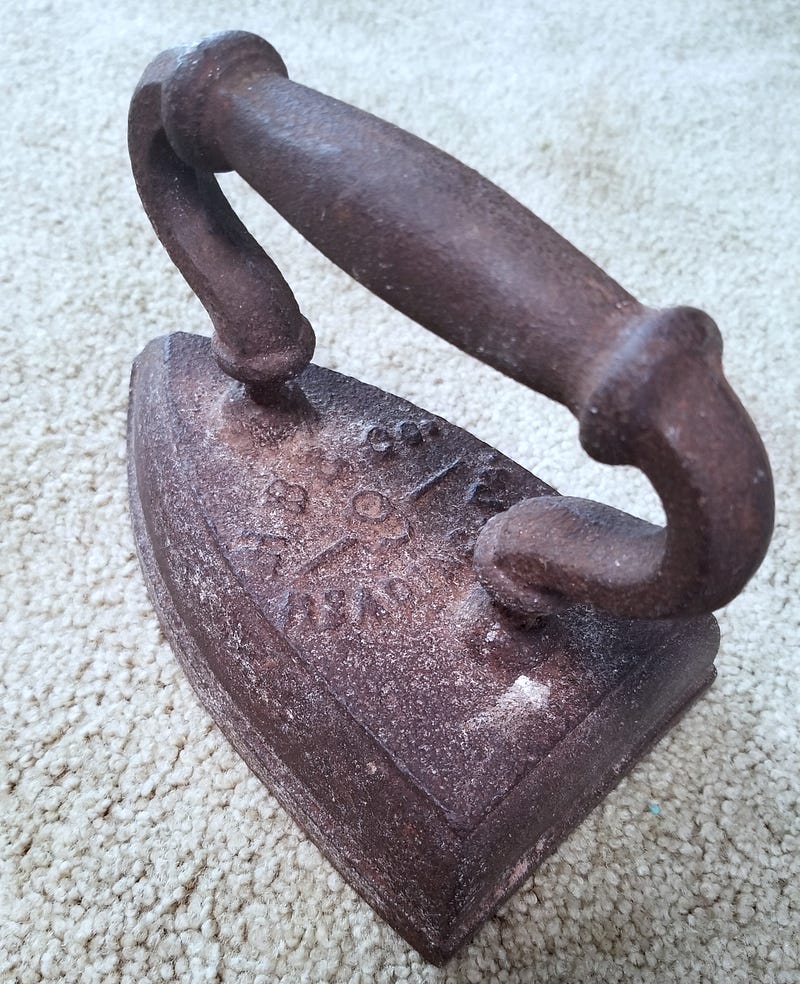
The way a sad iron worked is that the user (a woman, or quite often, a female child) would insert the iron into a stove. There, the iron would sit, happily toasting among the flames, until it got very hot. Then it would need to be removed from the fire and used on the fabric immediately, before it cooled. Since the irons cooled quickly and lost their effectiveness, wealthier households often had two or three irons, allowing for rotation so that at least one was always warming in the stove while another was threatening the safety of its user. (Fun sidebar: this is how “too many irons in the fire” became a thing we say.)
The women also had to be extremely particular about temperature. If the iron was too cold, it wasn’t effective on the wrinkles and all their work would be for naught. If it was too hot, it would scorch or burn the clothing. And the irons had to be kept ridiculously clean and sanded smooth, because otherwise they would deposit soot on the clothing that these poor women had just finished manually washing. These irons also needed to be greased on the regular, or else they would rust, causing stains. What a delightful chore!
So, the woman or young girl needs to retrieve the ready iron from the stove and start to use it. This is when I harken back to: the handle is cast iron. That means the handle was also burning hot. Brilliant. This is just like today’s solid metal pans that have metal handles. I get it: they can go directly in the oven and not melt. Great. But I also feel like they’re just daring me to remove the first few layers of my hand-skin.
The handle was also burning hot. Brilliant.
Anyway, back to ironing. The user would need to employ some type of rag to make the handle safe for its intended purpose. But, as you may imagine, these irons often resulted in painful, blistering burns.
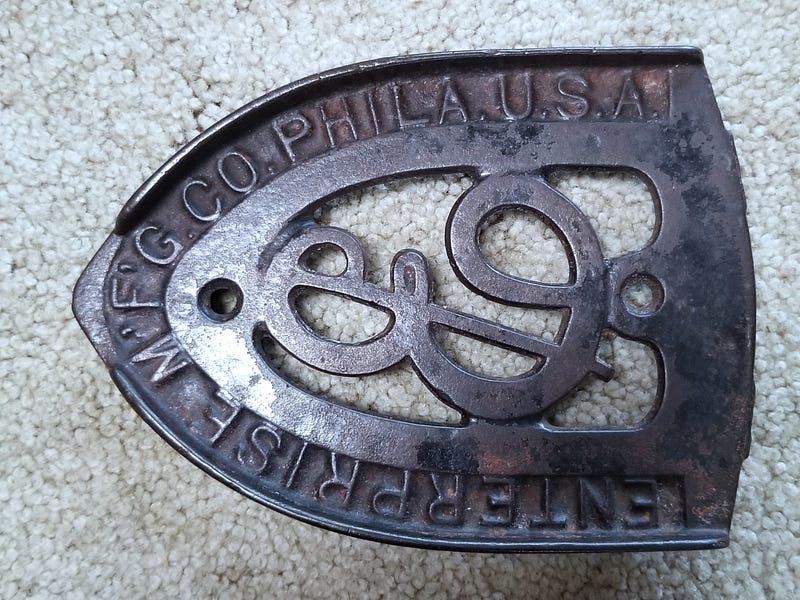
Since the irons were so hot and so heavy, putting them down was no simple task. You needed a trivet, a (usually) decorative sort-of iron coaster. See below for a photo of my trivet:
Mary Potts’ wooden handle
The first iron with a removable wooden handle, created to avoid burns, was invented in 1866 by a man named John Alexander. This meant that the iron could be put into the oven without the handle attached, so the woman no longer had to risk burning off her own hand. But his design didn’t really catch on, because his handle attached in the middle of the iron; that changed where the pressure had to be placed in order to move it when in use, and that turned out to be too awkward. Yet another example of a man designing something for women to use, when he probably never used it himself…
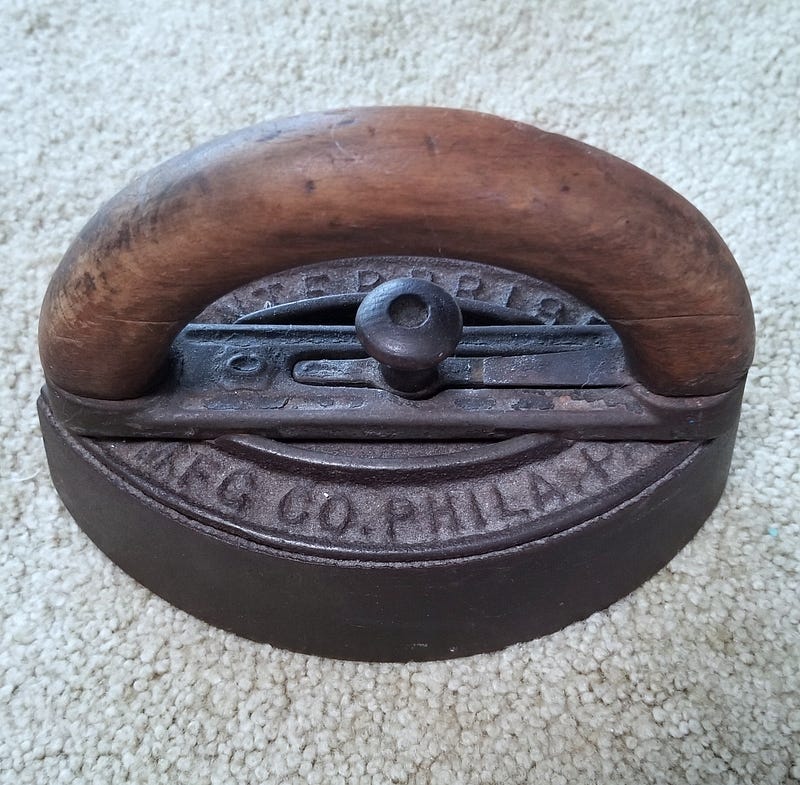
A woman named Mary Potts was to become (somewhat) famous for improving upon that design. She developed an iron with a removable wooden handle that was curved and attached on each end. This solved the center-pressure issue with the earlier design. She filled her irons with plaster, which helped to distribute heat more evenly while reducing weight. Her iron was pointed on both ends, which also addressed uneven heating, where the pointy end stayed hot far longer than the wide end.
That critical change also made the iron easier to use, as women could now glide the iron back and forth without having to lift and turn a 9-pound burning hunk of iron in order to get the pointy end where they needed it. Go, Mary!
Yet another example of a man designing something for women to use, when he probably never used it himself…
Other “hot” designs
Asbestos irons: Somewhere along the way, someone realized that by adding a compartment (referred to as a hood) below the handle of the iron and then filling it with, yes, asbestos, the handle would stay cooler. So that was a trend for a while. What could go wrong? At least fewer people were injured immediately this way…that’s better, right?
Charcoal irons: Also called box irons. To avoid having to put your entire iron into the fire, these were hollow irons that could be filled with hot coals. This was done to keep the handle from becoming weaponized. Some models had a funnel to release smoke; those were called chimney irons. Now, if you’ve ever used charcoal, you know it can be hard to keep lit. Which resulted in the user having to occasionally shake the iron to get the coals working again. So, we’ve now got a bunch of women (or small children) flinging about a burning hot, several-pound metal iron stuffed with hot coals. Nothing to see here, folks.
Gasoline irons: This just keeps getting better. If the smoke from your charcoal iron was annoying you, you could try a gas alternative. Yes, these irons used gasoline for ignition instead of heating in an oven. This typically required the addition of a small tank to hold the gasoline, right on the iron itself. Unfortunately, these tanks sometimes leaked burning hot gasoline which occasionally also caught fire. Manufacturers tested kerosene as an alternative. Hey, guess what? Kerosene is also flammable. Awesome!
It’s electric, boogie woogie
Finally! The first electric iron debuted in 1882. These early models offered no way to control temperature, so…yay. And at the time, the only electricity in homes was for lighting. This meant that to plug in your electric iron, you had to disconnect your electric light bulb and use that fuse (or whatever the term is, I’m not an electrician).
To plug in your electric iron, you had to disconnect your electric light bulb.
For reasons of — oh, I don’t know, sight?— that would best be done in the daytime when you had natural light by which to see. But early power companies didn’t deliver power in the daytime, due to reduced demand, until 1910. So I assume that means people were playing with electricity — and very early, untested electricity at that — in the pure dark of night. I’m sure no one electrocuted themselves this way.
The electric steam iron, the type that we still use today, was invented in 1926. Safety started to improve significantly from that point, but much of rural America still didn’t have access to electricity to benefit from it for a long time.
In fact, even though government-enabled programs meant that Europe and Canada had their countries more-or-less fully hooked to the grid by the ’20s, us good ol’ Americans fought back, calling that progress anti-American socialism (hmm, doesn’t sound familiar, does it?). That meant that our more rural areas didn't get power, and the safety benefits it brought to the women tending their clothes, until after WWII.
Holy fuck. I will never complain about ironing again.
That’s not true.^^
The sources that kept me honest on dates & other facts:
- Wikipedia
- Collector’s Weekly
- Chicago Tribune
- Press Republican
- Homethingspast.com
- Oldandinteresting.com
- Western Illinois Museum
- Streamlinedirons.com
- Enclyopedia.com
Also, the Antiques Freaks podcast has a good episode on sad irons.


