
Humanity is a Massive Tour de France Peloton — And Entrepreneurs Are The Only Ones Escaping It
Where do you choose to ride the peloton?
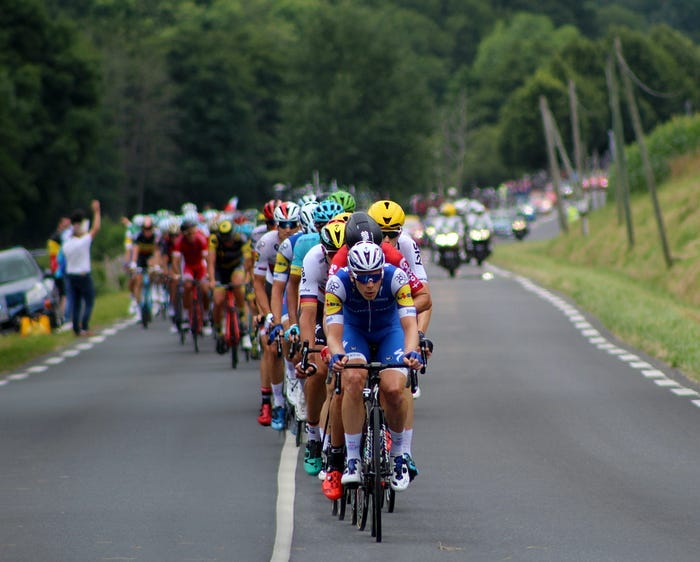
In the Tour de France peloton, riders work together to gain an advantage.
Most cyclists stay close behind the riders in front, benefiting from reduced air resistance called slipstreaming. This helps them conserve energy.
Occasionally, a rider will make a daring move, putting in extra effort and trying to escape from the group, known as a breakaway. This allows them to ride alone in the front and potentially outpace the peloton, taking a chance at victory. But these breakaways also require exceptional strength and strategy to maintain a lead over the pursuing peloton.
Humanity is just like that.
We are moving forward as a group.
Some people work harder against the primary resistance to growth and lead the peloton: they are the pacesetters.
Most of humanity takes advantage of the momentum diffusion of those ahead: they ride in the middle/back end of the peloton.
Those at the rear simply glide along, expending minimal energy. This phenomenon presents an enticing opportunity, as it is effortless, comforting, and familiar.
The challenge lies in breaking free from the pack and pursuing alternative slipstreams or pathways.
Crab Fishing is How Human Pelotons Form
A single crab can escape almost any trap.
But a simple trap can capture a large group of crabs.
- Here’s How it Works
Each trap has an open top and a pile of crab food inside.
- The first crab that finds the food goes in and eats.
- The second crab sees the first one eating and joins in.
- The third and fourth crabs do the same.
Before long, many crabs have entered the trap and stayed there, even after the food is gone.
- Here’s the Trap
If one crab tries to leave, the other crabs stop it.
If the disruptive crab keeps trying, the others amputate its claws.
If it persists, they kill it.
- Here’s the Point
Humans are not so different.
Big egos that prefer it when others fail rather than succeed more than us.
For this, we’ve created uniformity in words, actions, and thoughts to protect the status quo. We fear rejection and ridicule, and our true selves mean being vulnerable. Chasing a dream is foolish. The prescribed recommendation is to just merge with the pack.
And from there, watch the assembly line grow.

The Paradoxical Journey of an Overachiever
Last year at work, they hired a new maintenance guy.
He was very shy and quit. But heck, he was good at his job. So good that, though being silent, he would speak up, asking for more things to do.
The problem paradoxical problem was that he was significantly outperforming his peers, making them look like lazy-ass whining slugs. So, to counteract his determination, they isolated him and gave him a silent treatment.
No one likes an overachiever. No one likes a crab seeking better opportunities, innovation, and progress.
And like most overachievers, he succumbed to the pressure and reverted to the average.
An overachiever, like a breakaway from the herd of cyclists, requires not just a strong start but also enduring the challenges along the way to make it victorious to the finish line.
Otherwise, the peloton eats you back.
Entrepreneurs vs. Regulators
A Story of Concentrated Energy
Entrepreneurs are global overachievers. They shake up the established norms and face their fair share of challenges. They are the ones who dare to breakaway from the peloton.
After dropping out of Princeton and spending years as a monk in his home country India, Manoj Bhargava returned to the United States and founded a plastics company.
While attending a natural products trade show, Bhargava stumbled upon a 16-ounce energy drink that tasted terrible but provided a long-lasting boost.
Though their proven efficiency, he knew there was a reason these drinks hadn’t caught on: at sixteen ounces, they competed against other drinks such as Coke, Gatorade, or Frappuccinos.
Recognizing the flaws of existing energy drinks, he created a new category: the energy shot.
Within six months, he developed a concentrated formula packaged in a two-ounce bottle, launching the successful brand 5-hour Energy.
Bhargava’s breakaway innovation revolutionized the energy drink market, propelling him far from the peloton and into billionaire status, committing 90 percent of his earnings to charity.
The Dark Side of The Spectrum
Regulators are the crabs pulling entrepreneurs down the trap aiming to preserve the existing order, impeding the progress of those who pose a threat to their existence.
“Stop — I don’t understand this, we’ve got to regulate this, it’s too dangerous,” is their preferred motto.
- Transportation: Ride-sharing platforms such as Uber and Lyft have faced challenges from traditional taxi services in many cities worldwide.
- Accommodation: Facing housing availability and tax concerns, strict regulations were implemented in some cities, limiting short-term rentals and impacting Airbnb’s operations.
- Drone Delivery Services: Concerns about airspace safety and disruptions to traditional delivery led to strict regulations on permits, flight paths, and operational guidelines, hindering drone delivery services’ expansion.
- Cryptocurrency Exchanges: They faced regulatory challenges due to concerns about money laundering, fraud, and investor protection. Governments imposed stricter regulations, impacting the operations and accessibility of these exchanges.
Final Words of Expertise
In 2015, Peter Diamandis wrote the blog post “CLASH OF LINEAR VS EXPONENTIAL.”
He explained:
- What’s a linear system? Think governments, politicians, regulators, large and slow-moving legacy companies, and the like…
- What’s an exponential system? You. Today’s exponential entrepreneurs. Silicon Valley startups. Fast-moving innovators and disruptors that want to change the game.
No matter the situation, there will be a status quo to be disrupted.
But his last take was:
WE LIVE IN THE MOST EXCITING TIME EVER.
As we move towards this future, we are going to be disrupting many industries and creating even more entrepreneurial business opportunities.
So, the question is:
Where do you choose to ride the peloton?
a) Effortlessly gliding along the slipstream of a linear system
b) Putting in the extra work to breakaway from the claws of those in the back into an exponential system
Maybe you are not living up to your potential because you’re not in the habit of living up to your potential.
Maybe the suction power of the peloton is pulling you back from your breakaway.
Maybe you’ve automatized the numbing ride of conformity.
And it’s time to change that.


