
Human Thought with and without Language: Interconnected Minds and the Unconscious
Language is a natural instinct. We are compelled to express it, but what would become of us if we did not think or speak in words?
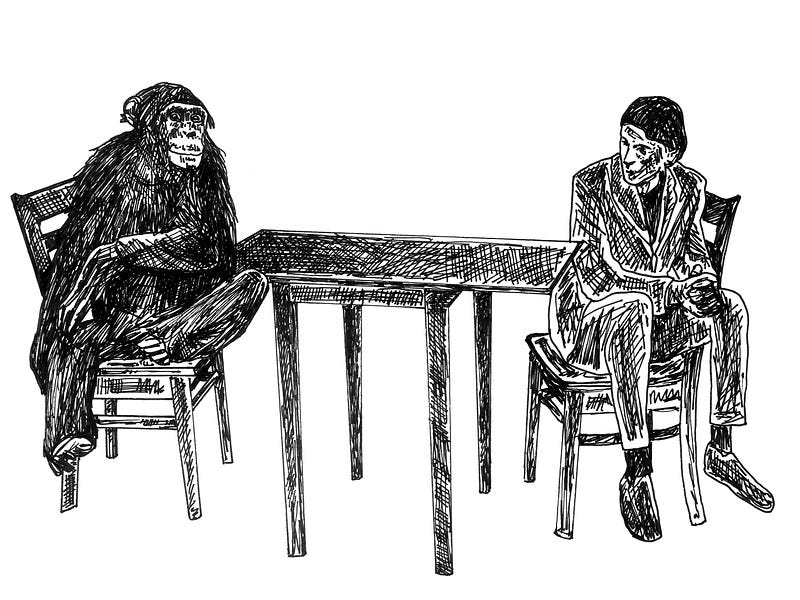
In Nineteen Eighty-Four, George Orwell recounted of a fictional totalitarian regime that imposed on its citizens a dialect, decimated in words and grammatical rules. The premise was simple. Words beget thoughts; their deletions sweep them away.
What would happen if we went to the extreme with this dystopian fantasy, and somehow all the words were eradicated from our head? Would there be anything left in our thought? Way before the advent of modern linguistics, Charles Darwin had an answer. He was convinced that language was a prerequisite for complex reasoning. He claimed that ‘a complex train of thought can no more be carried on without the aid of words, whether spoken or silent, than a long calculation without the use of figures or algebra.’
But could it be that Darwin imputed to language more than its fair share? Is it possible that we are also distinctly intelligent because of underlying non-verbal cognitive capacities we are not aware of? A good starting point for answering these questions is by probing human behavior when the language brain module is switched off. How well does one then fare?
The curious case of Brother John
What is an inarticulate human mind capable of? In a 1980 paper, Andre Roch Lecours and Yves Joanette tried to give an answer. They studied the case of a 50-year-old Canadian monk, they referred to as Brother John, who was suffering from seizures that selectively shut his language processing brain module, rendering him unable to speak, read, and think in words. During those spells of total aphasia, he was not helpless, but, in full consciousness, adept at interacting with his surroundings.
Brother John could not always wait out passively for his aphasia to pass; this was so when he traveled by train to a Swiss town he had never visited before. During his journey, he experienced an epileptic episode, and by the time he arrived at his destination he had already turned aphasic. From that moment and until he regained his language faculties, Brother John was operating on nonliguistic cues. After presenting his ticket stub to a train employee, he managed to find his baggage, walk out of the train station, and identify a hotel. There he explained by mime his situation, but despite his best efforts, the staff made him understand with their gestures that they were not sympathetic to his pleas. Frustrated but not dismayed, Brother John ventured to go to another hotel where the staff were more receptive. After arranging for his room, he felt hungry and went to the hotel’s restaurant. Since he could not read, he pointed to a random dish from the menu hoping it would be something of his liking. It was not, but he ate it anyways. He then proceeded to his room to sleep. His language faculties had fully recovered by the following morning.
Brother John could not understand or think verbally, but this inability did not throw his mental faculties in disarray. He could still recognize objects, faces, and places; he could orient himself spatially, evaluate the situation he was in and respond appropriately; his memory was intact since he could later recollect in detail all the events during his aphasic episode. His loss of language did not diminish his awareness or the coherence of his thought. By his own account, he ‘couldn’t find the words’, yet he could still pursue or develop complex thoughts, infer, plan and reflect. His reasoning did not crumble. Loss of language felt more like a loss of a sensory modality. As with blind or deaf people, Brother John compensated his handicap with a sense of urgency that afforded him with inventive solutions.
Inner speech gives us an impression of clarity, a way to communicate our thought. During Brother John’s episodes the analytical and intuitive components of his thought were not clad in words but in a form that still packed abstract concepts and sensory inputs, and yielded complex reasoning. Language for the most part failed him when he tried to explain his aphasic thoughts, possibly because of the very nature of the thoughts; they were nonverbal, unconscious or both.
Unconscious Cognition
In a way, language is a high-level interface that blinds us from the significance of the processing layers beneath it. We are so accustomed to thinking in words that when we form an idea, we may get the impression that it is the very source of the thought, but we are merely putting our finger on the verbalized component of our consciousness. Experimental evidence suggests that complex thought is built on foundations that are not only nonverbal but also unconscious.
In the early 1980s Benjamin Libet devised an experiment to probe the role of the conscious and the unconscious during decision making. He asked subjects to move their hand when they got the urge to do so and to point to the exact timing of their decision. From the recordings of the EEG electrodes attached on the scalp of the subjects, Libet found that activity in the relevant parts of the brain could predict the movement about three to four hundred milliseconds before the reported decision of the subjects. The finding created a stir, for it showed that the conscious decision of the subjects did not cause the movement. Many interpreted this as an argument for the absence of free will. But if the choice is made for you, who made the choice? Is there in us a homunculus pulling the levers?
Libet’s results suggest that the unconscious is at the vanguard when it comes to our behavior. If we accept that we are automatons, then the master puppeteer could be lurking somewhere in our unconscious. At the same time, our immediate impression clearly and unequivocally tells us that we have our own volition. But impressions are not enough for us to establish a connection between the unconscious and free will. We could argue that since for the most part our behavior is not erratic, there has to be a way where we are at the helm, molding the chaos within our unconscious into something reasonable and measured. This is a hypothesis based on common sense, but how many times has our common sense been treacherous to our understanding? The safest bet from Libet’s results is to put the question of free will aside and simply affirm that decisions are triggered by the unconscious. Unconscious processes provide to the conscious part the instruction ‘move your hand’; they also generate thoughts that do not reach our consciousness but still influence our behavior.
As we introspect, it becomes apparent that many of the processes controlling our thought and behavior are either nonverbal or unconscious, or both. When we speak in ad lib, we do not have an exact replica in our head of what we are about to say; some words hither and thither, but the way we string those fragments into a coherent expression-almost at an instant- is mostly unconscious. What about those memorable sparks stoking creative work? In most cases they presuppose laborious conscious learning. But there is no recipe for the eureka moment. It may or may not come, but when it does come, we have no idea of the route it followed to reach our consciousness. It is as if some Jack-in-the-Box sprung out of our head.
Conscious control can even become detrimental when we exert it forcefully upon our actions as Katherine Craster playfully puts it in her nursery rhyme, The Centipede’s Dilemma (1871). The poem reads:
A centipede was happy — quite! Until a toad in fun Said, “Pray, which leg moves after which?” This raised her doubts to such a pitch, She fell exhausted in the ditch Not knowing how to run.
The moment the centipede focused on its legs, it stopped moving. Try consciously focusing on the letters you want to type, the steps of a well-rehearsed movement you are about to perform, or even walking for that matter. You will turn slow and stilted. Jimi Hendrix was not consciously controlling the exact movement of his fingers on the guitar. His sound had a natural flow and spontaneity because he had spent an inordinate amount of time consciously practicing his craft and eventually developing a proficiency that was integrated into his unconsciousness.
There has to be a sort of communication channel between the unconscious and conscious/verbalized parts in our brain. The unconscious hears the conscious, does its processing and sends back via an interpreter module its instructions. For behaviors we are proficient at, the communication channel fades, and the unconscious does most of the work.
Interconnected brains
Different species can be worlds apart when it comes to the communication channels within their brain and interactions with their environment. Noted philosopher Charles Dennett tried to systematize these differences by constructing an evolutionary pyramid of intelligent behavior. At the base of the pyramid, we find instinctual, hardwired behaviors, but as we move up, behavior gets progressively more intricate.
At a certain height, we come across animals with malleable brain structures reflecting adaptable behavior. These sorts of organisms have the capacity to learn from their mistakes and change their behavior until they get what they are after. Adaptability gives them an edge over strictly instinctual organisms under a shifting environment. But adaptable species are also in danger when their trial-and-error technique is indiscriminate, for one mistake in a competitive environment could prove fatal.
As we go further up the pyramid, we find a smaller subset of organisms evolved to confront this problem. They are endowed with the capacity to construct an inner space in their mind reflecting their habitat. In this virtual reality, they play out what could happen in the future if they try out different things and depending on the utility of the predicted outcomes, they select the most appropriate action. These animals have a pre-emptive control system configured in their brain. It filters out behaviors they tested in their inner space without actually performing them.
And then it is us. We also have an internal representation of the world, but because of our capacity for language, it includes all kinds of tested solutions. We can communicate and access in detail projections of the future, miscalculations and failures, non-intuitive truths, and flashes of brilliance. Concepts and ideas that were not conceived by geniuses a couple generations back, are now common knowledge. Our minds are nodes in a network that includes past and present minds. Dennett calls us Gregorian creatures, after psychologist Richard Gregory who emphasized the role of information in the creation of smart moves. Gregory suggests that the fact that we have access to all knowledge endows us with intelligence. A fork, a pair of chopsticks, a bicycle and a book are not only the end results but also the conveyors of intelligence. Once you access them, your potential for intelligence increases. This process makes us part of a global entity. We get information, we add to it, and, if worthy, our contribution spreads within the human network, changing the neural wiring of receiving brains.
Final Thoughts
In the days of the transatlantic slave trade, African slaves who spoke different languages were put together on plantations, so that it would be difficult for them to communicate and possibly plan a rebellion. The slaves overcame this barrier by devising a type of a simplified language called pidgin that combined elements from their native tongues. In those cases when their children first learned pidgin, they further evolved it into a creole language. This evolved mosaic has all the typical characteristics of any other language, old or new. We are meant to speak and think in words, the same way a sparrow is meant to fly.
Language offers a tool from which we can organize our thoughts into a coherent stream readily available for manipulation. It forms a base for our creative capacity and reasoning. With it, we form connections and have access to the ideas of others, updating our internal model of the world. But language should not appropriate all thought. It appears that our brain operates for the most part silently, in the unconscious realm. We make decisions or perform complex tasks using involuntarily our unconscious. In all likelihood, the conscious and the unconscious do not operate separately, but form a complex loop in which there is transfer of data between them. The specifics of the interaction are still shrouded in darkness. Perhaps one day when we will manage to form a language for the unconscious we will be able to understand them.