
Intelligence without Language: Centralized and Distributed Neural Architectures
Nature has concocted a rich variety of structures to develop intelligence. Here, I discuss two of them, centralized and distributed neural architectures, and the behaviors emerging from them. These behaviors lack language, but they show complexity and adaptability.
Language represents the sharpest divide between humans and animals. With it, we can produce an infinite variety of sound combinations from which we express and communicate our thoughts. No other species has anything remotely similar to this faculty. As far as we know, animal calls are limited and always referring to external events. A monkey’s particular cry can only signify a handful of things: a potential threat, hunger, a challenge to the hierarchy.
At some point in our evolutionary history, possibly even before we could speak, language was internalized. This gave us the capacity to better organize our thoughts and to create complex mental constructs. The silent speech in our brain has helped us make logical arguments, inquire about the natural world and its laws, and build edifices that do not fall apart. All evidence points to the fact that language-both inner and oral- is human and only human.
Historically, a prevalent view, running through philosophy and psychology, held that there exists an unbroken link between language and thought. The claim was that an organism with no capacity for language is also devoid of thought. At the height of the modern scientific revolution Rene Descartes (1596-1650) argued that animals solely operate on instinct and John Locke (1632–1704) proclaimed that ‘Beasts abstract not’. But in recent years, closer and more systematic observations have indicated that animals are more than just instinctual automatons. They possess complex thought; they can learn and acquire new behavioral patterns if there is a need for them.
An understanding of animal thought, its scope and its limits, can clear the view from which to peek the evolution of human thought. But having traced the steps on the evolutionary ladder leading to human thought, does not mean that we have also discovered all there is about intelligence; far from it. Human intelligence offers one of infinite possibilities. In the organic world, some of these possibilities have manifested themselves.
Here, I discuss complex behavior emerging out of two fundamentally different biological constructs: centralized brains and distributed neural architectures. Nature has created two disparate neural structures, with their own rules and protocols, from which intelligence develops. In both examples, thought is inarticulate, but surprisingly intricate, for it results in complex behavior.
Centralized Intelligence- Primitive Cultures
We still do not understand the inner workings of thought in animals, but we can glean from their behavior some aspects of it. By observing how animals adapt and overcome hurdles, we can also evaluate their intelligence. An intelligent entity can solve problems and learn either by observation or instruction. Take for instance our close relative, the macaque monkey. A macaque, like the rest of the non-human primates, has a similar brain organization to ours; a centralized computing unit in its head acting as a master to all other peripheral modules. But despite its similarities to us, a macaque has limited means of communication. Yet, it has a knack for problem solving and learning.
On Koshima, an island off the southwest coast of Japan, scientists have been studying the behavior of a troop of wild macaques. In 1953, they observed a one and a half years old female macaque, Imo, acting out of the norm: she was dipping a sweet potato in the water, scrubbing off the sand of the submerged part before eating it.
Monkeys do not have a particular affinity for water, but this youngster somehow figured out a way to exploit this element to clean her food. The technique was evaluated and picked first by her immediate kinship, later by other members of the troop. Other behaviors, such as separating wheat from sand by flinging the mixtures into the water, or bathing, followed the same trajectory: after several fruitless attempts, one monkey had an eureka moment discovering a beneficial novel behavior which the rest of the group gradually adopted. During learning there was no teacher communicating the knowledge, neither verbal nor sign instruction whatsoever; the monkeys picked up the behavior by observing and imitating it.
These behaviors are not instinctual, but they are acquired after some sort of deliberation and practice. Groups of macaques in other regions have found and adopted other solutions for the same problems. Variability in behavior that bears no ecological explanation resembles at a more primitive level the cultural differences between human groups. Monkeys can’t read, write, or create art, but they can develop complicated behaviors that are regional and propagate through a non-genetic channel. Namely, Imo and the rest of the monkeys of that generation are now dead, but their acquired behaviors live on; their descendants still wash sweet potatoes, throw sandy wheat on water, and bath. This also constitutes culture.
Our closest evolutionary relatives, chimpanzees, have developed even more intricate behavioral patterns: toolmaking, social relations, diet, and leisure habits all varying from region to region. This variability is not caused only from the opportunities offered by their habitat, since often enough chimps from identical environments do not show the same behavioral patterns, but from the different turns of their complex and capacious reasoning.
Humans, chimps and macaques diverged from a common ancestor relatively recently in terms of evolutionary time. For that matter, we share a number of common structures. This proximity hints at a natural progression of thought and intelligence; a progression that modifies and adds upon a common neural template as we reach closer to the human brain. To discover general traits of intelligence, we also need to peek at phylogenetically distant organisms endowed with a completely different set of structures and functionalities.
Distributed Intelligence — Eight Limbs of Eeriness
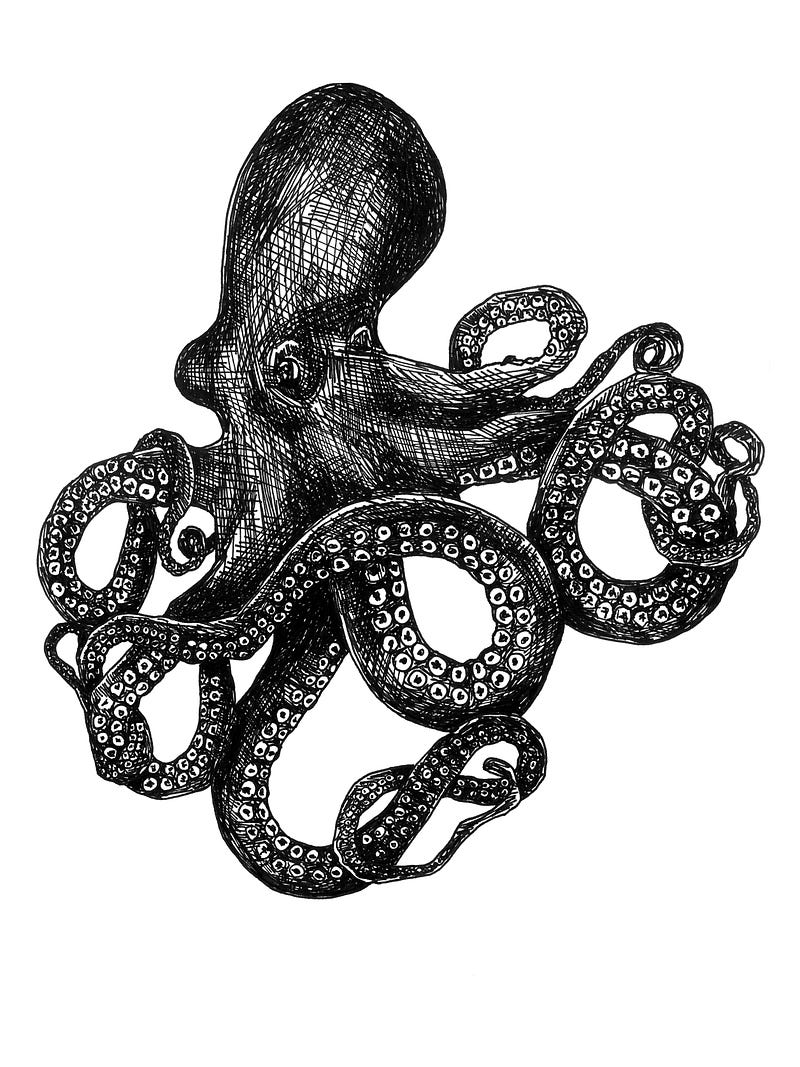
On the inside and on the outside, the octopus looks eerie. With three hearts, blue-green blood, a protean soft body changing continuously color, texture, and shape, and eight sucker-studded tentacles spiraling, stretching, treading, smelling, tasting, probing, and subduing prey the octopus could have arrived from a different planet. At least this is our impression. Evolutionary history explains in part our amazement.
At a point during the Ediacaran period, about six hundred million years ago, and long before the appearance of complex organisms such as fish, dinosaurs, and mammals, a miniscule aquatic flatworm with a rudimentary sensory apparatus, and simple automatic responses managed to survive a mutation in its genome and pass it to its progenitors. From this rift, the flatworm became the starting point from which two independent experiments on biological construction were carried out, one leading to all vertebrates, including humans, the other to mollusks and arthropods, the two largest invertebrate phyla. The invertebrate branch reached its apex in terms of intelligence with the octopus.
Our common ancestor with the octopus, the flatworm, did not have much of an intelligence, or a communication system. This suggests that the communication capacities of some invertebrates are of a different kind from our evolutionary line. The octopus itself is a solitary animal; it can generate a plethora of patterns and textures with its skin, but these are not usually relayed to a receiver; rather, they are meant for the deception of preys and predators. The complexity of the patterns resembling to our eyes human language seems to be an evolutionary coincidence.
Vertebrates have a centralized brain in their head; an all-too powerful unit that gives precise top-down instructions to the rest of the body. We can relate to this form of intelligence, understand it to some extent and build intelligent machines based on it. Macaques, chimps, even rodents and birds share a similar brain organization and homologous neural structures with us. This is scientifically helpful, because findings about the brain of a mouse, for example, could shed light on mechanisms or organizational principles in the human brain. But the octopus cannot partake in these comparisons, for it has an altogether different neural layout. About two-thirds of its 500 million neurons are contained in its appendages, a ten percent envelops its esophagus acting as its brain, and the rest, two lobes of neurons, is behind its eyes. In a way, nature was pushed to reinvent intelligence, creating a distributed neural pattern instead of a centralized one, because if the central brain of the octopus were to grow, its alimentary canal would also constrict, limiting the animal’s capacity to take in food.
With the octopus we are faced with an intelligence that is shared throughout the body and doesn’t always follow a hierarchical pattern. There is evidence that its arms operate semi-autonomously; receiving a rough outline on what needs to be done from the brain, but then dealing with the nuts and bolts of the action by themselves. Despite prioritizing local over centralized control of body parts, the octopus is not disjointed, but coordinated in its movement, as if it were a graceful eight-limbed dancer. This coordination emerges from an efficient and swift relaying of information directly from arm to arm and indirectly via the brain.
This kind of neural distribution and messaging does not only benefit movement or motor dexterity. Octopuses are highly intelligent. They are curious and exploratory, oftentimes appearing to manipulate objects with no particular purpose, just for the sake of it, as if engaging in play. They solve problems that are far from obvious even for human adults, like figuring out the push and twist movement to open childproof bottles. They also make tools. Researchers have observed octopuses off the coast of Indonesia carrying with them two coconut shell halves as they roam the seafloor. Once they find a convenient spot, they create a shelter by bringing the two coconut halves together and squeezing their body within the enclosure. This behavior shows ingenuity and foresight: an ability to estimate future needs and to come up with appropriate actions.
Different Ways at Intelligence
The octopus and the non-human primate offer two contrasting non-verbal structures of cognition: the former with an embodied, distributed neural layout and the latter with a centralized, top-down assembly. But despite their differences, both of them share some general traits in the way they are dealing with the world. They experiment and explore different possibilities when solving a problem, they estimate what they will encounter and find solutions accommodating their internal model of the future; when relaxed they engage in play and exploration.
Language is a mediator between us and the world before us, an interface that organizes a medley of neural signals into packages we can deliberate upon. Apparently, a pallet of complex behaviors is also possible without language. What’s more, different structures with different protocols could yield similar intelligence. Centralized or distributed structures, top-down or egalitarian signaling schemes, could solve complicated problems. Nature has built intelligence many times over. Who knows; perhaps, with the help of our language capacity and powers of abstraction, we will manage to build energy-efficient intelligent machines reflecting nature’s variability. Otherwise, in a few million years, a talking octopus will figure this out.