
Human Sacrifices in the Bible
The Christian God only accepts payment in blood
Growing up in church I’d hear the stories from the Old Testament about God demanding various sacrifices and “burnt offerings”, and the pastor normally rattled this off with enough charisma that it didn’t raise much interest in me.
I just imagined that they burned a portion of their food, or as I got older I realized that they would kill a sheep or other animal like in the instance of the Abraham and Isaac story, which is one of the stories that began to pull at the thread of my doubt about the Bible.
Then there’s the case of the firstborn of Egypt being killed by God, when God requires the Israelites to wipe their doorsills down with blood, to get the angel of death that God has sent to “pass over” their homes. During this section of the Bible God even turns the Nile River into blood.
So what is up with the blood fixation that God has here?
When we see this motif involving blood sacrifices to a supernatural entity in movies or TV shows it’s normally Satanic/demonic, but in the Bible, it’s the exact opposite.
Let’s start with an example that most of us probably already are familiar with:
Abraham and Isaac
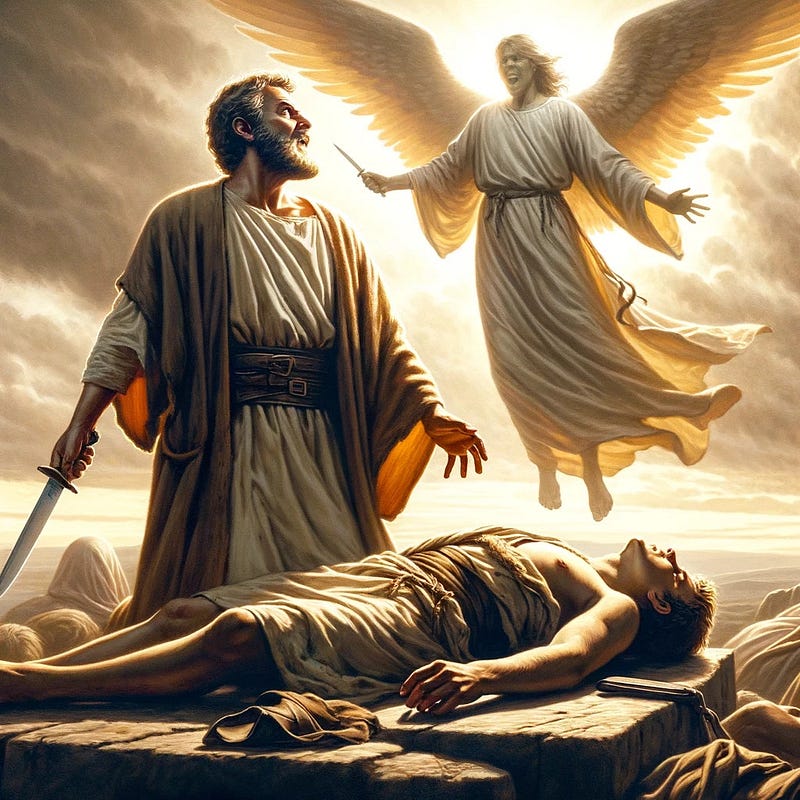
2 And he said, Take now thy son, thine only son Isaac, whom thou lovest, and get thee into the land of Moriah; and offer him there for a burnt offering upon one of the mountains which I will tell thee of.
7 And Isaac spake unto Abraham his father, and said, My father: and he said, Here am I, my son. And he said, Behold the fire and the wood: but where is the lamb for a burnt offering?
8 And Abraham said, My son, God will provide himself a lamb for a burnt offering: so they went both of them together.
9 And they came to the place which God had told him of; and Abraham built an altar there, and laid the wood in order, and bound Isaac his son, and laid him on the altar upon the wood.
10 And Abraham stretched forth his hand, and took the knife to slay his son.
11 And the angel of the Lord called unto him out of heaven, and said, Abraham, Abraham: and he said, Here am I.
12 And he said, Lay not thine hand upon the lad, neither do thou any thing unto him: for now I know that thou fearest God, seeing thou hast not withheld thy son, thine only son from me.
13 And Abraham lifted up his eyes, and looked, and behold behind him a ram caught in a thicket by his horns: and Abraham went and took the ram, and offered him up for a burnt offering in the stead of his son.-Genesis 22:2, 7–13
In this tale Abraham brings his son and makes an altar, goes through basically the whole process up until he’s about to murder his own son and then an angel stops him and manifests a ram to be used instead.
This story is taught in church with the lesson highlighting Abraham’s obedience as a good thing. Not focusing on the fact God had already made him wait until his old age to have a son at all.
A son that he could’ve given him prior to him choosing to get an Egyptian sex slave pregnant, and then subsequently leaving her and the child out in the desert for dead.
This just screams of emotional manipulation and a lack of self-confidence in the deity. He gave him this promised “golden child” just to then decide he would make him murder him with his own hands to prove his loyalty to this deity, or else make this man suffer who knows what type of punishment.
Why do all of this to one man?
Also, isn’t it suspect that Abraham didn’t think it was that odd for God to demand him to sacrifice a child? Almost as if this wasn’t unheard of among the Israelites.
As a side note, did anyone else notice that God calls Isaac Abraham’s “only son” in verse 12? I guess God forgot about the son that Abraham abandoned out in the desert, his first son Ishmael even though he’s still alive seeing as how God sent an angel to show Hagar where a well was so they didn’t die of thirst. Perhaps he’s forgetful?
At least in this instance, God didn’t make Abraham go through with it, let’s see what the next case in the “Good Book” holds.
Jephthah’s Daughter
29 Then the Spirit of the Lord came upon Jephthah, and he passed over Gilead, and Manasseh, and passed over Mizpeh of Gilead, and from Mizpeh of Gilead he passed over unto the children of Ammon.
30 And Jephthah vowed a vow unto the Lord, and said, If thou shalt without fail deliver the children of Ammon into mine hands,
31 Then it shall be, that whatsoever cometh forth of the doors of my house to meet me, when I return in peace from the children of Ammon, shall surely be the Lord’s, and I will offer it up for a burnt offering.
32 So Jephthah passed over unto the children of Ammon to fight against them; and the Lord delivered them into his hands.
33 And he smote them from Aroer, even till thou come to Minnith, even twenty cities, and unto the plain of the vineyards, with a very great slaughter. Thus the children of Ammon were subdued before the children of Israel.
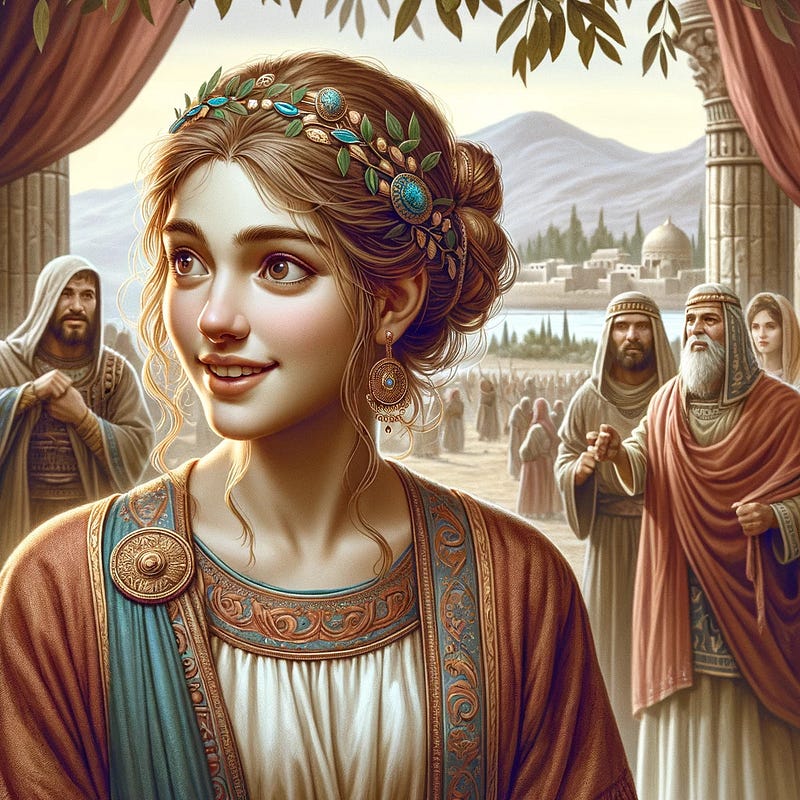
34 And Jephthah came to Mizpeh unto his house, and, behold, his daughter came out to meet him with timbrels and with dances: and she was his only child; beside her he had neither son nor daughter.
35 And it came to pass, when he saw her, that he rent his clothes, and said, Alas, my daughter! thou hast brought me very low, and thou art one of them that trouble me: for I have opened my mouth unto the Lord, and I cannot go back.
36 And she said unto him, My father, if thou hast opened thy mouth unto the Lord, do to me according to that which hath proceeded out of thy mouth; forasmuch as the Lord hath taken vengeance for thee of thine enemies, even of the children of Ammon.
37 And she said unto her father, Let this thing be done for me: let me alone two months, that I may go up and down upon the mountains, and bewail my virginity, I and my fellows.
38 And he said, Go. And he sent her away for two months: and she went with her companions, and bewailed her virginity upon the mountains.
39 And it came to pass at the end of two months, that she returned unto her father, who did with her according to his vow which he had vowed: and she knew no man. And it was a custom in Israel,
40 That the daughters of Israel went yearly to lament the daughter of Jephthah the Gileadite four days in a year.-Judges 11:29–40 KJV
That’s right, the omniscient deity assists Jephthah with his battle knowing damn well who is going to be the first to come out of the house when he returns, but goes through with it anyways.
This story is normally used in church as a lesson about not carelessly making promises to God, or highlighting being a “man of your word”. They never highlight the fact that God knew he would be demanding a human sacrifice, or that it would be Jephthah’s own daughter. I guess that doesn’t have the right spin.
As a side note in this culture, they would normally betroth and marry off daughters by the time they reached puberty. So given that she hadn’t been betrothed yet she was very likely under the age of 14, more likely 11 or 12, so a child sacrifice.
What sadistic cruel deity would demand such a thing from a Father? To make him kill his own daughter and then burn her, for what reason exactly?
“Devoted”
28 Notwithstanding no devoted thing, that a man shall devote unto the Lord of all that he hath, both of man and beast, and of the field of his possession, shall be sold or redeemed: every devoted thing is most holy unto the Lord.
29 None devoted, which shall be devoted of men, shall be redeemed; but shall surely be put to death.-Leviticus 27:28–29 KJV
The word “devoted” here is a translation from the Hebrew word “cherem” (חֵרֶם), which signified a type of offering that meant they were subject to complete destruction as part of a divine command, this did indeed include human beings. Keep this in mind with this next verse.
29 Thou shalt not delay to offer the first of thy ripe fruits, and of thy liquors: the firstborn of thy sons shalt thou give unto me.-Exodus 22:29 KJV
There is debate on what exactly this verse means. Some who try to claim that the Israelites didn’t perform human sacrifices claim this was just a dedication of the firstborn. If that were the case then why include humans in with all of the other things that were obviously for burnt offerings?
Also given what Abraham was prepared to do, and what Jephthah carried through with, it would make sense if this sort of practice wasn’t unheard of, or even somewhat common in early Israelite tradition.
Burned Priests
13 And, behold, there came a man of God out of Judah by the word of the Lord unto Bethel: and Jeroboam stood by the altar to burn incense.
2 And he cried against the altar in the word of the Lord, and said, O altar, altar, thus saith the Lord; Behold, a child shall be born unto the house of David, Josiah by name; and upon thee shall he offer the priests of the high places that burn incense upon thee, and men’s bones shall be burnt upon thee.-1 Kings 13:1–2 KJV
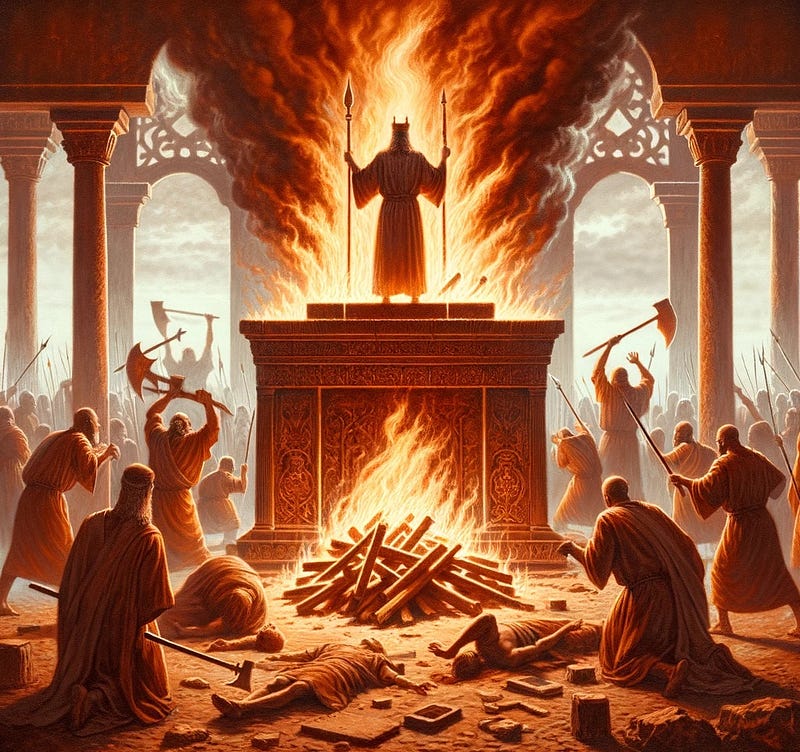
20 And he slew all the priests of the high places that were there upon the altars, and burned men’s bones upon them, and returned to Jerusalem.-2 Kings 23:20 KJV
David’s son Josiah starts a purge, killing all the priests of the old religion and burning their bodies on top of the altars that had been used for other gods. All of this was evidently “right in the sight of the Lord” if we are to believe the next verse.
34 Josiah was eight years old when he began to reign, and he reigned in Jerusalem one and thirty years.
2 And he did that which was right in the sight of the Lord, and walked in the ways of David his father, and declined neither to the right hand, nor to the left.
3 For in the eighth year of his reign, while he was yet young, he began to seek after the God of David his father: and in the twelfth year he began to purge Judah and Jerusalem from the high places, and the groves, and the carved images, and the molten images.
4 And they brake down the altars of Baalim in his presence; and the images, that were on high above them, he cut down; and the groves, and the carved images, and the molten images, he brake in pieces, and made dust of them, and strowed it upon the graves of them that had sacrificed unto them.
5 And he burnt the bones of the priests upon their altars, and cleansed Judah and Jerusalem.-2 Chronicles 34:1–5 KJV
This to me is more evidence of the God of the Old Testament being in approval of human burnt sacrifices. If this was just a religious reform he could’ve repurposed, exiled, or even executed the priests of the old religion. But for him to kill and then burn them on the altar indicates they were an offering to his god.
Sacrifices for the Crops
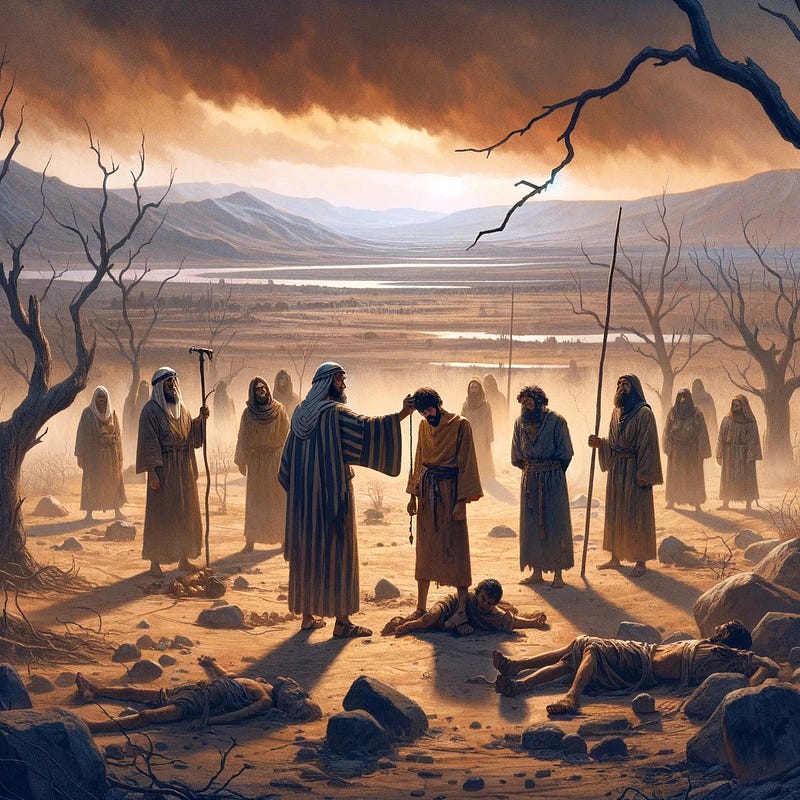
21 Then there was a famine in the days of David three years, year after year; and David enquired of the Lord. And the Lord answered, It is for Saul, and for his bloody house, because he slew the Gibeonites.
8 But the king took the two sons of Rizpah the daughter of Aiah, whom she bare unto Saul, Armoni and Mephibosheth; and the five sons of Michal the daughter of Saul, whom she brought up for Adriel the son of Barzillai the Meholathite:
9 And he delivered them into the hands of the Gibeonites, and they hanged them in the hill before the Lord: and they fell all seven together, and were put to death in the days of harvest, in the first days, in the beginning of barley harvest.
10 And Rizpah the daughter of Aiah took sackcloth, and spread it for her upon the rock, from the beginning of harvest until water dropped upon them out of heaven, and suffered neither the birds of the air to rest on them by day, nor the beasts of the field by night.
11 And it was told David what Rizpah the daughter of Aiah, the concubine of Saul, had done.
12 And David went and took the bones of Saul and the bones of Jonathan his son from the men of Jabeshgilead, which had stolen them from the street of Bethshan, where the Philistines had hanged them, when the Philistines had slain Saul in Gilboa:
13 And he brought up from thence the bones of Saul and the bones of Jonathan his son; and they gathered the bones of them that were hanged.
14 And the bones of Saul and Jonathan his son buried they in the country of Benjamin in Zelah, in the sepulchre of Kish his father: and they performed all that the king commanded. And after that God was intreated for the land.-2 Samuel 21:1, 8–14 KJV
Here David is king of Israel during a famine that God has sent due to the previous King Saul breaking a treaty with the Gibeonites…not sure why the descendants should be paying for the sins of their ancestors since the Old Testament directly says that shouldn’t be the case, but perhaps the Old Testament God had forgotten his own laws?
19 Yet say ye, Why? doth not the son bear the iniquity of the father? When the son hath done that which is lawful and right, and hath kept all my statutes, and hath done them, he shall surely live.
20 The soul that sinneth, it shall die. The son shall not bear the iniquity of the father, neither shall the father bear the iniquity of the son: the righteousness of the righteous shall be upon him, and the wickedness of the wicked shall be upon him.
21 But if the wicked will turn from all his sins that he hath committed, and keep all my statutes, and do that which is lawful and right, he shall surely live, he shall not die.
22 All his transgressions that he hath committed, they shall not be mentioned unto him: in his righteousness that he hath done he shall live.
23 Have I any pleasure at all that the wicked should die? saith the Lord God: and not that he should return from his ways, and live?-Ezekiel 18:19–23 KJV
Either way, it seems this famine could only be stopped by sacrificing the sons and grandsons of Saul to God to make the rain return…this is incredibly reminiscent of various ancient cultures that performed this same sort of practice for their gods to ensure a good crop yield, or that the sun would return.
Continuation into Christianity
The evidence I’m seeing is that this god wants blood, it seems to be the only thing that satiates him. In most cases it’s a regular stream of animal blood and war, but he also at times demands humans including children. Then ultimately he wants his own son’s blood to finally satiate at least part of his appetite. I mean we still see wars to this day, and that evidently gets him off as well.
When we get to the New Testament we see this even plainly stated.
13 For if the blood of bulls and of goats, and the ashes of an heifer sprinkling the unclean, sanctifieth to the purifying of the flesh:
14 How much more shall the blood of Christ, who through the eternal Spirit offered himself without spot to God, purge your conscience from dead works to serve the living God?
15 And for this cause he is the mediator of the new testament, that by means of death, for the redemption of the transgressions that were under the first testament, they which are called might receive the promise of eternal inheritance.
16 For where a testament is, there must also of necessity be the death of the testator.
17 For a testament is of force after men are dead: otherwise it is of no strength at all while the testator liveth.
18 Whereupon neither the first testament was dedicated without blood.
19 For when Moses had spoken every precept to all the people according to the law, he took the blood of calves and of goats, with water, and scarlet wool, and hyssop, and sprinkled both the book, and all the people,
20 Saying, This is the blood of the testament which God hath enjoined unto you.
21 Moreover he sprinkled with blood both the tabernacle, and all the vessels of the ministry.
22 And almost all things are by the law purged with blood; and without shedding of blood is no remission.-Hebrews 9:13–22 KJV
It seems Christians co-opted this entire premise into their religion with Christ being the ultimate blood sacrifice to this god.
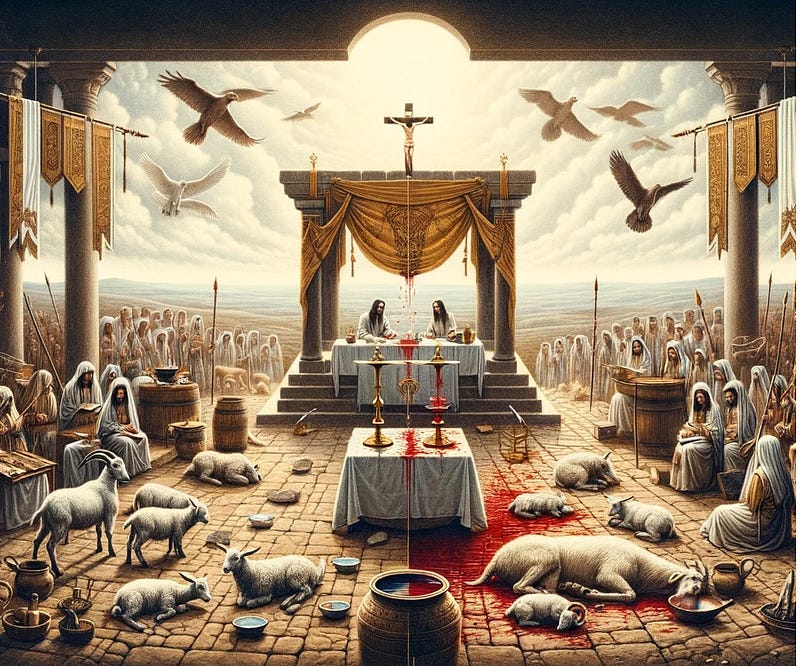
10 By the which will we are sanctified through the offering of the body of Jesus Christ once for all.-Hebrews 10:10 KJV
The use of the word “offering”.
7 Purge out therefore the old leaven, that ye may be a new lump, as ye are unleavened. For even Christ our passover is sacrificed for us:-1 Corinthians 5:7 KJV
The use of the word “sacrifice”.
18 Forasmuch as ye know that ye were not redeemed with corruptible things, as silver and gold, from your vain conversation received by tradition from your fathers;
19 But with the precious blood of Christ, as of a lamb without blemish and without spot:-1 Peter 1:18–19 KJV
We’re supposed to be impressed by this “sacrifice” of himself to himself for his blood fetish, but we’re also supposed to ignore the overall narrative of an angry blood god demanding sacrifices to be given to him, from animals, children, or even himself as a human.
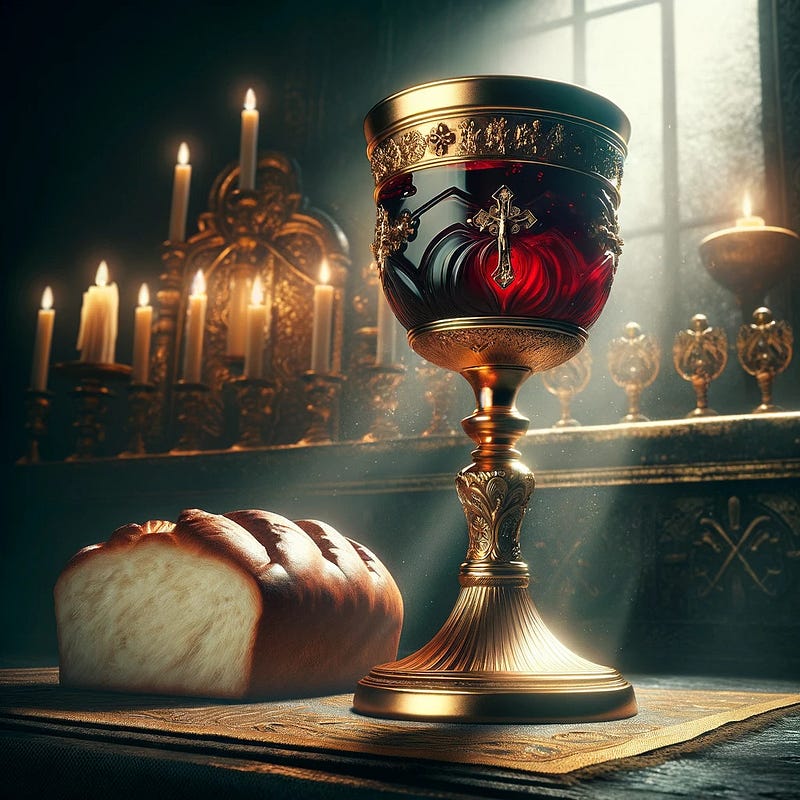
Even the Eucharist involves drinking his blood and eating his flesh…
When people talk about various primitive people sacrificing humans so that the rains would come back, or their god wouldn’t be displeased with him and prevent the sun from coming up we all shake our heads at how horrendous and primitive these people must’ve been.
Yet somehow this god gets a pass and is considered by millions to be the “only true” god.
Why is that?
I guess because unlike these other primitive religions, it wasn’t exterminated, and still has a huge influence over world politics and events to this day.


